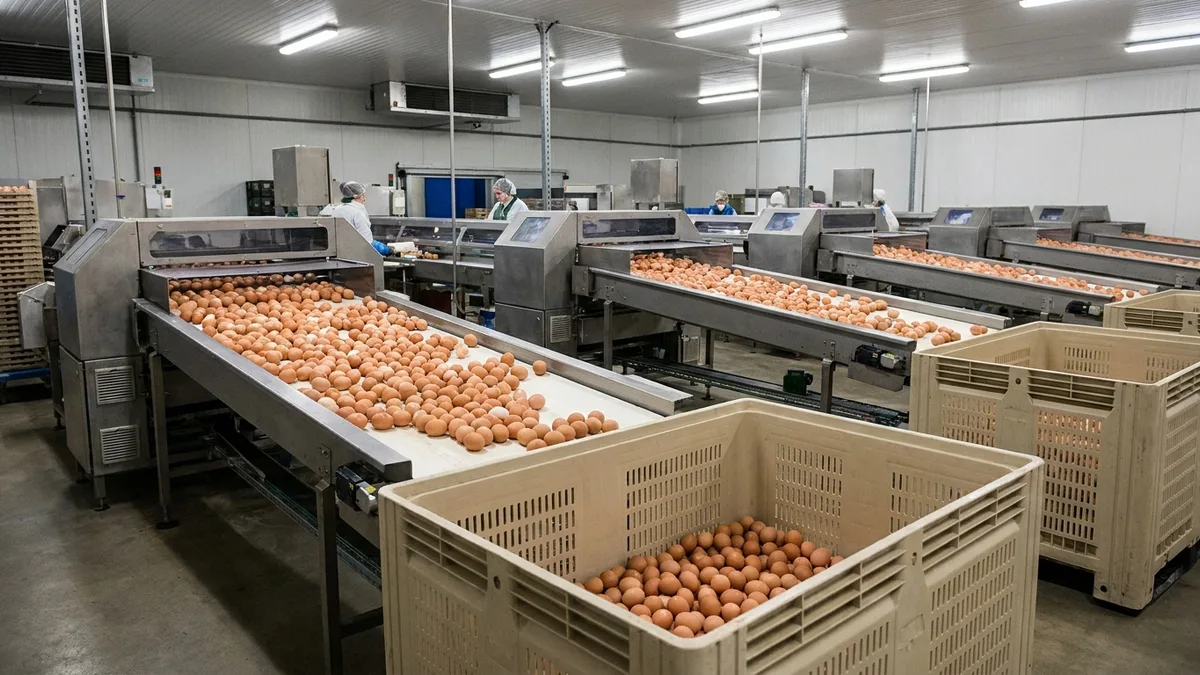


European egg prices turned firmer once the summer holidays ended, but the firmness is narrow rather than broad. Demand came back across every housing system at once. Supply did not. Over the two weeks to 17 September, retail caged eggs rose 8.04%, barn eggs 5.39% and free range 5.33%, with organic up 2.56%. On the industry side caged eggs moved further still, up 10.55%, while free range was unchanged.
The physical cause is behind the market rather than in front of it. Intense heat in late June and July suppressed lay rate and egg size, and it did so hardest in systems with outdoor access and lower stocking density. That is why the damage landed on organic and free range rather than on cage production. Organic and Label Rouge eggs are now described as very scarce, with several operators unable to fill all orders. France is short of barn eggs on spot while free range orders pick up, and caged eggs are holding shelf position precisely because the alternatives cannot be sourced. Unwinding this takes flock cycles, not weeks.
The timing is awkward. The processing industry is taking eggs off the market only with restraint, and the baking season still has substantial coverage to arrange. Brown shelled eggs in the XL and L weight classes are a persistent gap. Underneath that, the European Commission is due to present new welfare rules before year-end that sector bodies estimate at €2 to €3.2 billion of investment, with transport changes adding around €526 million. Requirements of that size tend to accelerate exit among smaller layer operations.
The United States has gone the other way. The wholesale market recorded its first fully flat week across every size and color since the correction began. A market that stops falling in every segment at once is consolidating rather than pausing, because a supply pocket would show up in one segment rather than across all of them. Egg products have now been unchanged for eleven weeks, with breakers running full schedules while still building stock. Demand has started to recover ahead of price, which is usually the sequence that precedes a turn.
Avian influenza is the open risk on both sides. It is quiet in Europe for now, with the wild bird migration running late, and it has re-entered the US picture through commercial turkey flocks in South Dakota and Minnesota, both on the Mississippi flyway. Vesper’s egg analysis sets out what an autumn wave would do to a market already carrying no spare supply.