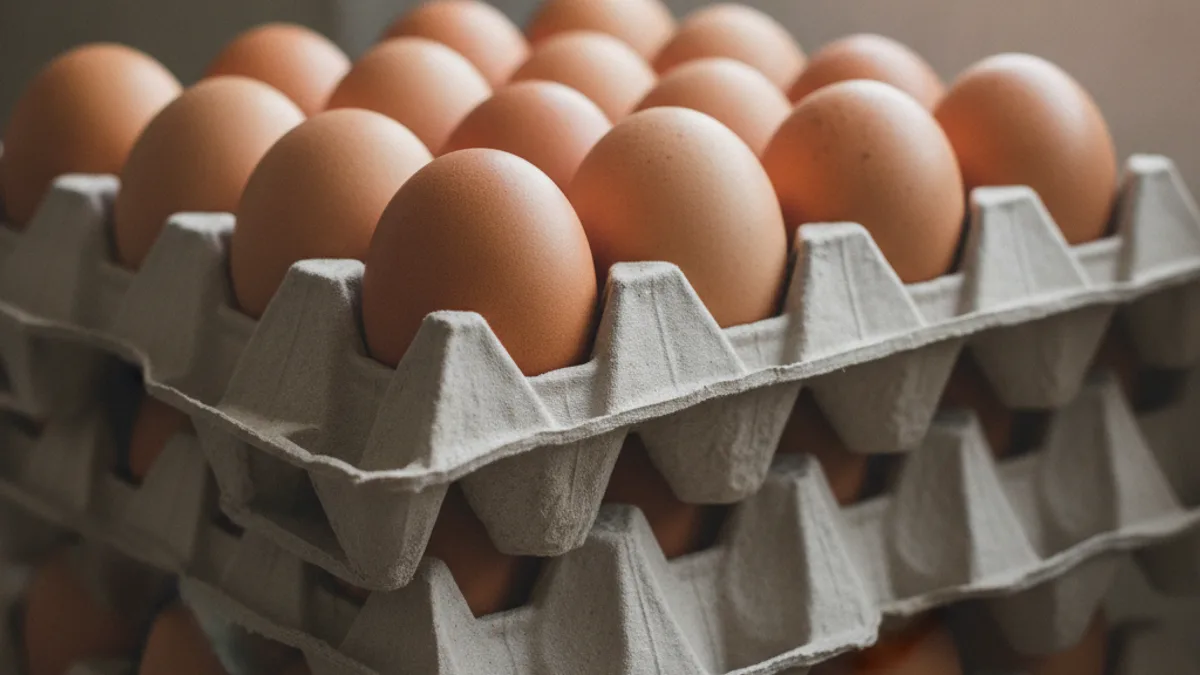


Europe’s egg market has shifted into its autumn pattern, and the recovery that started in early August has now run for a fourth consecutive week. Retail barn eggs are up 7.19% over the fortnight to 3 September, caged eggs 4.48% and free range 3.59%. On the industry side caged eggs gained 7.50% over the same two weeks. Processors report demand for fresh consumer eggs rising as expected once summer holidays ended, with current orders met in full except for the heaviest classes.
Heavier classes are gaining fastest as stores restock for returning holidaymakers and the back-to-school period, which is ordinary for September. What is less ordinary is who gets squeezed out when that happens.
Certified stock is a fixed pool
Packing-station stocks of KAT-certified eggs are thinning fast enough that Germany’s main wholesaler is warning the processing industry will soon be crowded out entirely. The mechanism is straightforward. Certified eggs are a fixed pool, and when retail draw-down accelerates faster than farms can replace it, the processing industry is the first buyer squeezed out, because it carries no certification requirement of its own and can substitute more easily.
Organic and free-range remain the hardest specifications to source even as the calibrated market as a whole loosens. Summer heatwave losses are still working through, and hens have not fully returned to lay. Outdoor-access systems lack the powered ventilation of barn and caged housing, so heat stress hits those flocks harder and for longer.
Import volumes are not the obvious relief they might be. Belgium is working through the worst salmonella outbreak in its history, first found in May, and the recall now reaches several other EU countries. A separate outbreak is under investigation in the United Kingdom, after French recalls of Polish-origin eggs in July. Buyers are reported to be turning away from import volumes specifically because of the salmonella cases. Ukraine, meanwhile, is pushing to reopen its EU export quota years ahead of the 2028 review, having already seen it tripled from 6,000 to 18,000 tonnes in October 2025.
Albumin sellers have the upper hand
Egg-white powder producers are in one of the stronger negotiating positions they have held all year. Albumin stocks are unusually low for this point in the season, and processors are actively competing for eggs for breaking rather than absorbing whatever the calibrated market does not want. That reverses the position earlier in the summer, when processing was the buyer of last resort.
Buyer behavior is moving the same way. Counterparties are already asking for full-year 2027 contracts roughly a quarter earlier than negotiations normally start in mid-Q4.
European prices should keep firming through September on returning demand, and a shortage in larger sizes is likely to widen the gap within the same category. The risk sits with disease rather than demand: with higher heat mortality in France, Newcastle disease culling in Poland and now salmonella recalls, poultry diseases could turn a slow seasonal increase into a spike.