

Grain prices moved up sharply over the past two weeks, and the reason is the same across every contract: nobody now expects the Black Sea to reopen soon.
MATIF milling wheat for September climbed to EUR 245/mt from EUR 223/mt two weeks earlier. CBOT hard red winter wheat rallied to 826 cents/bu from 743, and soft red winter went to 764 cents/bu from 665. MATIF corn for November hit a multi-year high at EUR 275/mt, while CBOT corn rose to 521 cents/bu from 463.
Prices did dip early last week, when Turkey said it had prepared a plan for safe agricultural cargo passage via the Black Sea and communicated it to Ukraine and Russia. That faded quickly. Russia’s Deputy Foreign Minister Grushko said there are no grounds for the Black Sea Grain Initiative to resume, citing non-fulfillment of conditions under the previous deal. Port infrastructure in both countries has suffered severely, and authorities on each side say repairs at certain terminals will take months.
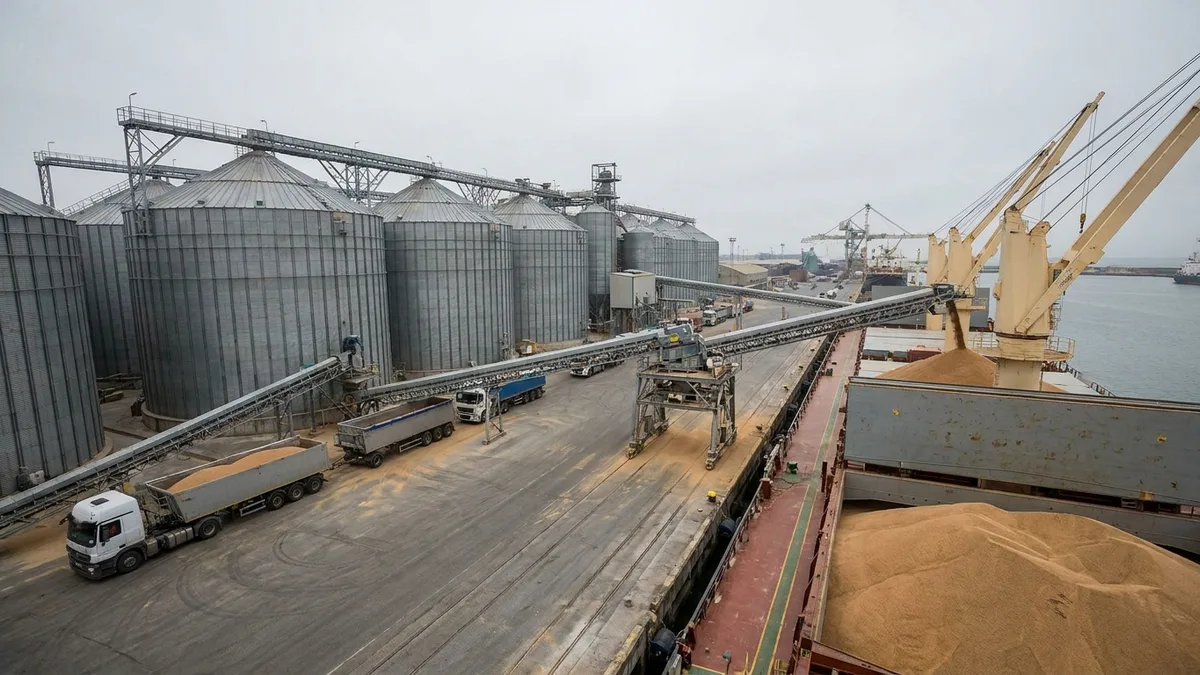
The trade flows show what that means in practice. Egypt, the largest wheat importer globally, saw arrivals fall 75.4% year-on-year to around 480 KMT across July and August. Egyptian buyers are now seeking alternatives, including roughly 60 KMT of French wheat scheduled for late August loading. At Sulina on the Ukraine-Romania border a large number of vessels are still waiting to enter the Danube, and some defaults involving cargoes destined for Egypt have already been reported.
Barley has followed wheat and corn up. Russia and Ukraine hold 17% of global barley exports between them, and the IGC’s historically good global crop of 152.5 MMT is only partly mitigating the logistics problem.
Corn carries a second issue. The European Commission cut its EU 2026/27 corn crop forecast to 50.1 MMT from 51.9 MMT a month ago, well below the 60.2 MMT recorded in 2025/26, and raised expected imports to 25.0 MMT. US crop conditions are slipping too, with 57% rated good or excellent as of 23 August, below the 59% expected, last year’s 71% and the five-year average of 62%.
Vesper’s Q3 view is sideways to up across all three grains. Rerouting solves the problem only partially in a region that historically handled 30% of world wheat trade, and some market participants think the disruption is still being underestimated.