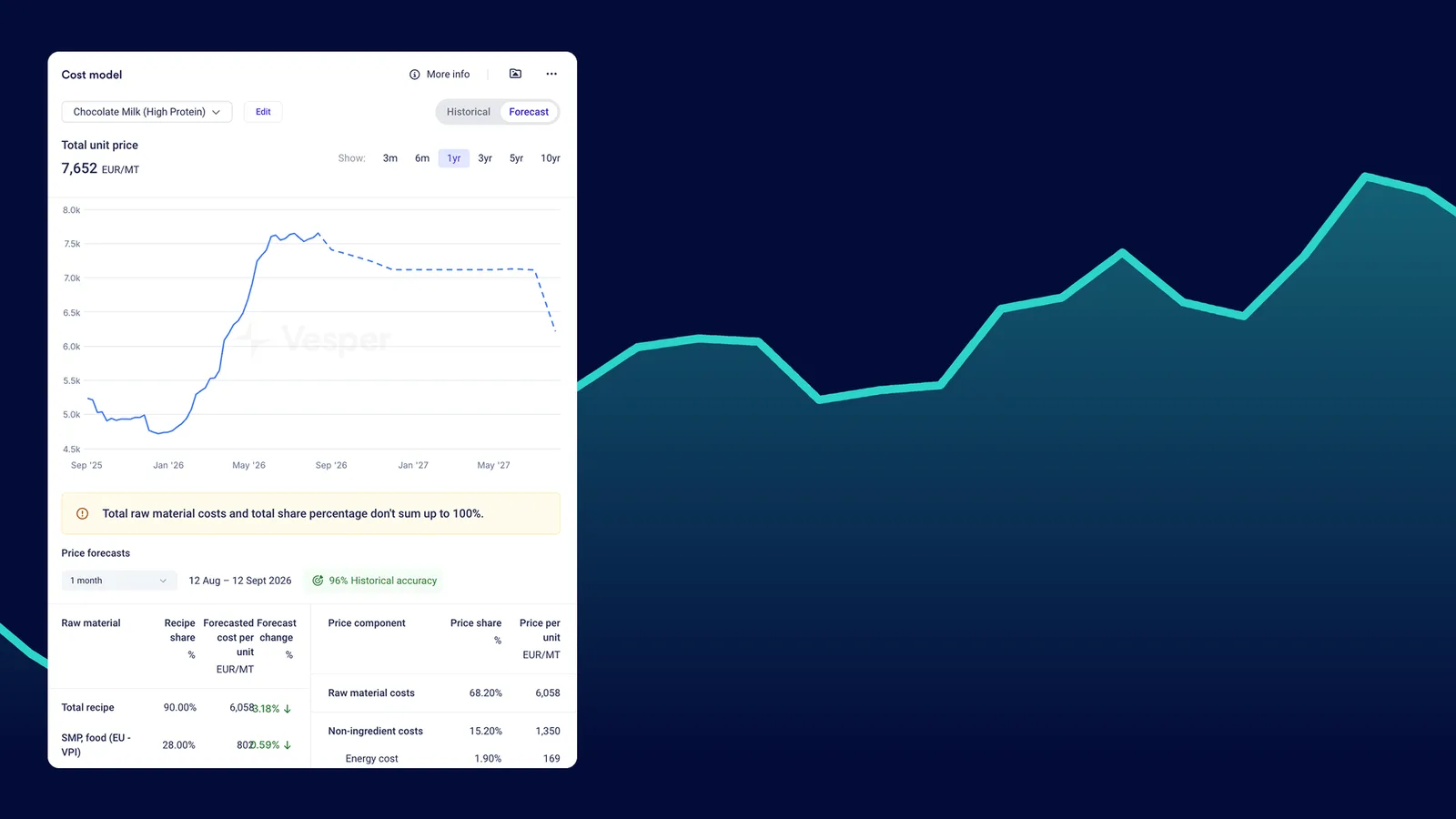



If you budget 2027 skimmed milk powder at the EEX futures strip, you build in 14.3% more than the Vesper forecast.
Do the same for butter and you land 4.2% below it.
Same milk. Same exchange. Opposite errors.
Budget season puts finance on your desk for a 2027 procurement number. This post gives you a 7-step method to set a commodity budget rate you can defend, with a worked SMP example and the 2027 futures and forecast averages for six ingredients.
Budgets are one part of a wider job. If you want the full picture first, start with our guide to managing commodity price risk in food manufacturing. This post zooms in on one number: the price per tonne that goes into next year’s plan.
What is a commodity budget rate?
A commodity budget rate is the price per tonne a company plans to pay for an input over the budget year, also called the budget price or standard cost. It blends the locked price of volume already contracted with a reference price (spot, futures or a forecast) for the volume still open.
That sounds simple.
Here’s the thing: most teams treat it as one number pulled from one source. Usually today’s price, or the futures strip, copied into a spreadsheet in October.
But the reference price is a choice, and for 2027 that choice is worth double-digit percentages on some ingredients.
Let’s set it properly.
How to set a commodity budget in 7 steps
Step #1: Split your 2027 volume into covered and open
Start with tonnes, not prices.
For each ingredient, list your forecast 2027 volume by month or quarter. Then mark how much is already covered:
- Fixed-price supplier contracts
- Forward purchases
- Futures hedges
- Index-linked contracts with a cap or fixed component
Everything else is open volume.
The covered share (your cover %) is the most important input in the whole budget. It decides how much of your 2027 cost is already known and how much is still exposed to the market.
Cover rarely appears in one go. Most teams build it in tranches over several quarters. If you want the mechanics, our post on forward buying and layered cover shows how cover % builds up quarter by quarter, with a backtest on butter, cocoa and sugar.
Step #2: Price covered volume at contract prices
This part is arithmetic.
Take each contract, multiply volume by contract price, add them up, and divide by covered volume. That gives you a weighted average contract price.
Use the price you will actually pay at delivery. If a contract is index-linked, price it at your best estimate of the index for the delivery months, and treat that part as open in the stress test.
Step #3: Choose a reference price for open volume
This is where budgets go wrong.
You have three common choices: today’s spot price, the futures (or forward) curve, or a forecast. Each answers a different question.
| Reference | What it tells you | Pros | Cons | Use it when |
|---|---|---|---|---|
| Spot | What the market pays today | Simple, observable, finance trusts it | Assumes nothing changes; bakes in today’s peak or trough | Short horizon, flat markets |
| Futures strip | What you can lock today for each delivery month | Lockable, public, auditable | Missing for many ingredients; reflects trader positioning; basis to your physical price | You plan to hedge or forward-buy open volume now |
| Vesper forecast | Where the physical price is expected to land | Built for physical benchmarks; uses supply and demand data | Not a promise; can be revised; horizon rolls (Oct 2027 as at 14 Oct 2026) | You will buy open volume through the year |
A futures price is the price at which someone will trade with you today. A forecast is an estimate of where the price will be. Those two can sit far apart, for good reasons. We explain why a futures price is not a prediction in a separate post.
Our rule: budget at the price you expect to actually pay.
If your policy is to hedge or forward-buy the open volume in Q4 2026, the curve is your price. Use the forward curves and exchange futures in Vesper for your delivery months.
If you will buy month by month through 2027, the curve is a price you chose not to take. Budget at the forecast, and show finance the futures number beside it as the price you could lock.
Step #4: Blend covered and open volume into one rate
Now combine steps 2 and 3.
Cover % and contract price come from your own books. The reference price comes from step 3.
One useful consequence: the gap between a futures-based and a forecast-based budget is only (1 − cover%) × (futures − forecast). The more you have covered, the less the choice matters.
Step #5: Add a stress band
A single budget rate hides the risk. Give finance a range.
Dairy shows why. Fonterra’s Richard Allen, on what buyers are up against:
Whole milk powder, for example, can swing a thousand dollars per metric ton in a matter of months. That kind of price movement creates big challenges for procurement teams trying to manage budgets or secure supply.
The simplest defensible band uses the 12-month high and low of the physical price, applied to open volume only:
- High case: open volume priced at the 12-month high
- Low case: open volume priced at the 12-month low
Covered volume stays at contract price in every case. That is what cover is for.
One trap: if the market sits at its 12-month high on the day you set the rate, the “high case” is no stress at all. Use the highest month on the futures strip, or a level above the high, instead. That is exactly the situation with EU SMP right now (see the worked example below).
Step #6: Convert FX for USD-priced inputs
Some inputs trade in US dollars, and some exchanges quote in US cents per pound.
ICE arabica coffee is one. On the Vesper futures curve read 14 Oct 2026, the Jul 2027 contract was quoted at 279.35 USc/lb.
To turn that into a budget number:
- Convert to USD per tonne: USc/lb × 22.0462. For Jul 2027 that is 279.35 × 22.0462 = $6,158.6/mt (our calculation).
- Convert to your currency at your treasury’s budget FX rate. If treasury hedges the dollar, use its hedged rate, so your budget matches what the company will actually pay.
Keep the FX rate as a separate line. If you bury it inside the commodity rate, you cannot tell later whether a miss came from coffee or from the dollar.
Step #7: Re-forecast quarterly and split the variance
A budget rate set in October is out of date by March.
That is not a failure of the forecast. It is how forecasting works:
Being a good forecaster isn’t about guessing the future. It’s about being flexible, adjusting to new data, and communicating clearly, even when there’s no perfect answer.
So re-forecast every quarter:
- Update cover % for new contracts and hedges.
- Re-price open volume at the latest forecast or curve.
- Report the variance against the original budget, split four ways.
| Variance | Formula | What it tells you |
|---|---|---|
| Price | (actual price − budget rate) × actual volume | You paid more or less per tonne |
| Volume | (actual volume − budget volume) × budget rate | You bought more or less than planned |
| FX | USD cost × (actual FX − budget FX), FX in EUR per USD | The currency moved |
| Mix | Shift between grades or products at different budget rates | You bought a different blend |
Why bother? Because cover strategy changes how big the price variance gets.
In our backtest, a butter buyer who set the 2026 budget at the October 2025 price (€5,400/mt, EU butter VPI) and bought spot each quarter averaged €3,900/mt, a 27.8% miss. Buying in rolling quarterly layers averaged €4,821/mt, a 10.7% miss (backtest on Vesper quarter-start prices; forward prices approximated by the price on the purchase date, no storage or financing cost).
Layering made the butter budget more accurate. It did not make butter cheaper: over 2024 to 2026 the layered buyer paid 1.7% more on average than the spot buyer (backtest).
Worked example: a dairy buyer’s 2027 SMP budget
Let me show you.
The 14.3% gap between the two references shrinks to 8.6% in the budget rate (261 ÷ 3,021.6), because 40% of the volume is already locked.
Now the stress band. The EU SMP price (Vesper Price Index, EXW) was €3,500/mt on 7 Oct 2026. On that date it was both a 12-month high and the highest print since October 2023. The 12-month low was €1,980/mt on 10 Dec 2025.
So the 12-month high gives no upside stress. Use the top of the 2027 futures strip instead: Feb 2027 at €3,698/mt.
| Case | Open 60% priced at | Budget rate (€/mt) | Cost on 1,000 t |
|---|---|---|---|
| Low stress | 12-month low, €1,980 | 2,388 | €2,388,000 |
| Base (forecast) | Vesper forecast avg, €3,036 | 3,022 | €3,021,600 |
| Futures | 2027 futures avg, €3,471 | 3,283 | €3,282,600 |
| High stress | Top of 2027 strip, €3,698 | 3,419 | €3,418,800 |
All rates are our calculation with 40% covered at the illustrative €3,000/mt.
That is a range of about €1,031/mt between low and high stress. That is the number finance should see next to the base case.
If we were setting this budget and buying through the year, we’d put €3,022/mt in the plan. We’d show €3,283/mt as the price we could lock on 14 October 2026. And we’d flag that the futures-based number carries about €261,000 of cushion that will look like “savings” later if the forecast is right.
Butter runs the other way
Now flip to EU butter price benchmarks. EU butter (VPI, EXW) was €3,790/mt on 7 Oct 2026.
The 2027 EEX futures average €4,366/mt across Mar, Jun, Sep and Oct. The Vesper forecast averages €4,556/mt. Futures sit 4.2% below the forecast.
With the same 60% open, budgeting butter at futures puts your rate 0.6 × (4,366 − 4,556) = €114/mt below a forecast-based rate (our calculation). That is a budget that looks good in January and misses in Q3 if the forecast is right.
One honest caveat for both dairy charts: the futures are EEX contracts, while the forecast tracks the Vesper Price Index. They are different references, so part of any gap is basis between the two.
The 2027 numbers: futures vs forecast for six ingredients
Here is what the curves and forecasts in Vesper said on 14 Oct 2026. Averages cover only the 2027 months that have both a futures contract and a forecast point.
| Commodity | Spot, EUR/mt (date) | 2027 futures avg | Vesper forecast avg | Futures vs forecast |
|---|---|---|---|---|
| EU butter | 3,790 (7 Oct 2026) | 4,366 | 4,556 | 4.2% below |
| EU SMP | 3,500 (7 Oct 2026) | 3,471 | 3,036 | 14.3% above |
| Cocoa, ICE London | 5,077 (13 Oct 2026) | 5,277 | 4,739 | 11.4% above |
| White sugar No.5 | 502.72 (13 Oct 2026) | 509 | 514 | 1.0% below |
| Euronext milling wheat | 245.75 (13 Oct 2026) | 241 | 231 | 4.5% above |
| Crude palm oil (Bursa vs MPOB forecast) | 981.47 (14 Oct 2026) | 1,104 | 970 | 13.9% above |
Source: Vesper, data as of 14 Oct 2026; averages and gaps are our calculation. Months averaged: butter and SMP Mar, Jun, Sep, Oct 2027; cocoa Mar, May, Jul, Sep; sugar Mar, May, Aug, Oct; wheat Mar, Sep; palm Mar, Jun.
What each line means for your budget:
- SMP: the biggest gap. Futures-based budgets carry cushion. Check where the physical price sits before you lock anything.
- Cocoa: ICE London futures average €5,277/mt for 2027, 11.4% above the Vesper forecast of €4,739/mt. Chocolate makers budgeting at the strip build in a buffer. See the cocoa bean prices and forecast.
- White sugar: futures and forecast agree within 1.0%. Here the reference choice barely matters, and your cover % and stress band do the work. Track white sugar prices for the delivery months you still need.
- Milling wheat: futures 4.5% above the forecast. As at 14 Oct 2026 the forecast ended Sep 2027, so it lines up with a harvest-year budget better than a calendar one. See Euronext-linked milling wheat prices.
- Crude palm oil: futures 13.9% above the forecast, but the bases differ (Bursa futures against a forecast on an EXW MPOB basis), and, as at 14 Oct 2026, the forecast ended Jun 2027. Treat this gap as a reason to dig into the basis before you budget it. Compare it with the crude palm oil price and forecast.
- Butter: the one where futures sit below the forecast. Budgeting at the strip risks an under-budget.
Bottom line: the reference price is a decision, and it is worth writing down why you picked it.
What to do when the forecast stops short of your budget year
On 14 October 2026 none of these six had a Vesper forecast reaching December 2027: most ran to October 2027, wheat to 13 September 2027 and palm to 14 June 2027. The horizon rolls forward, so check your own before you start.
You have two options for the missing months:
- Carry the last forecast point forward flat. For SMP, that is €2,896.88/mt for Nov and Dec.
- Use the futures for the missing months. For SMP, €3,140/mt (Nov) and €3,125/mt (Dec).
We’d pick option 1 for a forecast-based budget.
Here’s why: mixing sources creates a step at the seam, and that step comes from the spreadsheet, with no market behind it. Switching SMP from the October forecast to November futures would add 8.4% overnight (3,140 vs 2,896.88, our calculation). The futures curve itself is almost flat over those months: SMP falls 1.6% from Oct to Dec 2027 (3,175 to 3,125) and butter stays at €4,600/mt. So a flat carry matches the curve’s own shape.
Keep the futures for Nov and Dec as your high case, and replace the carried value when the forecast rolls forward.
How to budget ingredients with no futures market
Many food ingredients have no exchange contract to hedge or to read. Two examples from Vesper’s coverage:
- WPC80: no European WPC futures exist in Vesper. EU WPC 80 prices (VPI, EXW) were €21,000/mt on 7 Oct 2026, after a 12-month range from €12,300/mt (Oct 2025) to €27,900/mt (24 Jun 2026). That range runs from 41.4% below today’s price to 32.9% above it (our calculation).
- Cocoa butter: no cocoa butter futures exist in Vesper’s coverage. West-EU cocoa butter (EXW AMS/RDM/HBG) was €8,012.25/mt on 13 Oct 2026, with a 12-month range of €4,225.25 to €10,685.75/mt.
For these, use this approach:
- Base case: the Vesper forecast for the physical price, where one exists.
- Market check: forward quotes from two or three suppliers for your delivery months. If they sit well above the forecast, ask what is in them (risk premium, financing, their own cover).
- Wider stress band: use the 12-month high and low, and expect to need all of it.
- More cover through contracts: with no exchange hedge, fixed-price deals or index-linked price adjustment clauses are how you reduce open volume.
A proxy can help, with care. Cocoa butter is often discussed as a ratio to cocoa beans. On 13 Oct 2026, cocoa butter at €8,012.25/mt was 1.58 times ICE London cocoa at €5,077.02/mt. A year earlier the ratio was 1.98 (€9,474.50 vs €4,774.50, our calculation).
If you budget cocoa butter off the cocoa bean curve, the ratio is a second open risk. Stress it separately.
A note on standard cost and the planning calendar
Your budget rate usually becomes the standard cost in the ERP. Every purchase price variance for 2027 gets measured against it.
So set it once, document the inputs, and do not quietly change it mid-year. Re-forecasts go in a separate column. That keeps the price variance honest, and it shows the board how much of the year’s cost came from the market and how much from your buying decisions.
Next steps
- Pull your 2027 volume and cover % per ingredient.
- Price the open volume twice, at futures and at the forecast, using Vesper’s price forecasts.
- Add the stress band and write down which reference you chose, and why.
- For the dairy detail behind these numbers, download the EU dairy Q4 2026 market outlook.
Frequently asked questions
What is a budget rate in procurement?
A budget rate is the price per tonne a company plans to pay for an input over the budget year. It sets the standard cost finance uses for product costing, pricing and margin targets. For commodities it blends the price of volume already contracted with a reference price, such as futures or a forecast, for the volume still open.
Should I budget at futures or forecast prices?
Budget at the price you expect to actually pay. If you plan to hedge or forward-buy the open volume now, use the futures or forward curve, because that is the price you can lock. If you will buy through the year, use a forecast of where the physical price will land. Show finance both numbers and the gap between them.
How often should commodity budgets be re-forecast?
Quarterly is the practical default for most food ingredients. Each quarter, update your cover percentage, re-price the open volume at the latest forecast or curve, and report the variance against the original budget rate. Re-forecast sooner if a key input moves more than your stress band allowed for.
What is a budget variance?
A budget variance is the difference between what an input actually cost and what the budget said it would cost. For commodities it is useful to split it into four parts: price (you paid more or less per tonne), volume (you bought more or less), FX (the currency moved) and mix (you bought a different blend of grades or products).
How do you budget an ingredient with no futures market?
Use a forecast of the physical price as the base case, then check it against forward quotes from two or three suppliers for your delivery months. Because you cannot hedge on an exchange, set a wider stress band from the 12-month high and low, and consider fixed-price or index-linked supply contracts to cover more of the volume early.