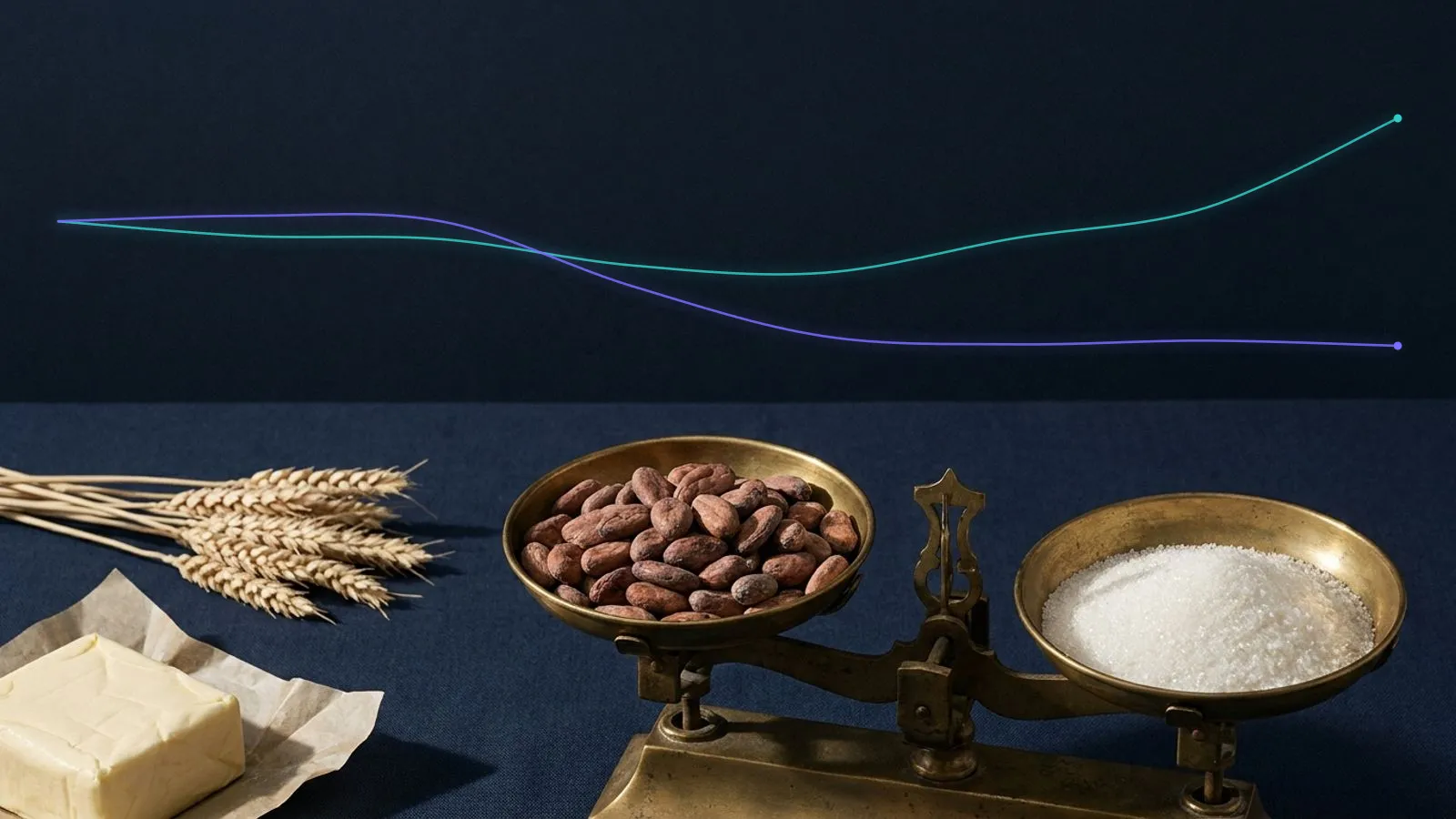



In the year to 13 October 2026, the ICE London-linked cocoa price rose 6.34%, to €5,077.02/mt.
Over the same year, West-EU cocoa butter fell 15.4%, to €8,012.25/mt.
So a chocolate maker that hedged its cocoa butter with cocoa futures held a hedge that moved one way while its costs moved the other.
Most hedging advice is written by brokers, and it assumes every ingredient has a futures contract that fits.
This guide is for the buyer. You’ll get six hedging tools side by side, a map of which food ingredients actually have futures, a four-step decision path, and a worked cocoa hedge with the cash numbers.
What is commodity hedging?
Commodity hedging is taking a position that gains value when your ingredient gets more expensive, so the gain offsets the higher bill. For a food manufacturer that position can be a futures contract, an option, a fixed-price supplier deal or physical stock. The goal is cost certainty for budgets and pricing.
Hedging is one part of the wider job covered in our guide to managing commodity price risk in food manufacturing.
Here’s the thing: a hedge doesn’t make an ingredient cheaper. It makes the cost known.
Sometimes you’ll pay more than a buyer who stayed open. That’s a fair trade when your retail prices are fixed for a year.
That is how the biggest food buyers see it too. Nestlé’s head of price risk management:
We’re not traders by nature, but risk management is mission-critical. We hedge using futures, options, and we invest in deep market intelligence, combining field data, consultant insight, and analytics.
Futures vs forward contract vs options: six tools compared
Most food companies already hedge. They just call it “buying forward” or “fixing with the supplier”. Here are the six tools side by side.
| Tool | What it locks | Cost | Cash and margin needs | Best for | Main risk |
|---|---|---|---|---|---|
| Supplier fixed-price contract | Price and volume with one supplier | Supplier’s risk premium, built into the price | None up front | Small buyers; ingredients with no futures | You miss price falls; supplier pushes to renegotiate in a spike |
| Forward contract | Price for a future delivery date, on your exact spec | Spread in the price | Usually none; uses a credit line | Set volumes of a specific grade | Hard to exit; counterparty risk |
| Futures | Exchange price for a standard grade and month | Broker fees, plus the cost of margin cash | Initial margin, then daily variation margin | Liquid, matching contracts (cocoa beans, wheat, sugar) | Basis risk, margin calls, lot sizes |
| Options (calls) | A price ceiling, while keeping the benefit of falls | Premium paid up front | Premium; buyers usually face no margin calls | Capping a budget when you fear a spike | Premium is lost if prices stay low |
| Index-linked contract | The formula (index plus a fixed conversion) | Low: admin and index access | None | Ingredients with an independent index but no futures | No price certainty; index and lag choice |
| Physical stock | Today’s price for the volume you store | Storage, capital, shelf life | Full payment up front | Storable inputs: sugar, powders, beans, grain | Spoilage; prices fall after you bought |
The two that get confused most:
A futures contract is standardized. The exchange sets the grade, lot size and delivery months. You can close it any trading day, and gains and losses settle in cash daily.
A forward contract is private. You agree a price with a supplier or trader for your exact spec, volume and date. Nothing settles until delivery, and exiting early is a negotiation.
Index-linked contracts share price risk with the supplier instead of removing it. In the illustrative dairy-blend example in our guide to index-linked price adjustment clauses, a buyer indexed to SMP and butter paid 6.9% less on average over eight quarters than a fixed-price buyer (our calculation on Vesper Price Index prints). Then SMP jumped, and in Q4 2026 the indexed price went above the fixed one.
Which ingredients can you hedge with futures?
Most hedging guides list “agricultural commodities” as if every ingredient trades. It doesn’t. Here’s what Vesper’s futures curves cover for common food inputs, with front-month prices from the 14 October 2026 curve.
| Ingredient | Futures in Vesper? | Exchange | Front-month price (contract) | If no futures, use |
|---|---|---|---|---|
| Cocoa beans | Yes | ICE London; ICE US | €5,110.87/mt (Dec 2026); ICE US €5,135.51/mt (Oct 2026) | n/a |
| Cocoa butter | No | none | n/a | Supplier forward; index clause on a partner price |
| White sugar | Yes | ICE London (Sugar No.5) | €495.02/mt (Dec 2026) | n/a |
| Raw sugar | Yes | ICE US (No.11) | 21.11 USc/lb (Mar 2027) | n/a |
| Milling wheat | Yes | Euronext (MATIF) | €248.25/mt (Dec 2026) | n/a |
| Palm oil | Yes | Bursa Malaysia | €969.34/mt (Oct 2026) | n/a |
| Rapeseed | Yes, the seed | Euronext (MATIF) | €518.75/mt (Nov 2026) | For the oil: supplier forward or index clause |
| Sunflower oil | No | none | n/a | Supplier forward; index clause |
| Olive oil | No | none | n/a | Fixed price; index clause; stock |
| SMP | Yes | EEX; SGX-NZX | €3,525/mt EEX; €3,443.45/mt SGX-NZX (both Oct 2026) | n/a |
| Butter | Yes | EEX; SGX-NZX; CME | €4,175/mt EEX (Oct 2026) | n/a |
| Whey | Yes | EEX (sweet whey powder, feed); CME (dry whey) | €1,675/mt EEX (Oct 2026) | EU food grade: index clause or forward |
| WPC80 | No | none | n/a | Index clause; forward contract |
| Processing potatoes | Yes | EEX | €18.5/100kg (Nov 2026) | n/a |
| Eggs | China only | Dalian (DCE) | €517.62/500kg (Oct 2026) | EU: index clause or supplier contract |
Source: Vesper futures curves, snapshot of 14 October 2026. Vesper shows several non-EUR contracts converted to EUR. Raw sugar is quoted on the Mar 2027 contract because the October 2026 contract has already expired.
Three things surprised us.
Processing potatoes have futures. The EEX contract quoted €18.5/100kg for November 2026. If you make fries or chips, check how closely it tracks your own processing potato prices before you rely on it.
Eggs only trade in China. The one egg contract in Vesper is on the Dalian Commodity Exchange. There is no European egg future, so an EU bakery has nothing to hedge with on an exchange.
High-value specialty inputs have nothing. WPC80, cocoa butter, olive oil and sunflower oil have no futures contract in Vesper. EU WPC80 was €21,000/mt on 7 October 2026 (Vesper Price Index, EXW), up 70.7% in a year. That risk has to be handled by contract design. The WPC80 benchmark is one place to anchor an index clause.
For the mechanics of a single market, our Knowledge Hub has a reference page on how dairy futures work.
How to hedge ingredient costs: a four-step decision path
Step #1: Write down the exact exposure
Spec, volume, delivery months and how the price is set today. “Cocoa” is too vague. “180 tonnes of natural cocoa butter, delivered monthly into Hamburg, priced each quarter” is an exposure you can hedge.
Step #2: Is there a liquid futures contract that matches your spec?
Same product, a close grade, a delivery month near yours? Then futures or options are on the table. Cocoa beans, milling wheat and white sugar usually pass. Check the basis first (see below).
Step #3: If not, does an independent index exist?
No futures, but a published benchmark? Use an index-linked contract with your supplier. The formula moves your price with the market, and both sides can check it. It’s often the only practical tool for WPC80 or olive oil.
Step #4: Is the ingredient storable?
If it keeps (sugar, powders, cocoa beans, grain), you can buy ahead and hold stock. Count storage, financing and shelf-life costs first. If it doesn’t keep, agree a forward price or a fixed price with the supplier for the next delivery periods.
If an ingredient fails all three tests, a fixed-price or forward supplier contract is your hedge. That’s normal. It’s how most food companies cover most of their spend.
Worked example: a chocolate maker hedges cocoa with futures
Let me show you.
A chocolate manufacturer needs 100 tonnes of cocoa beans for production in March 2027. It wants that cost fixed now.
On the 14 October 2026 curve, ICE London cocoa for March 2027 was quoted at €5,252.09/mt equivalent. One ICE London cocoa contract covers 10 tonnes, so the buyer purchases 10 contracts.
To keep the math clean, assume the physical price at delivery equals the futures price (zero basis).
| Scenario (our calculation) | Price at delivery | Physical cost, 100 t | Futures result, 10 lots | Net cost |
|---|---|---|---|---|
| A: price rises 10% | €5,777.30/mt | €577,730 | gain €52,521 | €525,209 |
| B: price falls 10% | €4,726.88/mt | €472,688 | loss €52,521 | €525,209 |
| No hedge | either | €472,688 to €577,730 | none | €472,688 to €577,730 |
Inputs: Vesper, ICE London cocoa Mar 2027 at €5,252.09/mt, 14 Oct 2026. Price moves are illustrative.
The result? The net cost is €525,209 in both scenarios. The hedge removed a €105,042 swing from the budget.
But look at Scenario B again.
When prices fall, you pay the futures loss in cash, day by day, long before the cheaper beans arrive. That’s variation margin. The €52,521 leaves your account during the months the price slides. You also post initial margin when you open the position (your broker sets the amount).
Tell treasury before you trade. Hedges get closed early when nobody budgeted for margin calls.
Two more things for a euro-based buyer:
- Currency. ICE London cocoa is quoted in pounds sterling. Vesper shows it converted to EUR. Your real hedge has a currency leg unless you cover GBP too.
- The futures price is a price, not a forecast. The Vesper forecast for mid-March 2027 is €4,880.61/mt, so March futures sat 7.6% above it (our calculation). You’d be paying for certainty. A forecast is not a promise, so that can still be the right call. Here’s why futures prices are not forecasts.
For the full cost picture behind a chocolate bar, get the chocolate Q4 2026 market outlook.
Basis risk: why your hedge and your invoice drift apart
Basis is the gap between the futures price you hedge and the physical price you pay.
If it stays constant, your hedge works. If it moves, part of your exposure stays open.
A small basis: EU SMP
EU skimmed milk powder prices on the Vesper Price Index (EXW) were €3,500/mt on 7 October 2026. EEX SMP futures for October 2026 were €3,525/mt on the 14 October curve.
That’s a gap of €25/mt, or 0.7% (our calculation). The dates differ by a week, so treat it as indicative. For an SMP buyer, that’s a tight match.
A broken basis: cocoa butter against cocoa futures
Cocoa butter has no futures contract in Vesper. The tempting fix is to hedge it with cocoa bean futures. Here’s how that would have tracked over the past year.
The two moved in opposite directions. A long cocoa futures position gained while cocoa butter prices fell.
This year that suited the buyer, by luck. Reverse the moves and the hedge loses money while the butter bill rises.
The ratio between the two is unstable too. Cocoa butter was 1.58 times the cocoa price on 13 October 2026 (€8,012.25 vs €5,077.02). At their peaks in December 2024 (€42,540.75 and €12,007.46, five days apart) it was 3.54 times (our calculation). No fixed cross-hedge ratio survives that.
Bottom line: when the basis is unstable, a futures hedge becomes a second bet. Use supplier contracts or an index clause for that ingredient instead.
Commodity options: a price cap you pay for up front
A call option gives you the right to buy at a set price (the strike), with no obligation to use it. You pay a premium for that right.
In plain words, a call caps your price.
Take the cocoa buyer above. Instead of buying futures at €5,252.09, it buys calls with a strike 10% higher, around €5,777/mt (our calculation).
- If cocoa rises past the strike, the call pays out the difference. The buyer’s cost is capped at the strike plus the premium.
- If cocoa falls, the buyer lets the call expire and buys at the lower market price. It loses only the premium.
You get a known worst case and still benefit from falls. The cost is the premium, paid on day one whether the spike comes or not. Premiums change daily with price and volatility, so ask your broker for a live quote.
A collar cuts that cost: buy a call and sell a put below the market. The put income offsets the premium, and in exchange you give up savings below the put’s strike.
Whatever the structure, know what you’re giving up. Kendra Rhodes, who leads commodity risk management at General Mills:
There’s no silver bullet. The danger comes when these tools are sold as no-cost or fail-proof. If you don’t fully understand the trade-offs, you’re setting yourself up for surprises.
Hedge ratio and hedge policy: decide how much before you decide how
Your hedge ratio is the share of an exposure you’ve covered. 60 tonnes hedged against a 100-tonne need is a 60% hedge ratio.
Few food companies hedge 100% far ahead. Volumes shift, recipes change, and a fully hedged buyer can’t benefit when prices fall.
The usual shape is layered cover: high for the next quarter, lower further out, topped up as each quarter gets closer. In our backtest of quarter-start prices from 2024 to 2026, layering roughly halved the average budget miss for butter and sugar and cut it by a third for cocoa. It did not make buying cheaper. The method is in our guide to forward buying and layered cover.
Then write the rules down in a short hedge policy:
- Scope. Which ingredients, which tools are allowed, which are banned.
- Ratios. Minimum and maximum cover per period ahead.
- Authority. Who can trade or sign, and the volume or value limits.
- Reporting. Monthly view of hedged vs open volume and mark-to-market.
- Review. When the policy is checked and who signs it off.
For a real-world version, look at how General Mills runs its program: a range of outcomes, clear rules and constant communication with the business.
A note on hedge accounting
Derivatives can make your reported earnings jump around even when the hedge works. Hedge accounting rules (IFRS 9 in Europe, ASC 815 under US GAAP) can let you match the hedge result with the purchase it protects, but they come with documentation requirements. Talk to your finance team before the first trade, not after.
What’s changing on the European exchanges
Two developments matter if you buy dairy in Europe.
First, Euronext listed dairy futures for butter and SMP on 19 October 2026. They settle on VPI-B, the BMR-compliant index based on the Vesper Price Index. The details are in our post on Euronext using the Vesper Price Index in new futures contracts.
Second, EEX announced on 8 September 2026 that it will transition its European dairy business to CME Group, moving the indices behind its dairy futures before the end of 2027. Existing EEX contracts keep trading through their listed maturities.
Liquidity is the thing to watch. Fonterra’s Richard Allen, on where dairy derivatives stand:
It’s true, dairy’s derivative markets haven’t scaled as fast as some other commodities like grains or energy. But things are changing. Skim milk powder, butter, whole milk powder: we’re starting to see growing liquidity, and that’s a good sign.
If either change shifts which contract best matches your spec, rerun Step #2.
Next steps
- List your top ten ingredients by spend and run each through the four steps above.
- Where futures exist, check the basis against your physical price. Vesper’s futures data shows the curves next to the physical benchmarks.
- For ingredients with no futures, set up index-linked or forward contracts with your suppliers.
- Agree the hedge ratio and policy with finance before anyone trades.
Frequently asked questions
What is commodity hedging?
Commodity hedging means taking a position that gains value when an ingredient gets more expensive, so the gain offsets your higher purchase cost. Food manufacturers use futures, options, forward contracts, fixed-price supplier deals, index-linked contracts and physical stock. The aim is a predictable cost for budgeting and pricing. Beating the market is a separate goal, and hedging does not deliver it.
How do food companies hedge commodity prices?
Most food companies mix tools by ingredient. They hedge exchange-traded inputs such as cocoa beans, milling wheat, sugar and palm oil with futures or options, often through a broker or their supplier. For ingredients with no futures, such as WPC80, cocoa butter or olive oil, they use fixed-price or forward supplier contracts, index-linked clauses or extra stock. A written hedge policy sets how much of each exposure gets covered.
What is the difference between a futures and a forward contract?
A futures contract is a standardized deal on an exchange: fixed grade, lot size and delivery month, settled daily through margin. A forward contract is a private agreement with a supplier or trader for your exact spec, volume and date, usually with no daily cash flows. Futures are easy to unwind but rarely match your exact ingredient. Forwards match your spec but are hard to exit.
What is basis risk?
Basis risk is the chance that the price you hedge and the price you actually pay move differently. It shows up when your ingredient's spec, location or timing differs from the futures contract. For example, cocoa butter fell 15.4% in the year to 13 October 2026 while the ICE London-linked cocoa price rose 6.34%, so cocoa futures would have been a poor hedge for cocoa butter.
Can small food companies hedge?
Yes, though futures may be too lumpy. One ICE London cocoa contract covers 10 tonnes, and every lot needs margin cash. Smaller buyers usually get more from supplier tools: fixed-price or forward contracts for the next quarters, index-linked clauses for ingredients with a published benchmark, and a simple written rule for how much volume to cover ahead. Some suppliers also offer futures-based pricing on your behalf.