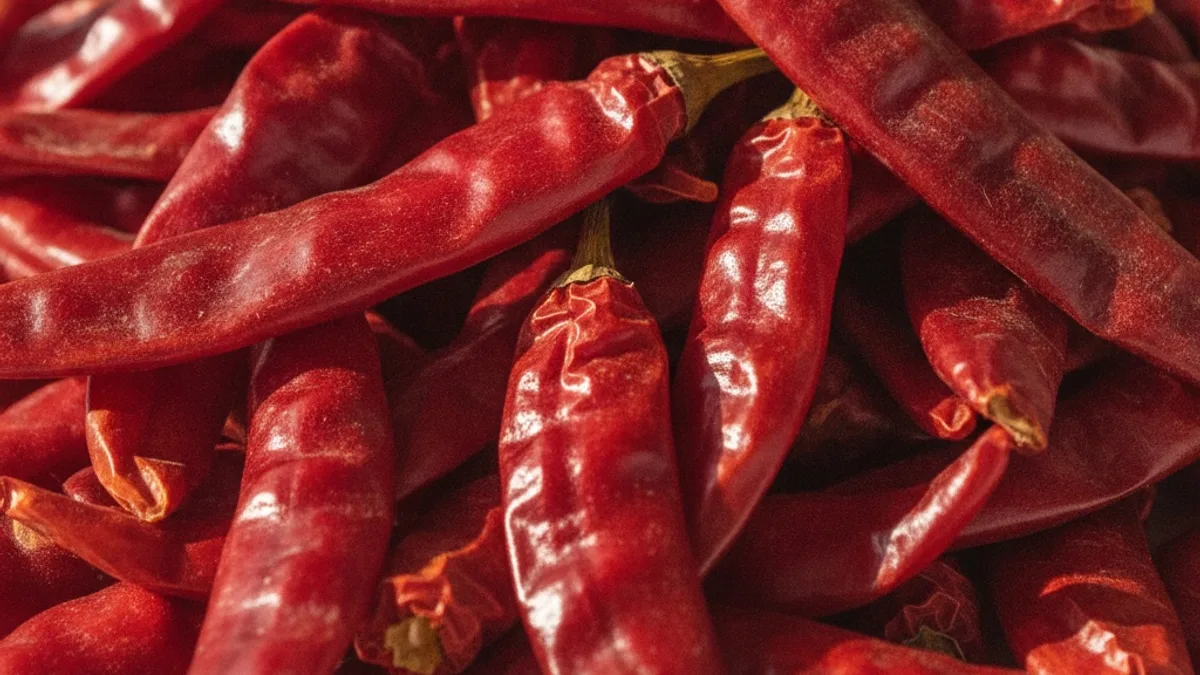


Red chilli spent the second half of August frozen near $253 per quintal. In the first week of September the Delhi 334 grade moved $39.85, roughly 16%, to $293.65 per quintal inside about a week, held there through 8 September, then eased into a $272.68 to $293.65 range by 9 to 11 September.
The trade’s own framing was quality improvement and a genuine pickup in buying interest rather than a single event. Underneath it sits Andhra Pradesh’s monsoon, which ran close to 40% below normal through the sowing window and which Vesper’s spices report reads as the likely engine of the move. Arrivals held steady at roughly 40,000 to 45,000 bags in Guntur and around 20,000 in Warangal, so this was not an arrivals story, and exporter demand was notably absent even while the rally was running. Guntur origin quotes show the quality variance reaching the market: 334 grade ran $209.75 to $272.68 per quintal, Teja $230.73 to $251.05, and Fatki $136.34 to $157.32.
The bigger supply event of the fortnight came from Nepal. Its big cardamom crop is up an estimated 35% to 36% on favorable weather, with quality reported strong, and that lands directly on Indian prices because the Gangtok and Siliguri belt covers only about 37% of domestic consumption. Kanchicut fell from $16.57 to $16.62/kg at the open to below $15.73/kg on 11 September before stabilizing at $16.05 to $16.15/kg by 13 September, with trade talk pointing toward $14.68/kg by Diwali. Small cardamom looked steadier: Delhi 7.5mm closed back at $29.89/kg, and auction prices held a tight $32 to $33/kg band while arrivals fell from 78,122 kg to 30,527 kg across four sales, which suggests the new crop wave that pressured the market in August may be tapering.
Black pepper did not move at all. Mercura sat at $8.02/kg on 1, 6, 7, 10 and 13 September, a sixth straight week without a confirmed net change. What is new is why the ceiling looks less solid. Sri Lankan prices have started rising, driven by Indian import demand, which reduces the cheap import pressure that has capped Indian prices since spring. India’s 2026 production is now pegged at 65,000 to 75,000 tonnes with downside risk if El Nino effects continue, and India already trades at a premium, around $7,800 a tonne against Sri Lanka’s $6,900, Vietnam’s $6,000 and Brazil’s $5,800.
Whether chilli holds its new level into the Diwali stretch is the open question, and Vesper’s biweekly spices report tracks it fortnight by fortnight.