Search for the world cocoa price today and you get one number. It’s the most-quoted figure in the chocolate industry, and it’s rarely the number on a chocolate maker’s invoice.
This post explains what that headline price actually measures, why processed cocoa can move the other way, and why your own cost sits somewhere else again. It finishes with five steps for turning the screen price into a number you can budget with.
It’s written for buyers and finance teams at chocolate makers, confectioners and bakeries that buy cocoa beans, cocoa butter or cocoa powder.
What is the world cocoa price today?
When a news site or a price ticker shows the world cocoa price, it almost always means the front-month futures contract, the one closest to delivery. On November 2, 2026, ICE New York cocoa settled at $5,435 per metric ton and ICE London at £4,140 per metric ton.
A futures price is a price for a standard grade of cocoa beans, delivered to an exchange warehouse in a set month. It’s the best single reference the market has, which is why every cocoa contract is priced off it in some way. But it’s a price for beans, in one place, on one date. Everything a chocolate maker actually buys is a step or two away from it.
Two exchanges, two currencies
Cocoa trades on two exchanges, and they don’t always move together. New York is priced in US dollars and London in British pounds, so currency moves alone can open a gap between them.
| ICE contract | Currency | 12 months | May to Aug | Aug to Nov |
|---|---|---|---|---|
| New York | USD | -17.1% | +53% | -8.5% |
| London | GBP | -12.1% | +64% | -6.0% |
Front-month settlements: November 3, 2025, May 4, August 3 and November 2, 2026. Source: ICE.
The table shows how much the path matters. Both contracts fell to a low in early May, rallied hard into August and have eased since. A buyer who quotes “cocoa is down 17% on the year” is right, but someone who bought in May and someone who bought in August had very different years. The cocoa futures curve is a better guide than any single print, because it shows where every delivery month trades today.
Why processed cocoa doesn’t follow the bean price
Most chocolate makers don’t buy beans. They buy cocoa butter, cocoa powder or cocoa liquor from a grinder, and those products have prices of their own.
The reason is how cocoa is processed. Grinders roast the beans and grind them into cocoa liquor. Pressing that liquor splits it into two products: cocoa butter (the fat) and cocoa cake, which is milled into powder. Every metric ton of beans pressed gives both, in roughly fixed proportions. But the buyers are different. Butter goes mostly into chocolate, and powder goes into baking, drinks, dairy and coatings. When demand for one is strong and the other is weak, their prices split, even though the bean price is the same for both.
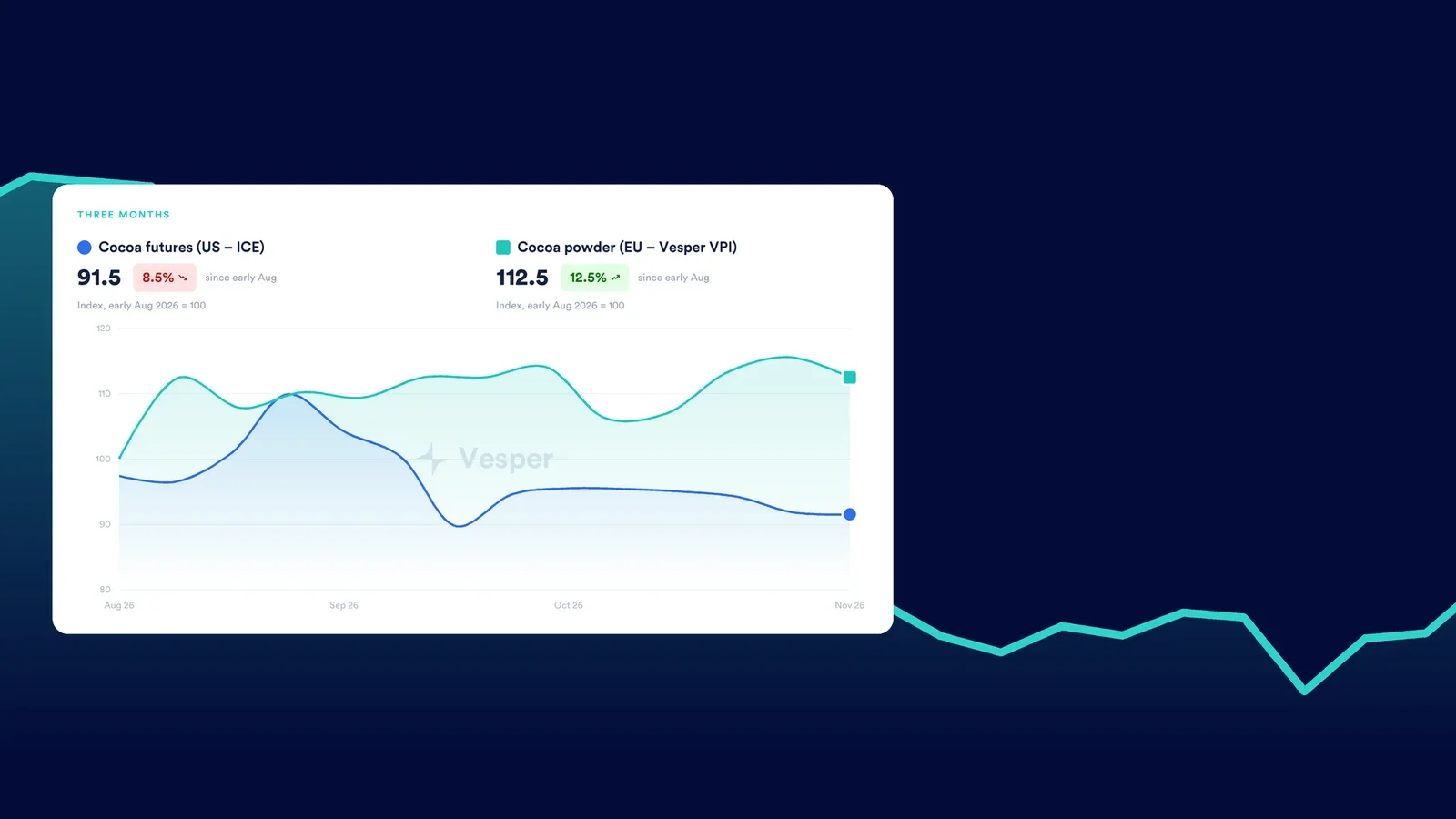
That’s what happened this year. Over the three months since early August, European cocoa powder prices on the Vesper Price Index rose 12.5%, while the European cocoa butter market fell 11.1%. Over the same months, ICE New York futures eased 8.5%. Measured from early May, both butter and powder are up by about a third.
Grinding picked up at the same time. European cocoa grind rose from 316,366 metric tons in the second quarter of 2026 to 348,215 metric tons in the third, and our latest cocoa analysis notes that third-quarter grindings turned positive year on year. More grinding means more butter and powder coming onto the market together, and the two prices then depend on which product buyers are short of.
Why your own cost differs from the screen price
Even when you benchmark the right product, the number on your invoice won’t match today’s price. Five gaps sit between the two.
| Gap | What it is | What to check |
|---|---|---|
| Timing | Your contract was priced when you bought, not today | The fixing dates on each open contract |
| Hedge cover | Futures you hold lock in part of your cost | What share of the next 12 months is already covered, and at what level |
| Currency | London is in GBP, New York in USD, your budget may be in EUR | The exchange rate on the fixing date, not today’s |
| Origin | Beans from different origins trade at premiums or discounts to the exchange | The origin differential in your contract |
| Product | Butter, powder and liquor each have their own price | The processed product benchmark, not just the bean |
Hedge cover is the one that confuses budgets most. A company that bought futures in early August locked in a price close to the top of this year’s rebound. A company that bought in May locked in close to the low. Both now see the same screen price, but their costs for 2027 are very different. Our guide to commodity hedging for food manufacturers explains how layered cover smooths those swings.
Origin matters too. Exchange contracts cover a basket of deliverable origins, and physical beans from a specific country trade at a differential to that basket. Vesper tracks the Ghana cocoa bean differential for exactly this reason.
What could move cocoa next
Both ICE futures curves rise gently into mid-2027 before easing into 2028. The Vesper forecast for cocoa beans delivered into West Europe from Ivory Coast points lower between the end of November and early May 2027.
Our latest cocoa analysis sees limited near-term upside, because more cocoa is available for delivery against the exchanges. It also lists the risks that could change that view:
- Ghana weather. Conditions have been drier in Ghana while Ivory Coast has been more supportive.
- El Niño. There’s an El Niño risk going into the Harmattan season, the dry, dusty wind that hits West African crops early in the year.
- Ecuador. Exports are strong now, but very wet conditions could raise disease and quality problems later.
- EUDR. The EU deforestation regulation deadline for large and medium companies is approaching, which affects how beans can be sourced and documented.
- Demand. European grinding has turned positive, but our analysis still describes wider chocolate demand as challenging.
Putting it to work: from the screen price to your cost
These five steps turn the world cocoa price into a number you can use in a budget or a supplier negotiation.
Step 1: pick the benchmark for what you buy
If you buy cocoa butter or powder, track those prices, not only the bean futures. If you buy chocolate couverture, your supplier’s price will follow a mix of beans, butter, sugar and milk powder.
Step 2: pick the right exchange and currency
Match the contract to your purchase. If your supplier prices off London, a New York chart can mislead you, especially when the pound and the dollar move apart.
Step 3: list your fixing dates and cover
Write down what share of your next 12 months is already priced, and when each part was fixed. That tells you how much of today’s move actually reaches your cost, and when.
Step 4: add origin and processing premiums
Ask your supplier for the differential or premium in each contract. It changes over time, and it can move against the exchange price.
Step 5: compare with the forecast direction
Before you fix more volume, check where the futures curve and the price forecast point. If both point lower, there’s less reason to rush. If they disagree, that’s a signal to buy in smaller layers.
For more on how we got here, read why cocoa prices dropped 43% in 2025. To track beans, butter and powder side by side with price forecasts, see the full cocoa market view on Vesper.
Frequently asked questions
What is the world cocoa price today?
The world cocoa price usually means the front-month futures contract on ICE. On November 2, 2026, both ICE contracts were lower than a year earlier, by 17% in New York and 12% in London.
Why is cocoa quoted in two places?
Cocoa trades on two exchanges. ICE New York is priced in US dollars and ICE London in British pounds. They follow the same bean market but differ in currency, delivery rules and the origins they accept, so they don't move by exactly the same amount.
Why did cocoa powder rise when cocoa futures fell?
Powder and butter are produced together when cocoa beans are pressed, but each has its own buyers. In the three months to early November 2026, ICE New York futures fell 8.5% while European cocoa powder rose 12.5% and cocoa butter fell 11.1% on the Vesper Price Index.
Why doesn't my cocoa cost match the futures price?
Because your cost reflects what you bought, when you bought it and in which form. Hedged cover, contract timing, origin premiums, currency and the processed product you buy all sit between the screen price and your invoice.
Where are cocoa prices heading?
Both ICE futures curves rise gently into mid-2027 and ease into 2028. Vesper's forecast for Ivory Coast beans delivered into West Europe points lower into spring 2027, with weather in Ghana, El Niño and the EUDR deadline as the main risks to that view.