

In an exciting development for the dairy and sports nutrition industries, Vesper is proud to announce the introduction of the first-ever price benchmark for MPC 70 (Milk Protein Concentrate with 70% protein content) for the European and US market. As a leading provider of market intelligence, Vesper is once again pioneering transparency in a previously opaque market, helping buyers and sellers gain a clearer understanding of pricing trends for this crucial ingredient. The MPC 70 price is updated every Wednesday, ensuring market participants always have access to the most current and reliable data.
Why MPC 70?
MPC 70 is a key ingredient in high-protein dairy and nutrition products, yet until now, it hasn’t had a price benchmark due to the niche nature of the market. The effort required to gather reliable price inputs, combined with the relatively small size of the market, has made it unattractive for most data providers to invest resources into creating a benchmark. Simply put, the costs of conducting research and sourcing accurate data often outweigh the perceived benefits.
However, Vesper’s extensive network, built through years of providing insights on dairy commodities such as whey permeate, lactose, and WPI, has enabled us to take on this challenge. By leveraging our network’s shared commitment to improving market transparency, we have now created the first-ever benchmark for MPC 70. Besides, Vesper aims to go beyond providing prices for major commodities, expanding to derivatives and niche products to serve the diverse needs of all market participants.
Rough Estimations to Establish the MPC 70 Price
The lack of a standardized benchmark has historically left businesses relying on rough estimations to calculate MPC 70 prices. Buyers typically used SMP (Skimmed Milk Powder) prices as a basis for calculating the price of MPC 70. Here’s why:
- Similar Production Origins: Both SMP and MPC 70 are derived from skimmed milk and go through similar production processes, particularly in the early stages, making SMP a logical reference point for buyers.
- Protein Content & Interchangeability: SMP contains around 35% protein, while MPC 70 contains 70% protein (roughly double the protein content of SMP). This higher protein content often leads buyers to apply a multiplier to SMP’s price to estimate MPC 70’s price. Additionally, due to their shared dairy origins, SMP and MPC 70 can be interchangeable in certain formulations based on protein content, although MPC 70 is typically preferred for high-protein applications.
- Lack of Market Data: Until Vesper introduced a benchmark, there was no direct or transparent market price for MPC 70. Buyers had to rely on SMP pricing and adjust for the additional processing and higher protein content of MPC 70.
Example Calculation To illustrate how buyers traditionally calculated the price of MPC 70, let’s take the current SMP price of 2,530 EUR/MT. With SMP containing approximately 35% protein and MPC 70 containing 70% protein, buyers would multiply the SMP price by 2 to estimate the price of MPC 70. Therefore: MPC 70 price = 2,530 EUR/MT x 2 = 5,060 EUR/MT.
MPC 70 generally incurs higher processing costs compared to SMP due to the additional steps involved in concentrating the protein content to 70%. These costs come from the protein concentration process, which involves removing water and other non-protein components, typically through ultrafiltration and spray drying. These steps require more energy, labor, equipment maintenance, and production time, making MPC 70 more expensive to produce than SMP.
Assuming an extra 20% processing premium, the calculation would be:
- Processing Premium: 5,060 EUR/MT (base price) x 20% = 1,012 EUR/MT
- Final MPC 70 Price Including Processing Costs: 5,060 EUR/MT + 1,012 EUR/MT = 6,072 EUR/MT.
This estimate falls 228 EUR/MT short of the actual MPC 70 price of 6,300 EUR/MT, according to the Vesper Price Index recorded on 25 September 2024, see figure below.
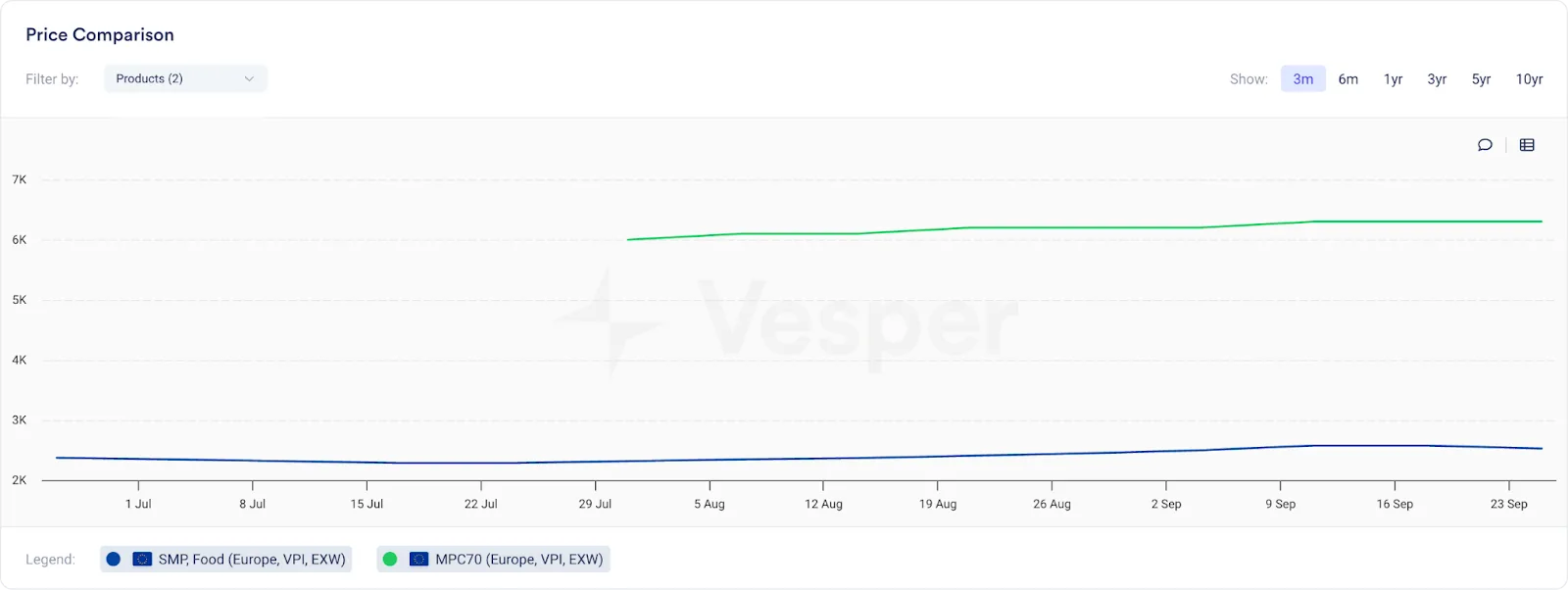 Figure 1: SMP and MPC 70 prices for Europe according to the Vesper Price Index in EUR/mt
Although this calculation provides a reasonable estimate, it doesn’t fully capture the actual price benchmark. Additionally, while the 20% premium is used as an example, the true processing premium can range from 10-30%, depending on factors such as region, production efficiency, and market conditions.
Why Calculating MPC 70 Price Based on SMP Isn’t Always Reliable
While both SMP and MPC 70 share common origins, they are subject to different supply and demand dynamics. To be more precise, both products are derived from the same skimmed milk input, so manufacturers must choose between producing SMP or MPC 70. If more SMP is produced, SMP prices tend to decrease due to higher availability, while MPC 70 prices increase as its availability becomes limited. This inverse relationship means that simply multiplying SMP’s price by a factor (e.g., 2) plus production costs doesn’t always provide an accurate reflection of MPC 70’s market price.
Additionally, MPC 70 and SMP serve different end-uses and aren’t always interchangeable. MPC 70 is favored for high-protein applications in sports nutrition, while SMP is more commonly used in lower-protein formulations. As demand for specialized, high-protein products grows, MPC 70’s pricing may diverge further from SMP’s, driven by different market forces and product applications.
Why Trust the MPC 70 Price from the Vesper Price Index?
With Vesper’s introduction of the first-ever price benchmark for MPC 70, businesses no longer need to rely on rough calculations or guesswork. Our proprietary methodology ensures that the price data we publish is both accurate and representative of the market, giving you the confidence to negotiate effectively and plan strategically.
Our methodology is as follows:
- Gathering Price Inputs: We collect data from a diverse range of market participants, including buyers, sellers, traders, and brokers, using multiple channels such as email and API.
- Validating Inputs: Every price input is verified for accuracy and consistency by ensuring that contributors are active and engaged in the market with significant trading volumes.
- Matching Inputs: We compare all collected inputs to create a balanced and market-representative price, considering different industry perspectives.
- Active Price Validation: We continually communicate with market participants to ensure that all data reflects real-time market conditions, reducing the impact of outliers.
- Mode Calculation: We use the mode (the most frequent price among inputs) to calculate a final price that minimizes extreme highs or lows, ensuring accuracy.
- Publishing the Price: After validation and calculation, the price is published in the Vesper Price Index (VPI), with regular updates to ensure current and reliable data.
By following these steps, Vesper ensures that the published MPC 70 price is a transparent and reliable benchmark, providing the insights needed to stay competitive in the dairy and sports nutrition markets.
Interested in accessing weekly updated MPC 70 prices? Book a free demo with one of our commodity experts here.