

At the Sugar and Sweetener Colloquium in Orlando this February, a room full of producers, processors, and food manufacturers from bakeries to beverages gathered to talk shop, and one topic quietly hijacked every hallway conversation: weight loss drugs. What struck us was how differently that conversation sounded depending on which room you were standing in. In a sugar room, GLP-1s feel like a direct threat to demand; in a dairy room, they feel like a tailwind propping up whey, yogurt, and anything labelled high-protein. Same drug, opposite reactions, and both camps turn out to be right.
This article is about the half of that equation protein buyers, sellers, and traders need to understand (for the fuller cross-category picture, see our review of what 9 GLP-1 studies say about food demand), because GLP-1s and protein have already moved past the forecast stage. The effects are showing up in the Vesper Price Index (VPI) for whey and milk proteins, in pricing models that used to be reliable and suddenly aren’t, and in the billion-dollar capacity bets being placed across three continents. Here’s what the data is telling us.
GLP-1 adoption is bigger than most protein buyers assume
Before we dig into the commodity side, it’s worth pausing on the sheer scale of what’s happening, because that’s what lifts this from a consumer trend into a commodity issue that procurement teams will feel for years. A 2025 RAND Corporation survey of nearly 9,000 Americans found that 11.8% of US adults have used a GLP-1 medication for weight loss or diabetes, and by late 2025 consumer tracking firm Circana was reporting that nearly a quarter of all US households have at least one person actively using these drugs.
That household number is the one to fixate on. Grocery shopping is a consolidated activity in most homes, so a single GLP-1 user sitting at the kitchen table is usually enough to reshape the entire weekly basket, and those baskets are changing fast.
The protein winners, according to 150,000 US households
A Cornell study recently published in the Journal of Marketing Research (Hristakeva, Liaukonytė, and Feler) tracked 150,000 US households to measure what actually changes when someone starts a GLP-1, and the picture it paints is remarkably consistent. Within six months of starting the medication, households cut grocery spending by 5.3% on average, and for households earning over $125,000, the decline was steeper still at more than 8%. The cuts landed hardest on calorie-dense, ultra-processed categories: savoury snack spending fell 10.1%, sweets, baked goods, and cookies saw similarly sharp declines, and fast-food and coffee shop spending dropped roughly 8%.
Only a handful of categories actually grew, and the list is telling. Yogurt led, followed by fresh fruit, nutrition bars, and meat snacks. Four of the five growth categories in an otherwise contracting grocery basket were protein-forward, with fresh fruit the only non-protein item on the winners’ side of the ledger. If you’re sourcing dairy protein, whey, meat, or plant-based protein, that’s a demand signal you can confidently price into your 2027 budget planning.
Whey: a protein boom, now turbocharged
The protein market had already been running hot for years before GLP-1s entered the picture, but adoption took it somewhere genuinely new. In one of our US Weekly editions last summer we flagged that a five-year view of the Vesper Price Index for high-protein whey would give buyers whiplash, with the VPI sitting roughly 3x above its five-year floor. In practical terms, a US buyer of WPC80 in mid-2025 was paying around three times what the same product would have cost during the softest point of the previous five-year window, and not as a momentary spike, but as a sustained working price that procurement teams had to build into their contracts and cost models.
What made that level feel even more unusual wasn’t just the absolute number but the market behaviour underneath it. Any price relief, however small, triggered immediate buying that pulled the VPI straight back into tightness, which meant the ceiling kept proving higher than buyers expected and the floor kept quietly stepping up beneath them. That pattern didn’t break as the year progressed; if anything it deepened.
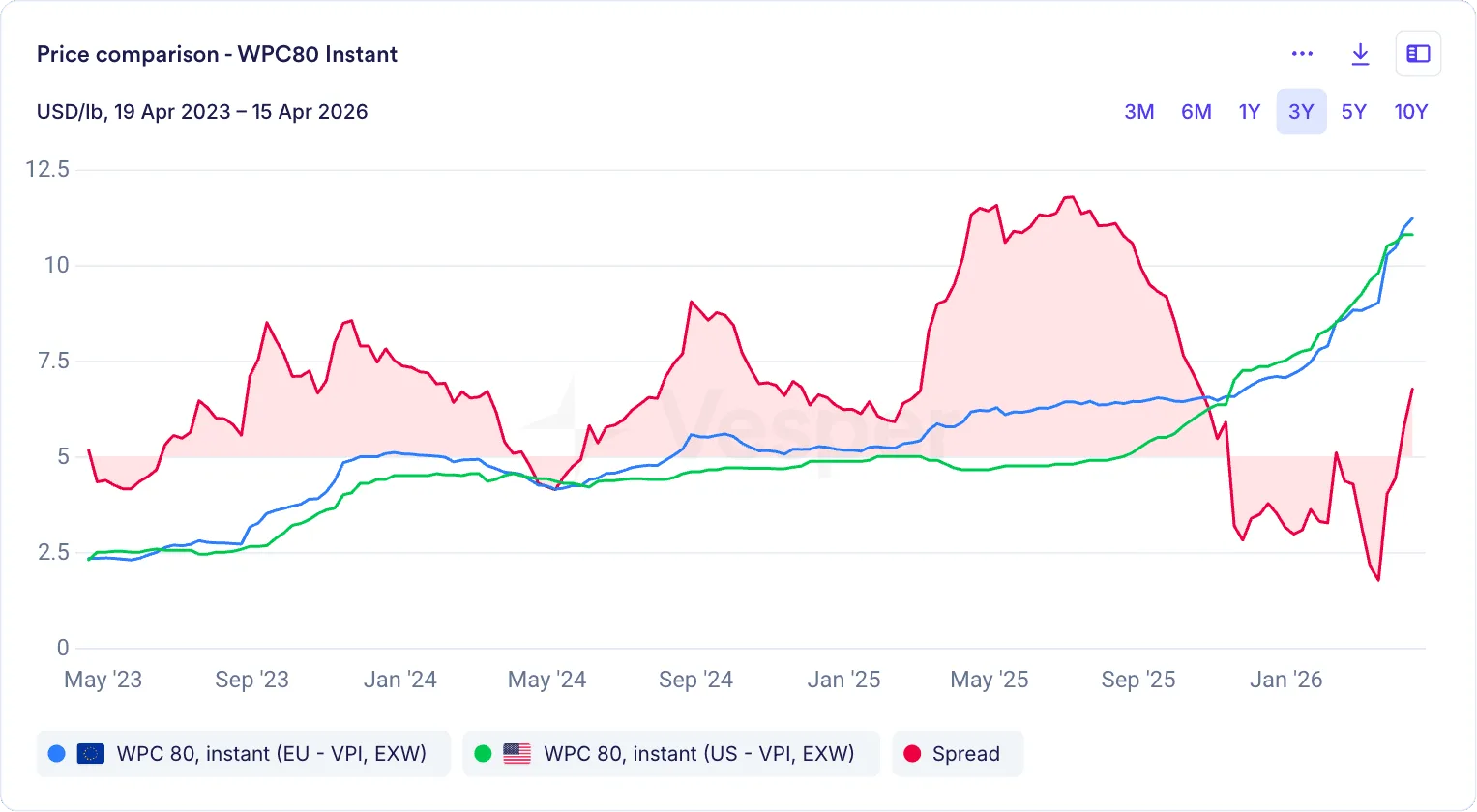
By December 2025, buyers were describing WPC80 to us less as a sourcing decision and more as an allocation lottery (we tracked this shift in detail in our month-by-month US whey protein story). The VPI for US WPC80 had overtaken the European benchmark for the first time, and the feedback we were getting wasn’t about switching suppliers to capture arbitrage but about being grateful to secure any product at all.
Jasper, our senior dairy analyst, put it this way in a Vesper market analysis:
“WPC80 markets show no signs of cooling as the shortage presses harder across all major producing regions. With GLP-1-driven demand ever-increasing and production capacity unable to expand quickly enough, prices will likely continue climbing through Q1 2026. We are currently waiting for production capacity expansion or a massive move to different proteins before we see this market turn.”
By March 2026, the VPI for whey protein had climbed to roughly $11 per pound, and at that level something genuinely unusual happened: cheese producers are now earning more from whey than from the cheese itself. For a product that was historically treated as a byproduct of cheesemaking, whey has quietly become the more valuable output on the line.
A capacity race that dwarfs anything in recent dairy history
When byproducts become the bigger prize, capital reallocates, and that’s exactly what’s happening across the global dairy industry. In the past twelve months alone, Fonterra has put $50 million into whey facility expansion, FrieslandCampina acquired a US whey supplier, Tirlan committed €126 million to a new processing plant in Ireland, and Amul is doubling its whey protein plant in India. In the US alone, over $11 billion is going into 53 new or expanded dairy factories scheduled to come online by 2028.
Rabobank’s Lucas Fuess has flagged the obvious second-order risk: the chase for whey could flood the cheese market as a side effect. US cheese exports have already doubled in the past five years, and the scale of new capacity coming online will test how much the market can absorb. For anyone running a procurement budget, there are two clear implications here. Whey capacity is coming, but not fast enough to relieve 2026 pricing pressure, which means buyers should plan around continued tightness in high-protein product through at least the first half of next year. At the same time, cheese buyers should be watching this capacity wave closely, because the same investments that will eventually ease whey prices will also add meaningful cheese supply to an already well-supplied market.
The pricing models that stopped working
Here’s a subtler effect worth flagging, because it tends to hit procurement teams before it shows up in any headlines. For decades, the dairy industry has priced specialty products using commodity benchmarks as proxies: pricing MPC off NFDM, pricing WPC80 off dry whey or WPC 34, pricing mozzarella off cheddar blocks. These rules of thumb power a lot of contract math across the industry, and for most of that time they’ve held up reasonably well. In 2025, some of them broke.
When we matched NDPSR weekly pricing for the commodity base products against the Vesper Price Index for the derived products across 2025, the dry whey → WPC80 multiplier ranged from 6.68x to 10.83x over the course of the year, with a correlation of just 0.53, which means anyone using a fixed multiplier mispriced product at some point during the year. WPC 34 to WPC80 was worse: a -0.72 correlation indicates the two products actually moved in opposite directions for much of 2025. The reason is structural, not noise. GLP-1-driven demand for high-protein whey has created its own market dynamics, increasingly independent of commodity whey pricing, and if your contracts still index high-protein products to commodity whey, that’s a 2026 risk worth auditing before renewal.
The nuance most articles miss
Before the protein side celebrates too hard, the Cornell study flagged two patterns that deserve attention. The first is that the dietary shift isn’t substitution, it’s contraction: GLP-1 users aren’t simply swapping chips for protein bars, they’re also buying less food overall, and the yogurt and nutrition-bar gains, while real, were modest compared to the scale of the overall grocery decline. The second is that the durability of the effect is genuinely unclear.
About a third of GLP-1 users in the Cornell study stopped taking the medication during the observation period, and when they stopped, their spending bounced back to pre-adoption levels, with baskets actually becoming slightly less healthy than before they started and an uptick in candy and chocolate purchases. The medication suppresses cravings while you’re on it, but it doesn’t appear to build new habits that stick afterwards. There’s also a split by patient type that’s worth pricing in: for diabetes users, the grocery spending reduction held beyond six months, while for weight-loss users, the effect faded and was no longer statistically significant after six months. In other words, the group driving most of the food industry’s anxiety may also turn out to be the least sticky over time.
What this means if you buy, sell, or trade protein
Pulling it all together, here’s how to think about GLP-1 as a variable in a protein sourcing strategy across the main categories.
For dairy and whey buyers, tightness in WPC80 is likely to persist through 2026, and contracts indexed to dry whey or WPC 34 should be re-examined because the correlations that used to anchor those formulas have meaningfully weakened. Yogurt and MPC demand are supported by the same underlying shift, so NFDM and MPC 70 belong on the watchlist alongside the high-protein whey products.
For dairy and whey sellers, the capacity wave is real but won’t land in full until 2027-2028, which means pricing power sits firmly with sellers of high-protein product through at least the next 18 months. (For how food manufacturers are responding to this same shift more broadly, see our company-by-company breakdown.) That power will soften as new lines come online, and the cheese overhang that comes alongside them is a second-order risk worth planning for now rather than when it arrives.
The impact of GLP-1 adoption on protein isn’t one trend but at least four running in parallel: a demand shift, a capacity race, a pricing model breakdown, and a durability question, each with a different time horizon and each moving prices in its own way.
Want to stay ahead of how GLP-1 adoption is shaping protein prices? Vesper tracks WPC80, WPC 34, dry whey, NFDM, MPC, yogurt ingredients, and the broader protein complex with real-time benchmarks, AI-driven forecasts, and weekly expert analysis from our US dairy team. Explore the platform.