

In 2025, the US dry whey market got pulled two different ways at once.
On one side, trade tariffs with China crushed demand. On the other, the global boom in whey proteins (WPC80 and WPI) pulled production away from dry whey, creating scarcity when the market needed supply most. By year end, dry whey was the only CME product trading near year-ago levels while everything else in dairy collapsed.
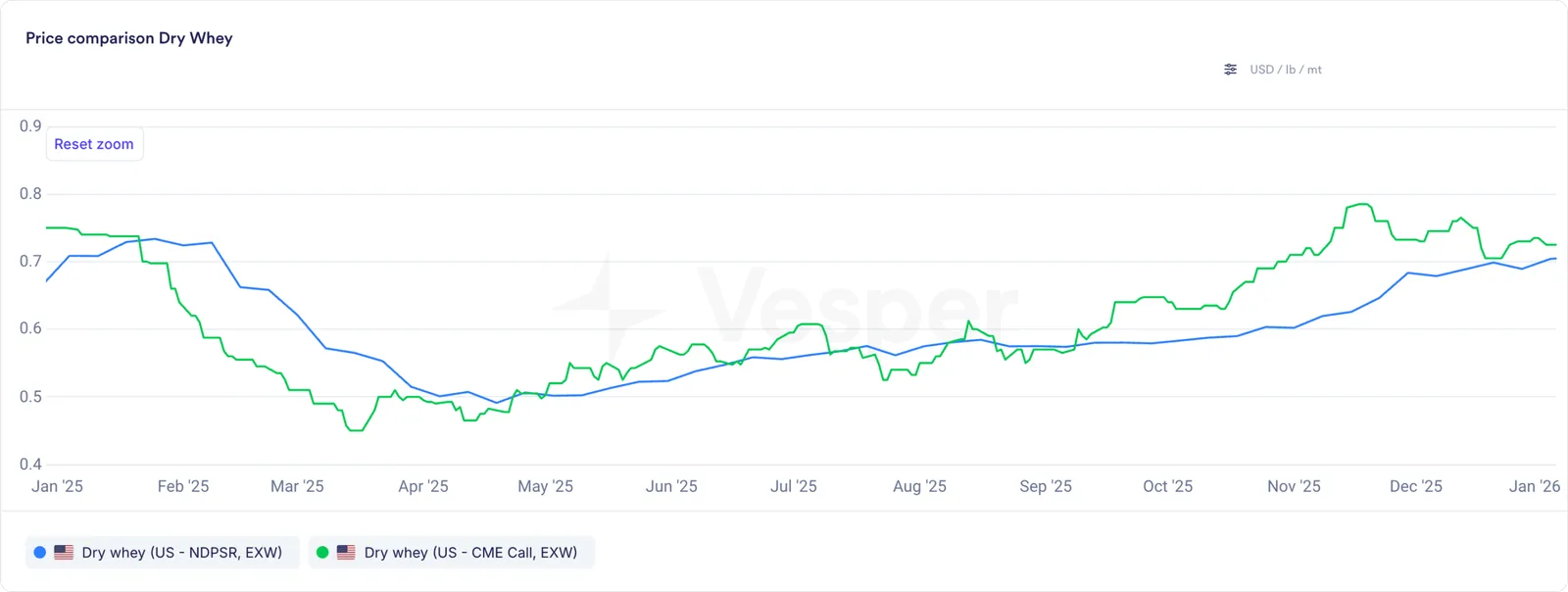
US Dry whey prices according to NDPSR and CME Call in USD/lb (year 2025)
Two opposing forces cancelled each other out. Prices went nowhere while the world around them shifted.
Here’s what happened, month by month.
January: Elevated prices, Tight supply
The year opened with dry whey prices elevated and the market tight.
Only 8 loads of NFDM and dry whey combined traded on the CME. That’s almost nothing. Cheese and whey powder prices remained favorable, so production stayed strong. WPI (whey protein isolate) was stealing the spotlight at $9.5/lb, pointing to where manufacturing investment was heading.
The signal was clear: whey proteins were booming. Dry whey was becoming the byproduct.
February: Prices free-fall
By late January, dry whey began a remarkable collapse. It gained momentum in February.
Prices lost 25% in a month. On January 21, dry whey was heading downward fast. By early February, it hit $0.56/lb, still above European pricing at $0.51/lb, but the gap was narrowing.
The reason was tariff fear. US manufacturers and traders watched China announce potential duties on US dairy. If tariffs landed, prices would fall further. They already knew what was coming.
March: Tariffs land, Production falters
In March, China placed a 10% tariff on all dairy products.
But here’s the twist: they exempted whey powder and lactose. It wasn’t an oversight. China needed those products badly. They consume 150 million pounds of the 400 million pounds of US dry whey exports annually. Exempting it kept the door open.
The real shock came from production numbers. March data showed whey permeate prices collapsed 38.5% week-over-week in the US while European prices climbed 4%. The widest US-EU price spread since Vesper started tracking it.
Production wasn’t keeping up.
April: China escalates, Producers pivot
Tariff escalation came fast. The US imposed approximately 145% tariffs on Chinese goods. China retaliated with 84% duties on US products, including dairy.
In response, US producers shifted strategy. Some moved to WPC80 and WPI production. Both were more profitable. Why make dry whey at depressed prices when proteins paid better?
But here’s the problem: US dry whey production fell 12.4% year-over-year in March. That production decline was real. But losing half of China exports to tariffs meant demand fell much faster than supply.
The math was brutal. You can cut production by 12%, but losing 150 million pounds of exports (37% of total supply) to tariffs is a 37% demand hit. Production adjustments couldn’t fix that gap fast enough.
In two weeks, US whey permeate prices crashed 12 cents/lb. European lactose hit a 27 cent/lb premium over US pricing. The two markets had decoupled.
May: Tariff pause offers relief
The US and China announced a 90-day tariff pause on July 1.
Whey permeate prices responded immediately. Traders expected some breathing room. But dry whey remained weak. March production was down 12.4% year-over-year. The inventory damage was done.
What did shift: arbitrage opportunities opened up. US WPC80 was “landing” in Europe at €11,000/mt, about €1,000/mt below European pricing. Exporters and traders started opportunistically moving product eastbound, eating into what would have been dry whey pricing.
June: Export collapse widens
April trade data told the story. Whey exports to China had surged 65% in March, just before tariffs. That was panic buying, traders and manufacturers front-running the duties.
Then April hit. Exports to China plummeted 30% month-over-month.
Southeast Asia and Latin America buyers stepped up, but they couldn’t fill the China void. New trade lanes were forming, but volumes weren’t sufficient. The world’s largest buyer had been partially shut off.
July: Production bounces, But against a weak base
May production data arrived with a surprise: dry whey production was up 6.49% year-over-year.
But context matters. 2024’s base was very low because WPC80 and WPI had been cannibalizing dry whey production for months. Huge cheese production gains in the US meant roughly 40 million pounds of additional cheese. That generated about 300 million pounds of additional liquid whey. WPC production was capped, so some of that liquid whey had to become dry whey.
Forced production wasn’t the same as real demand.
The US-China tariff pause extended beyond the initial 90 days. Dollar weakness also helped exporters move product.
August: Global dairy downturn, But whey holds
August brought a broader global dairy downturn. Butter and cheese prices weakened. Milk powder was under pressure.
Whey proteins were the exception. Demand for WPC80 and WPI remained fierce. Global buyers lined up. Any manufacturer who could shift from dry whey to whey proteins did so. The protein market’s gravity pulled hard.
Dry whey found itself in a strange position: hard to sell at good prices, but supported by being the byproduct of a profitable other choice.
September: Dry whey holds, Proteins boom
By September, dry whey became the only CME dairy product maintaining year-over-year price levels.
Finding demand was hard. But WPC80 and WPI’s strength kept the entire whey spectrum afloat. Global buyers were queuing for US WPC80, which was trading at a discount to European prices. That export demand funded production, and dry whey came along.
China tariff pause kept extending. US whey exports to China recovered: July was up 160% month-over-month. Year-to-date growth to China turned positive at 0.27%.
But the composition was shifting. Belarus, Poland, Argentina, and Turkey were gaining share. Single-buyer dependence was weakening.
October: Government shutdown, No data
A government shutdown meant no production data was released. The market operated blind.
Whey proteins stayed anomalously strong in an otherwise weakening dairy complex. US dry whey prices held stable near year-ago levels while butter, cheese, and NFDM collapsed.
Of the top 10 US whey export destinations, 7 had received tariff threat letters. Eight of the 10 biggest buyers faced potential duties. The threat of tariff escalation hung over everything.
November: Production shift to dry whey
Limited new data arrived, but the pattern was clear: dry whey production tracked higher year-over-year as a forced byproduct of massive cheese expansion.
WPC production was hitting capacity limits. Some producers had no choice but to make dry whey. The market was rationing production shift by product profitability, and dry whey was the residual.
September China data showed the market’s new shape. The US still supplied 45% of China’s dry whey imports (55 million pounds of 122 million pounds). But US year-to-date shipments to China were up only 3.7%.
Germany, Belarus, and Poland were posting double-digit growth in the same period. Buyers were diversifying away.
December: Year ends in the middle
The year closed with dry whey as the overlooked middle child of US dairy.
It wasn’t collapsing like butter, cheese, or NFDM. It wasn’t booming like WPC80 and WPI. It was caught between two opposing forces that happened to balance.
Trade disruption with China hit hard early. The 90-day pauses and extensions kept it from getting worse. But they didn’t fix the fundamental problem of losing a customer that took 37% of US supply.
Forced production from the massive cheese expansion compensated. Whey protein demand pulled production away from dry whey. These two forces canceled each other out, leaving dry whey prices near where they started.
The market was simultaneously oversupplied (because of Chinese tariffs) and undersupplied (because of forced production constraints and protein demand). That contradiction meant prices went nowhere.
What this means for your business
2025 proved that dry whey is no longer the story. Whey proteins are.
If you buy whey for protein-rich applications, the commodities market is telling you something: WPC80 and WPI drive profitability and investment now. Dry whey is the byproduct that comes along.
That matters for procurement planning. When production capacity fills with proteins first, dry whey supply gets whatever’s left. When China tariffs shift export destinations, your supplier’s regional sourcing strategy changes.
You can’t rely on historical pricing patterns. Trade policy and protein demand are now the variables that move the needle.
What’s next for US dry whey?
The US dry whey market moves fast. Every week, new production data, trade flows, tariff developments, and protein market shifts reshape the picture.
Our US Weekly covers all of it: whey, cheese, butter, NFDM, milk production, tariffs, and the global forces pulling US dairy prices in every direction. Written by Vesper’s dairy team, delivered to your inbox every Friday.