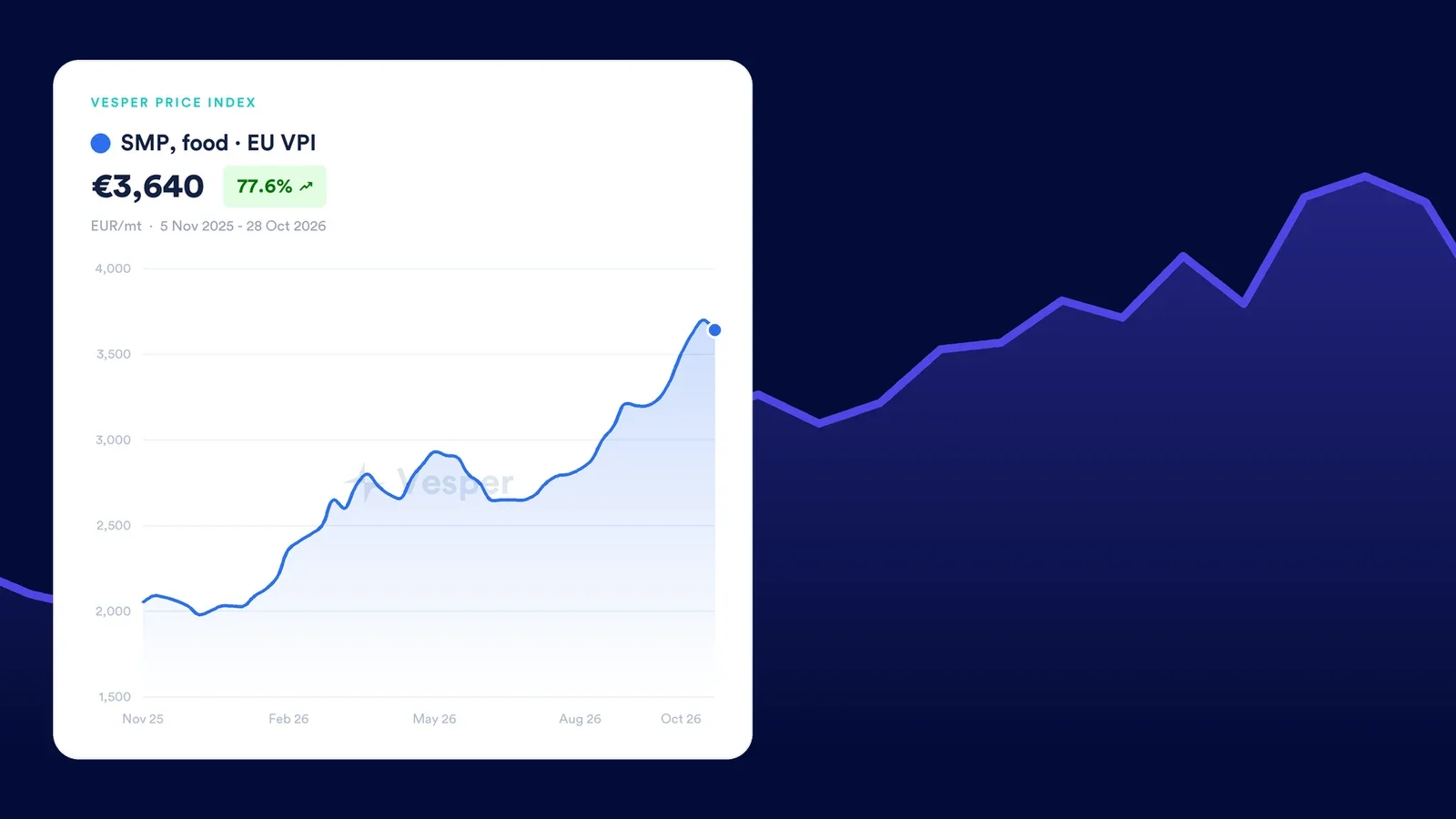
European SMP prices are 77.6% higher than a year ago. At these levels it pays to know exactly what’s in the powder you buy, how much milk it takes to make it, and why prices have climbed so far.
This post explains what skim milk powder is, what its standard solids content is, and how to work out how much powder a given volume of milk produces. It then looks at why prices rose, how buyers can hedge, and what to do before covering 2027.
It’s written for buyers and planners at dairy, bakery, confectionery and nutrition companies that buy SMP or NFDM.
What is skim milk powder?
Skim milk powder is milk with the fat and almost all the water taken out. A dairy first separates the cream, which goes into butter or cream products. What’s left is skim milk, which is concentrated and then spray-dried into powder.
The table shows where the parts of milk end up, using the default composition in our SMP yield calculator.
| Part of the milk | Share of milk (calculator default) | Where it ends up |
|---|---|---|
| Fat | 4.2% | Removed as cream, then made into butter or cream |
| Protein | 3.4% | Stays in the powder |
| Lactose and minerals | 5.4% | Stays in the powder |
| Water | the rest, about 87% | Mostly removed by evaporation and drying |
Default values in Vesper’s SMP yield calculator. Real milk varies by region, season and breed.
The protein, lactose and minerals together are called the solids-not-fat, or SNF. They’re what you’re really buying when you buy SMP.
What is the standard total solids content of SMP?
Drying never takes out every drop of water. Our calculator assumes finished SMP is 96.5% solids, which means about 3.5% moisture.
That moisture figure matters for two reasons. First, it’s part of the product specification, so it should be in your contract and on your supplier’s certificate of analysis. Second, it affects yield: the drier the powder, the less of it you get from the same milk.
How much SMP does milk make?
Because SMP is just the milk’s solids-not-fat with a little water left in, the yield is easy to work out.
With the default composition above, the solids-not-fat share is 3.4% protein plus 5.4% lactose and minerals, or 8.8%. So 100 kg of milk gives 100 × 0.088 ÷ 0.965, or about 9.1 kg of SMP. Standard EU bulk milk gives roughly 8.5 to 9.2 kg per 100 kg, depending on protein content. Higher-protein milk gives more powder.
If you work in liters, multiply by about 1.03 kg per liter first. For 10,000 liters of milk, that’s 10,300 kg, which gives about 940 kg of SMP.
This is also why SMP prices are so closely tied to milk supply. Every metric ton of powder needs about 11 metric tons of milk, so a small change in milk collections becomes a large change in powder supply. Our SMP price calculator works the other way, from the value of raw milk to a theoretical powder price.
Why EU SMP prices are up 78% in a year
All three main export regions have moved higher together.
| Region | Benchmark | 12 months | 3 months |
|---|---|---|---|
| Europe | SMP, food, Vesper Price Index | +77.6% | +30.0% |
| United States | NFDM, CME Call | +94.2% | +43.9% |
| Oceania | SMP, food, Vesper Price Index | +62.8% | +26.9% |
Latest prints October 28 to November 2, 2026. Sources: Vesper Price Index, CME.
Our latest dairy analysis points to three drivers:
- Tight nearby supply. Nearby product in Europe and New Zealand is hard to find, and sellers have been raising offers week after week. The rally is continuing, but more slowly than earlier in the year.
- Strong import demand. Buyers are active across several forward delivery periods. Recent Global Dairy Trade events showed renewed buying from North Asia, including Chinese cover into the first half of 2027, along with steady demand from Southeast Asia and the Middle East.
- Tenders for 2027. Algeria is tendering for February to April 2027 volumes, which adds demand well beyond the current quarter.
The same tight skim supply is lifting other dairy proteins. Milk protein concentrates are made from skim milk that could otherwise become SMP, which is why they’ve risen too. We explain that link in our buyer’s guide to dairy protein grades.
Why the US could correct first
US NFDM prices have risen the most, and our analysts see the US as the region most likely to correct first. It’s priced well above Europe and Oceania, which makes US powder hard to sell abroad. CME futures have also been pricing NFDM well below the spot price, even while the physical market stays tight. We covered the start of that rally in how NFDM rose 90% in five months.
How buyers can hedge SMP
Buyers who want to fix part of their 2027 cost now have two exchange options.
| Exchange | Contract | Settles against | Curve, November to May |
|---|---|---|---|
| EEX | EU SMP futures | EEX’s own SMP index | About 2.7% lower |
| Euronext (MATIF) | EU SMP futures, since October 2026 | Weekly Vesper Price Index for EU SMP | About 3.0% lower |
Futures settlements for November 2026 and May 2027 contracts, early November 2026. Sources: EEX, Euronext.
We covered the new contract in Euronext launches butter and SMP futures settled against the Vesper Price Index. Both curves slope gently lower into spring 2027, and our own SMP forecast for Europe also points lower through late April 2027.
Putting it to work: before you cover 2027
Step 1: confirm your specification
Check protein, moisture and heat class in your contract. Price comparisons only work for the same spec.
Step 2: convert your needs into milk
If you make SMP or plan with milk volumes, use the yield formula above to turn liters or kilos of milk into metric tons of powder.
Step 3: decide how much to cover, by quarter
Write down how much of each quarter of 2027 you’ve already bought. Decide how much more you want fixed, rather than buying everything at once.
Step 4: compare the futures curve with the forecast direction
The futures curve shows what the market prices in today. Our forecast shows where we think prices are heading. When both point the same way, as they do now, the question is how much of the easing is already in the price.
Step 5: buy in layers
Spread new cover over several weeks or months. That way one bad day doesn’t set your whole year’s cost.
For buyers covering 2027, the question is less about whether SMP is expensive and more about how much of the expected easing is already in the curve.
Frequently asked questions
What is the total solids content of skim milk powder?
Skim milk powder is about 96.5% solids and about 3.5% moisture, which is the assumption our SMP yield calculator uses. The solids are the protein, lactose and minerals left in the milk once the cream is removed. Check your supplier's specification sheet for the exact limits in your contract.
How much skim milk powder do you get from 100 kg of milk?
Standard EU bulk milk gives roughly 8.5 to 9.2 kg of SMP per 100 kg of milk, depending on its protein content. Higher-protein milk carries more solids-not-fat and gives more powder.
How do you calculate SMP yield?
Multiply the milk weight by its solids-not-fat share, then divide by 0.965 to allow for the moisture left in the powder. For 100 kg of milk with 8.8% solids-not-fat, that's 100 × 0.088 ÷ 0.965, or about 9.1 kg of SMP.
Why are SMP prices so high in 2026?
Our dairy analysis points to tight nearby supply in Europe and New Zealand and strong import demand across several delivery periods, including Chinese buying into the first half of 2027 and an Algerian tender for February to April 2027. EU SMP rose 77.6% in the year to late October 2026.
Can you hedge skim milk powder?
Yes. EU SMP futures trade on EEX, and since October 2026 also on Euronext's MATIF, where they cash-settle against the weekly Vesper Price Index for EU SMP. Both curves slope gently lower into spring 2027.