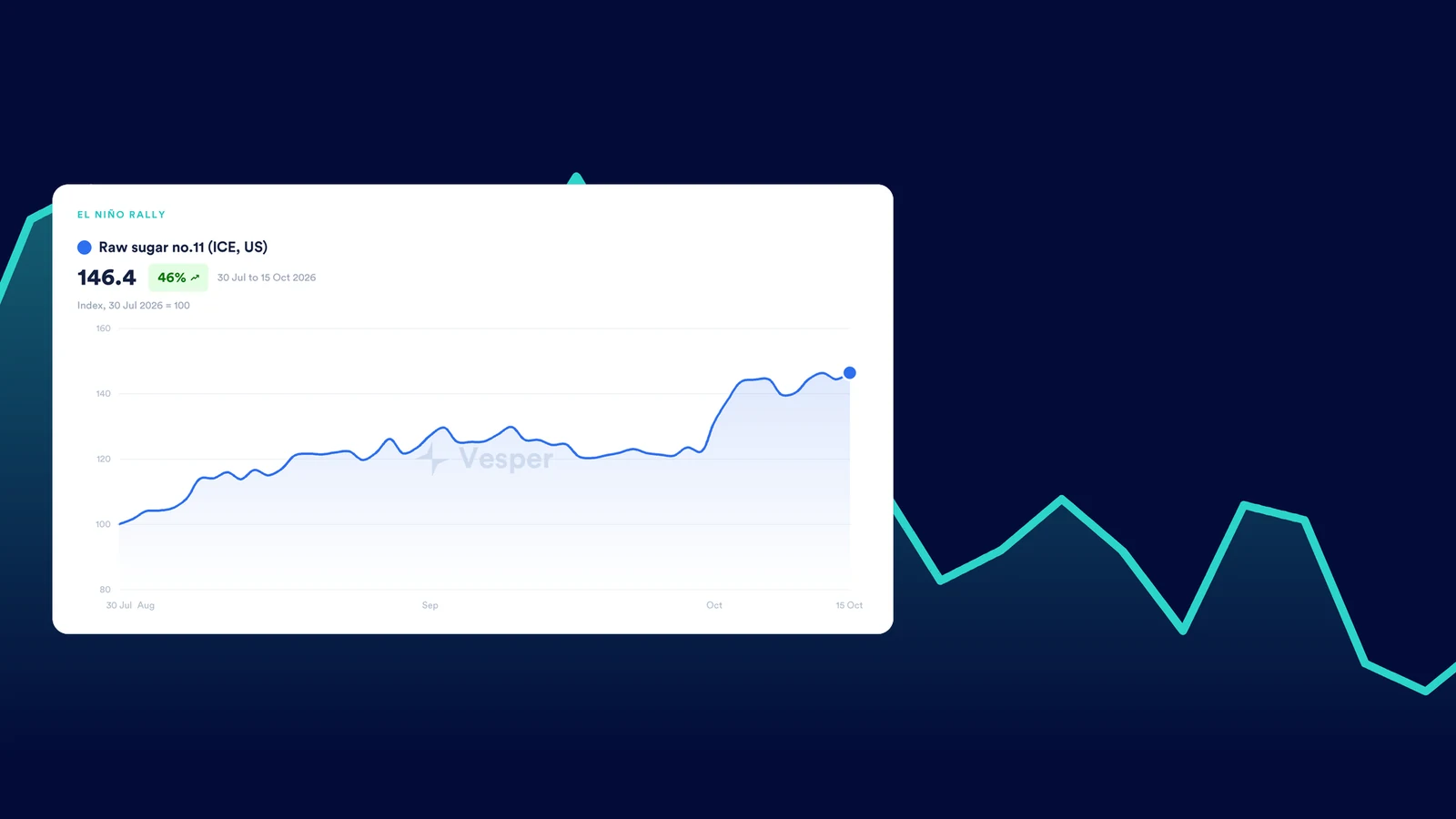
Sugar entered the 2026 El Niño near multi-year lows, and it is now the market where the event shows most clearly in price. Raw sugar prices rose about 46% in eleven weeks, from the end of July to 15 October, and are still about 30% above a year ago.
The reason is that El Niño hit cane in two ways at once. A weak monsoon brought drought to India, and the rain El Niño usually brings to Center-South Brazil turned excessive.
This post explains how El Niño reaches the sugar market, what drove the 2026 rally, and what the 2015–16 record event did to sugar. It is written for sugar buyers at confectioners, bakeries and beverage makers.
How does El Niño affect sugar production?
El Niño is the warm phase of the Pacific ENSO cycle, and its weather footprint lands on almost every major cane belt. Our guide to how El Niño affects commodity prices explains the science. For sugar, the map looks like this:
| Origin | Typical El Niño weather | Effect on sugar |
|---|---|---|
| India | Weaker monsoon, drought | Lower cane yields |
| Thailand | Drier and warmer | Lower cane yields |
| Center-South Brazil | Wetter | Rain costs mills crushing days and lowers sugar output |
Source: Vesper analysis, November 2026.
The Brazil row is the one that surprises buyers. Rain helps cane grow, but mills lose crushing days when it rains heavily, so a wet season leaves cane standing in the fields and lowers that season’s sugar output.
Why did sugar prices rise in 2026?
The 2026 rally came from both hemispheres at once.
In India, a weak monsoon led to drought being declared across major growing regions. Domestic sugar prices reached records, and the government allowed one million tonnes of duty-free raw sugar imports. The deadline for that quota has since been extended to the end of December because uptake was limited.
In Center-South Brazil, the rain was excessive. Mills lost crushing days and sugar output fell against last season.
Prices have eased since the mid-October high, but remain well above where they stood before the event was declared.
What happened to sugar in the 2015–16 El Niño?
The 2015–16 event peaked near +2.6°C, the largest since 1997–98, and it is the closest guide to 2026 in strength. Sugar was the market it moved most.
Drought cut Indian and Thai cane while prolonged rain in Brazil hurt cane yields and disrupted the harvest. Raw sugar roughly doubled off its 2015 lows by late 2016, and India’s sugar supply fell about 20% in 2016/17.
The pattern of 2015–16, with Indian drought and Brazilian rain in the same event, is the one 2026 has followed so far. How closely the rest of the story repeats is the question for 2027.
Putting it to work
1. Watch Brazil’s crush
Brazil’s fortnightly cane crush figures show how fast cane is being processed and how much is being left in the fields. They are the most frequent read on Brazilian supply.
2. Follow India’s import quota and next crop
Uptake of the one million tonne duty-free quota before its end-December deadline, and India’s outlook for the next cane crop, show how tight its domestic market stays.
3. Follow NOAA’s monthly ENSO updates
They show how strong the event gets and how long it lasts, which decides how long the cane belts stay in its path.
Get the full El Niño report
Our report, The 2026 El Niño, sets sugar alongside seven other markets, from cocoa and palm oil to coffee, wheat and corn. For sugar it answers:
- How much of its El Niño risk has sugar already priced?
- What the cane left in Brazil’s fields means for the 2027/28 crop.
- What India’s weak monsoon means for its next season.
- What the 2015–16 record says about the timing and size of the move.
- How to weigh this season against next when planning cover.
Download The 2026 El Niño report to see how exposed your sugar and other inputs are, and when.
Frequently asked questions
How does El Niño affect sugar prices?
El Niño affects sugar through cane yields in the main producing countries. It tends to weaken the monsoon in India and bring drought to Thailand, which cuts cane, and it brings heavy rain to Center-South Brazil, which costs mills crushing days and lowers sugar output. When both happen in the same season, as in 2026, global supply tightens and raw sugar prices rise.
Why did sugar prices rise in 2026?
Raw sugar rose about 46% from its late-July low to its mid-October high. In India, a weak monsoon led to drought being declared across major cane regions and pushed domestic prices to records. In Center-South Brazil, excessive rain slowed the cane crush and lowered sugar output against last season.
What happened to sugar in the 2015–16 El Niño?
Raw sugar roughly doubled off its 2015 lows by late 2016. Drought cut Indian and Thai cane while prolonged rain in Brazil hurt cane yields and disrupted the harvest, and India's sugar supply fell about 20% in 2016/17.
Why does rain in Brazil lower sugar output?
Mills lose crushing days when it rains heavily, so cane that would have been processed stays in the fields and the season's sugar output falls. Rain helps the cane grow, so the effect on the following season can be different.
What should sugar buyers watch during El Niño?
Brazil's fortnightly cane crush figures, India's cane outlook and uptake of its duty-free import quota, and NOAA's monthly ENSO updates on how strong the event gets and how long it lasts.