

Using the latest commodity spot prices to inform your market strategies
Benefits of Analyzing Commodity Spot Prices
Enhanced Decision-Making Accuracy Using the latest spot prices allows commodity market players to make more informed and precise decisions. Market participants can understand the current state of the market with prices paid in the current market environment. This real-time pricing information ensures all market participants optimise their cost structures and profit margins.
Market Transparency and Competitive Advantage Real-time spot prices promote transparency, allowing all market participants to compare prices and negotiate better deals. This transparency fosters a competitive environment, enabling buyers to secure better deals, sellers to attract more buyers, and traders to identify and exploit arbitrage opportunities. By leveraging the latest spot prices, market players can respond quickly to market changes, enhancing their competitive positioning and maximising profits.
Finding today’s commodity prices: step-by-step
1. Selecting your commodity for spot pricing
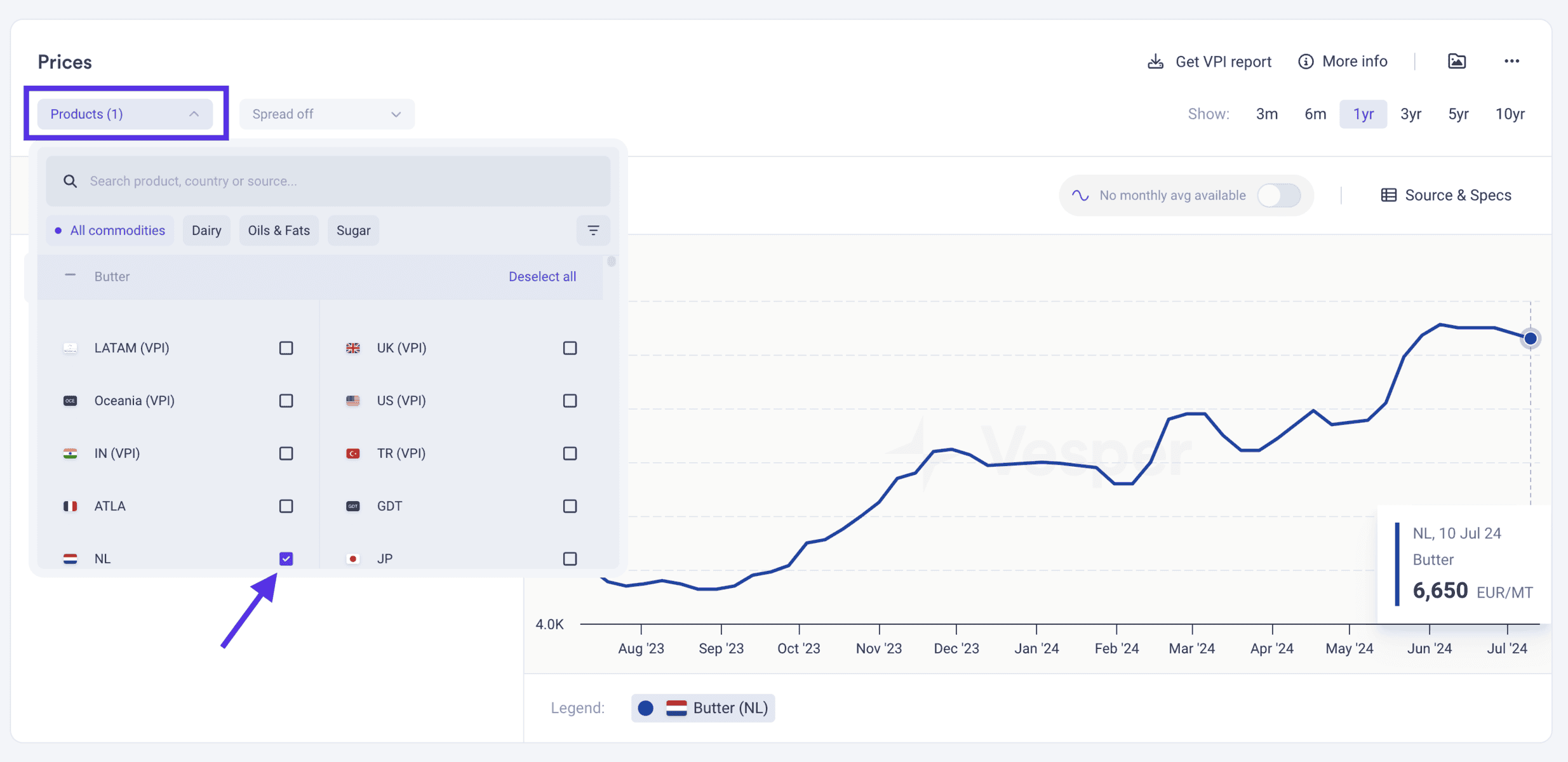
In your prices widget, click on the product dropdown. Select the commodity of your choice and the country or source for which you want to see current commodity prices.
In the example, we are now showing the most current prices for butter in the Netherlands. Hover over the chart to see details about the real-time prices of your selected commodities:
Wonder what VPI means? Vesper Price Index. Read more about our proprietary commodity benchmarks.
2. Different Ways to Analyze the Spot Prices
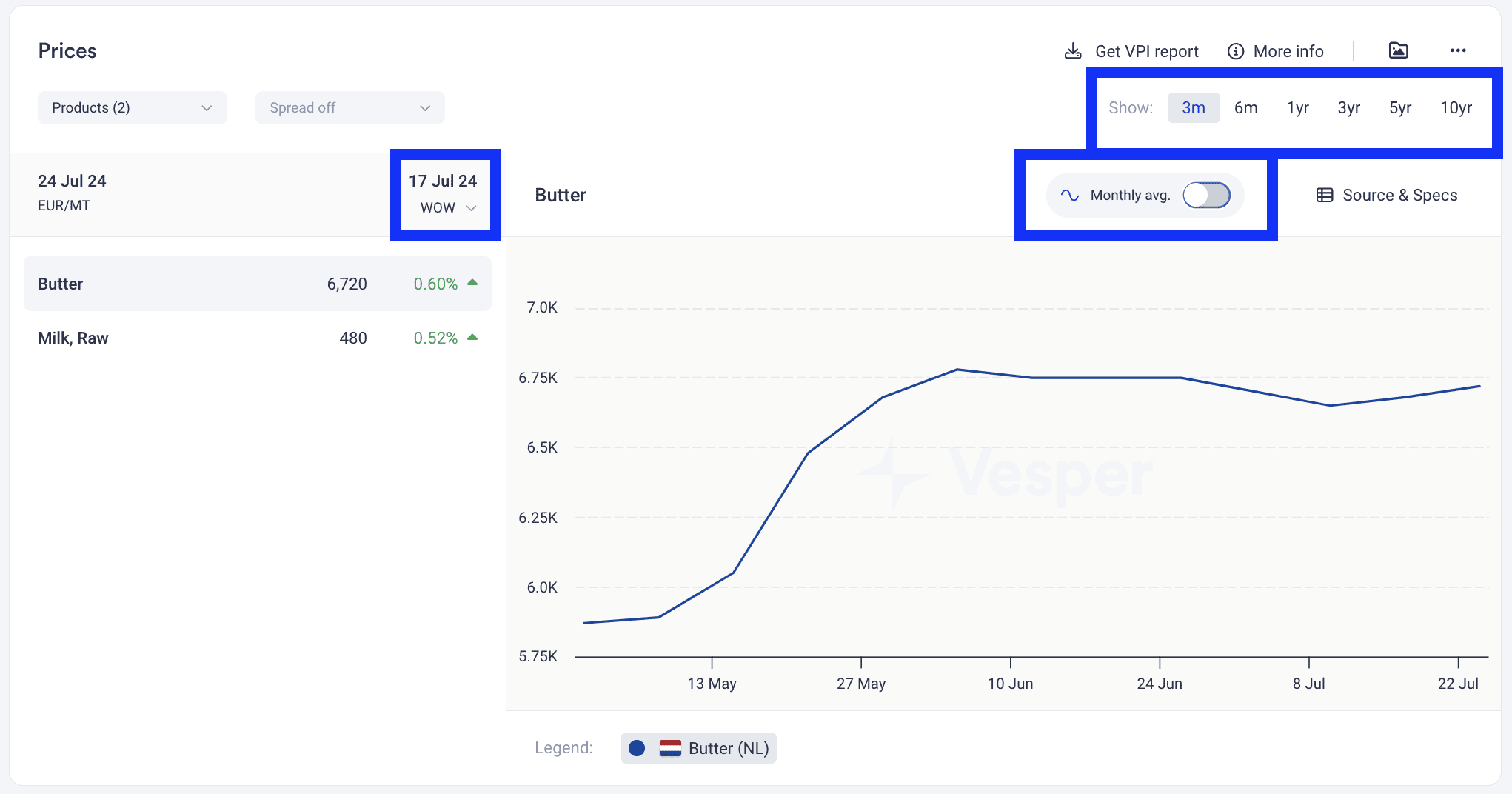
You can set up the prices widget with your product list. On the right-hand side, you get a quick overview of your product list, with the latest spot prices, and the percentage change per:
- WOW (Week Over Week)
- MOM (Month Over Month)
- YOY (Year Over Year)
In the right-hand graph, you can analyze trend lines and change the graph view by:
- 3 months
- 6 months
- 1 year
- 3 years
- 5 years
- 10 years
If available, you can toggle on the monthly average view, which only plots one point per month, representing the average.
Use cases for analyzing today’s commodity prices
Procurement Manager
A Procurement Manager can optimise purchase timing by analysing spot prices to buy when prices are low, reducing costs and improving budget management. With up-to-date spot price information, you can negotiate better terms with suppliers, securing cost savings and more favourable contract conditions.
Sales Manager
A Sales Manager can use spot price data to set competitive yet profitable pricing for products, ensuring the company remains competitive while maximising profit margins. Understanding current spot prices allows them to position products more effectively in the market, highlighting cost-effectiveness compared to competitors.
Market Analyst
A Market Analyst can track and analyse historical spot price data to identify market trends and predict future price movements, providing strategic insights for decision-making and long-term planning. Evaluating spot price volatility helps assess the risks associated with commodity purchasing, facilitating the development of risk mitigation strategies.
Frequently asked questions
What is a commodity spot price and how does it differ from a futures price?
A spot price is the price paid for immediate delivery of a commodity in the current market, reflecting today's supply and demand. A futures price, by contrast, is agreed now for delivery on a set future date. Spot prices show where the physical market stands right now, which is why procurement teams use them to time purchases and benchmark supplier quotes.
How can a procurement manager use spot prices to time purchases and negotiate?
Spot prices let you see when the market is low so you can buy at a more favourable moment and improve budget management. Having current pricing in hand also strengthens supplier negotiations, helping you secure better terms and contract conditions. You can review live commodity spot prices across products and countries to support each conversation.
Can I compare spot prices across different countries or sources for the same commodity?
Yes. In the prices widget you select both the commodity and the country or source, so you can view current prices for the same product in different regions. The article shows butter prices for the Netherlands as one example. Comparing across sources improves transparency and helps you identify the most cost-effective origin for your purchasing.
What time ranges and percentage changes can I view to spot price trends?
Alongside the latest spot price, you can see percentage change week over week (WOW), month over month (MOM), and year over year (YOY) for each product on your list. Trend graphs can be set to 3 months, 6 months, 1 year, 3 years, 5 years, or 10 years, and a monthly average view plots one averaged point per month when available.