

Using the latest commodity forward prices to track the market
Forward prices are the agreed-upon prices for transactions that will occur at a future date. These contracts lock in prices today for delivery and payment at a later date, which could be months or even years into the future. Forward prices incorporate expectations about future market conditions and risks, such as potential changes in energy prices, logistics costs, or supply chain disruptions. This introduces a layer of complexity, as it requires an understanding of future market trends, which can be affected by numerous unpredictable factors.
Benefits of analyzing commodity forward prices
Forward Market Insights Analysing forward prices allows market participants to anticipate market trends and price movements for future deliveries. By understanding the market expectations for purchasing products in advance with a forward delivery, businesses can plan their procurement and sales strategies more effectively. This foresight helps in mitigating risks associated with price volatility and ensures more stable financial planning.
Timely Pricing Tracking Forward pricing provides a snapshot of market prices at specific points in time, reflecting the trades completed by market participants. For volatile markets like Oils & Fats, forward pricing trades occur multiple times daily. With Vesper’s forward pricing updated up to 6 times a day, you can ensure you are analysing the most recent market prices and effectively tracking price differences over time.
Strategic Planning Forward prices provide crucial information for long-term planning and budgeting. Companies can lock in prices for future delivery, securing supply costs and protecting against unfavourable price fluctuations. This certainty aids in better financial forecasting, cost management, and resource allocation, allowing businesses to maintain competitive advantage and operational efficiency.
Managing Risks Forward prices serve as a critical tool for risk management. By entering into forward contracts, market participants can hedge against adverse price movements, ensuring price stability and protecting profit margins. This ability to manage price risk is especially valuable for industries highly sensitive to commodity price changes, such as the Oils & Fats market, enabling them to safeguard their financial health in volatile markets.
Finding commodity forward prices: step-by-step
1. Forward Prices
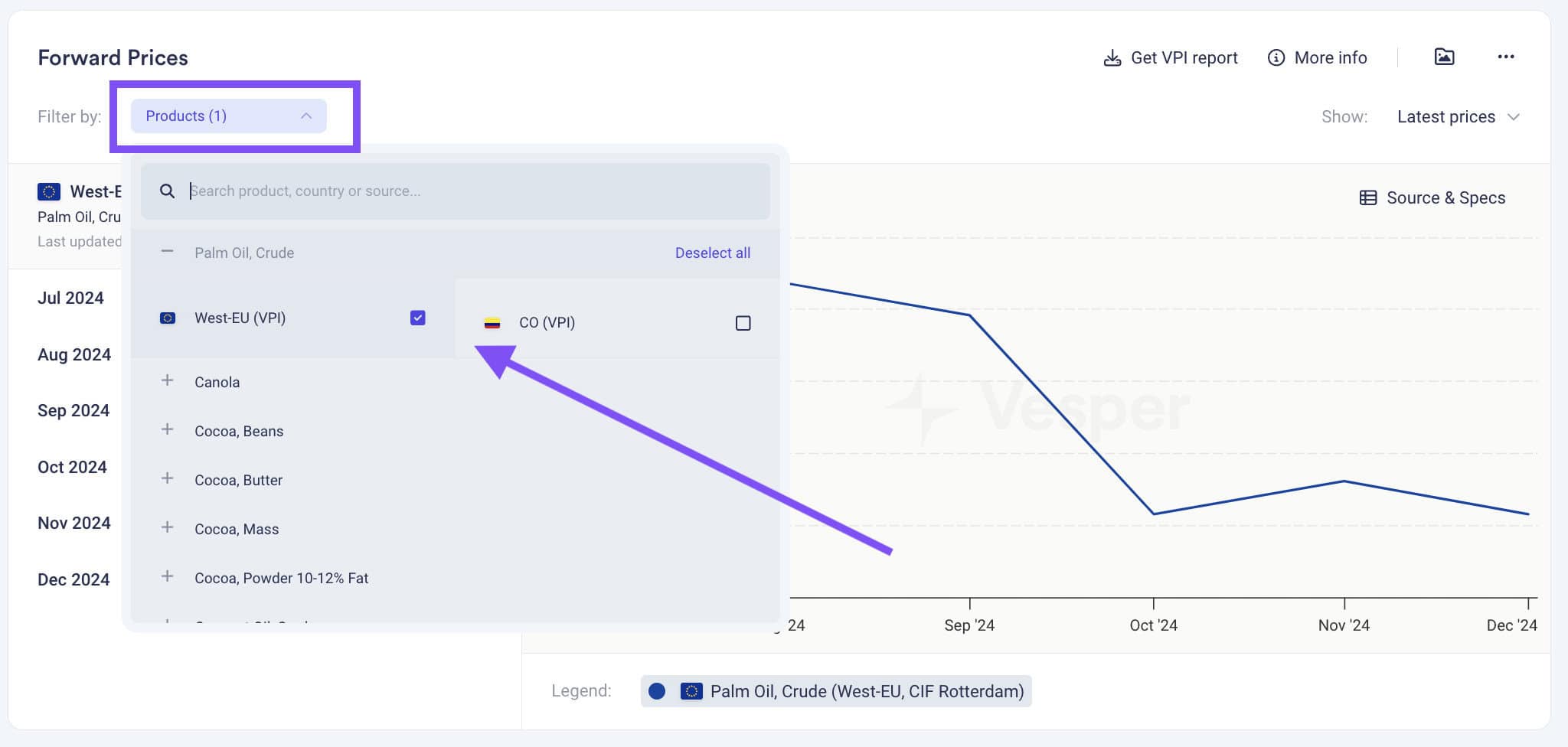
In your forward prices widget, click on the product dropdown. Select the commodity of your choice and the country or source for which you want to see current commodity forward prices.
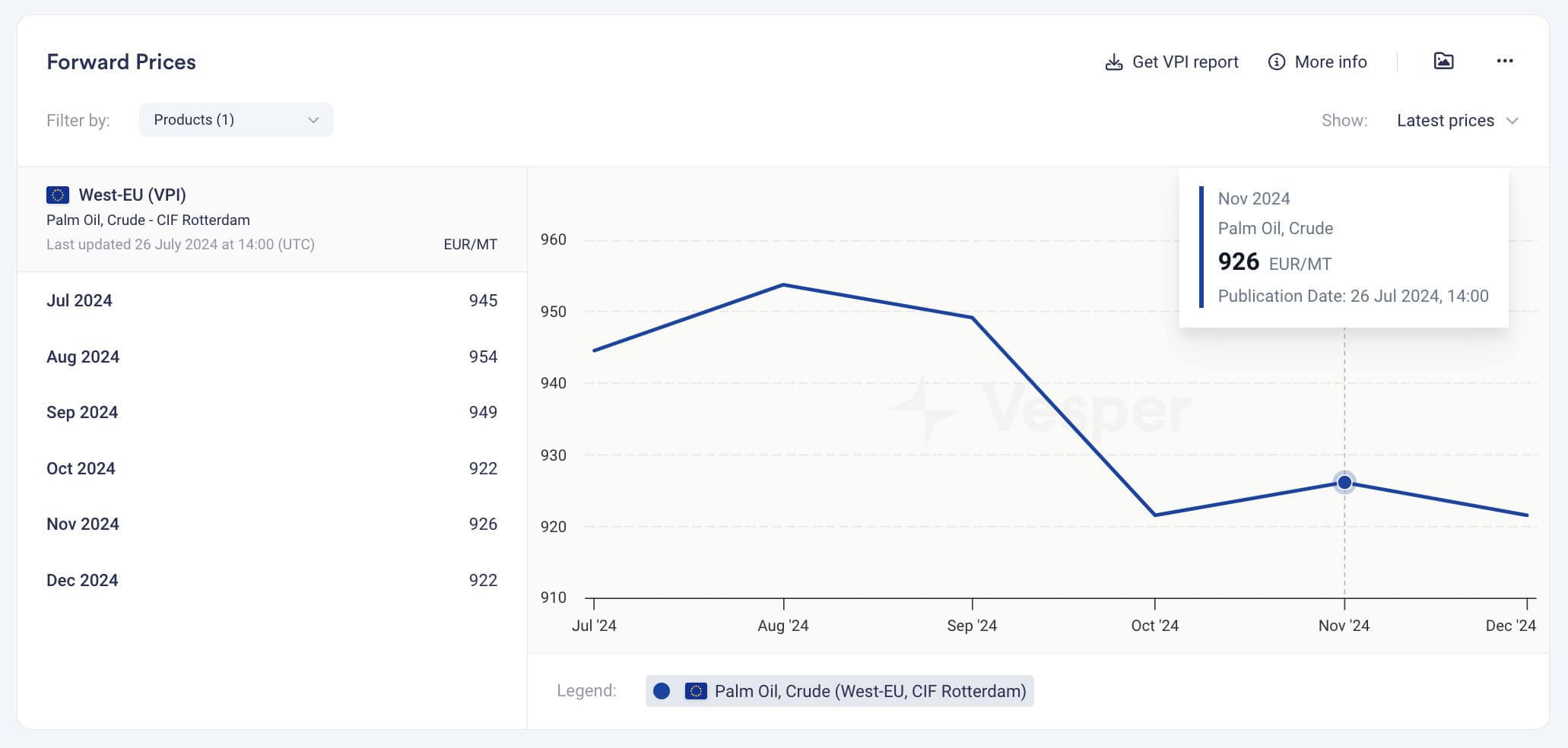
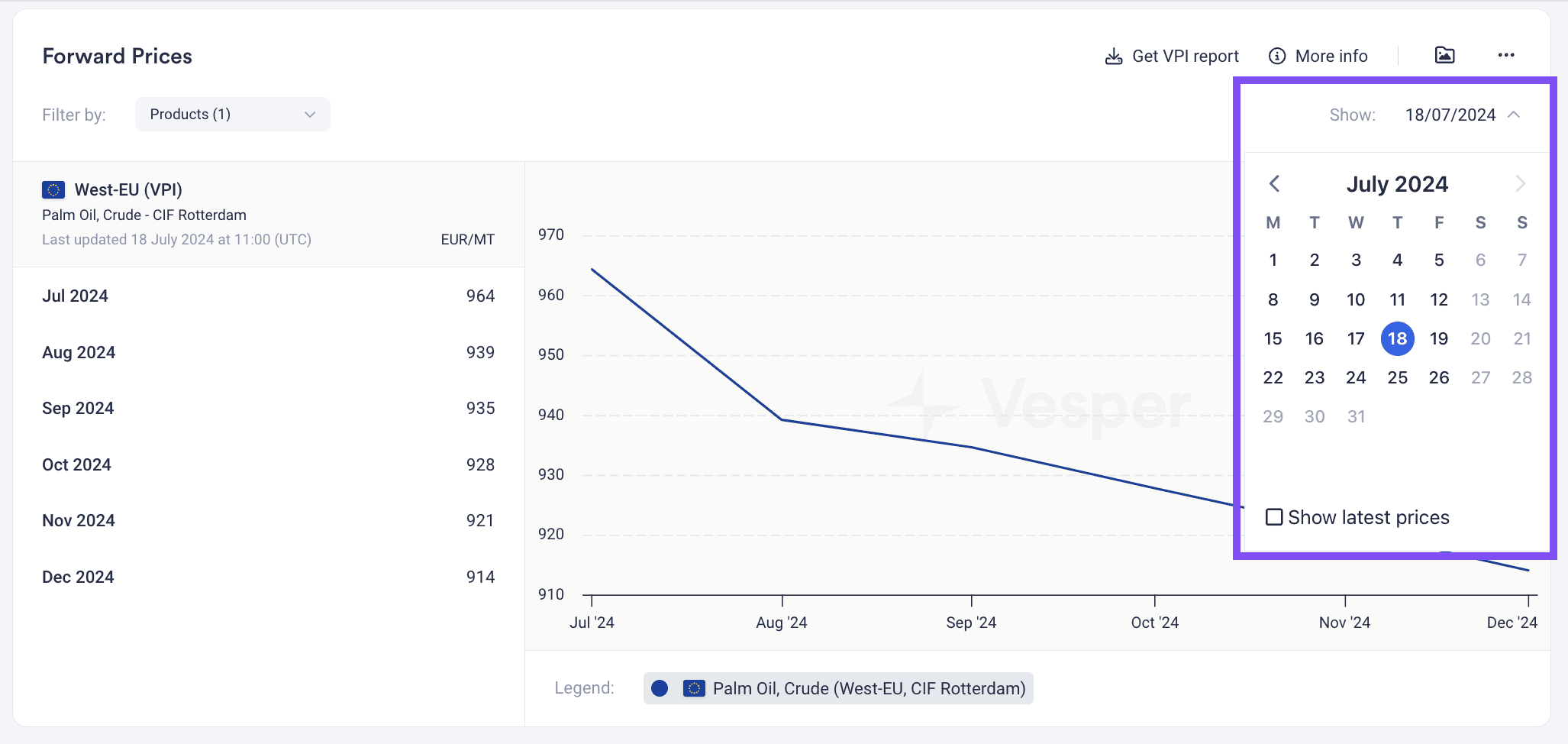
In the example, we are now showing the most current forward prices for crude palm oil in West-EU.
On the right-hand side of your widget, you will see the time the latest price has been updated. Underneath that, the contract delivery months are listed with their current prices. Hover over the chart to see details about the forward pricing for each month.
You can also analyse forward pricing from previous dates by clicking on the timespan dropdown on the right, above the graph. Selecting another date will display the prices for each forward delivery, paid on that date.
In the example below, you can see the prices paid from 18 July for each forward contract month.
Wonder what VPI means? Vesper Price Index. Read more about our proprietary commodity benchmarks
2. Forward Prices Table
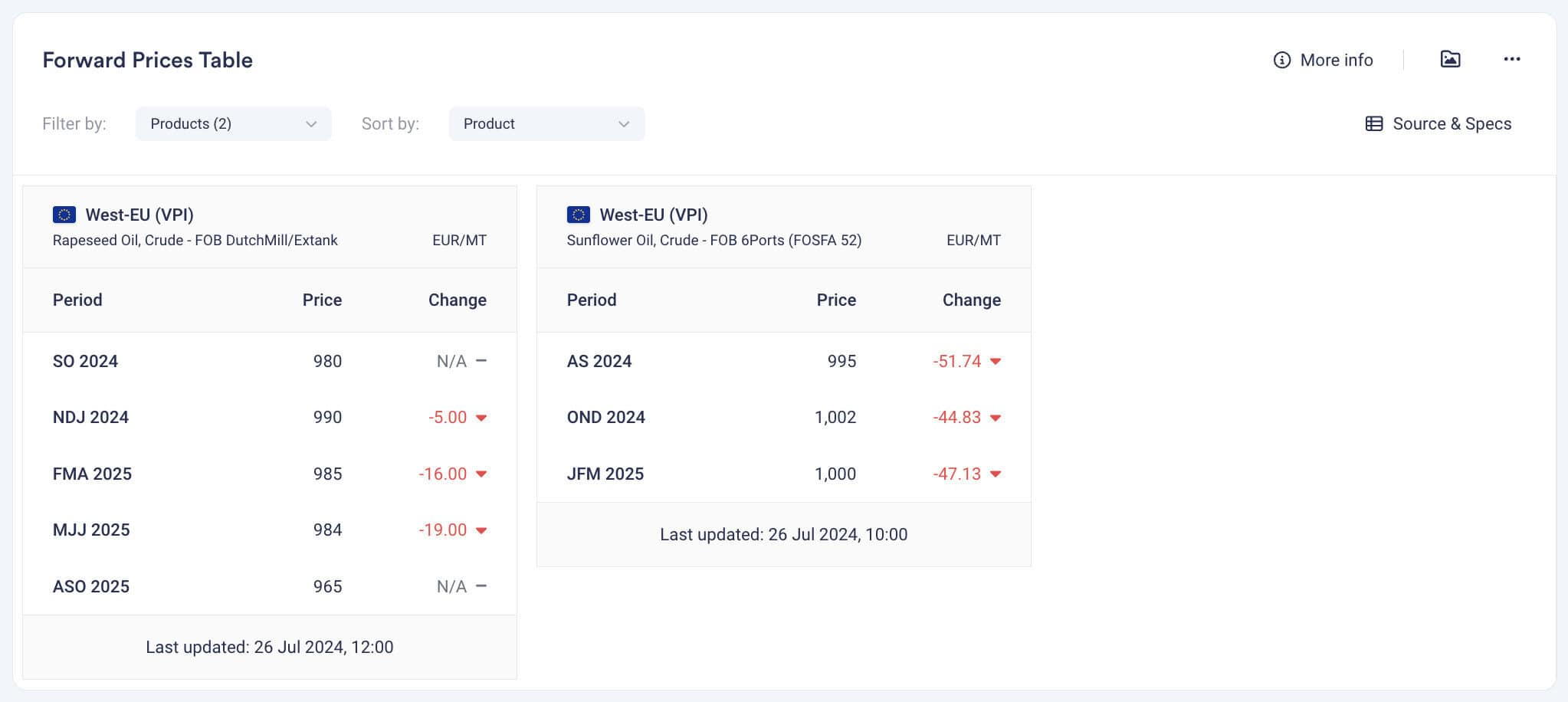
This Forward Prices Table widget provides the most recent known price, for every available product/source combination that you have selected - allowing for easy comparisons.
In the example below, we are looking at Crude Sunflower Oil and Crude Rapeseed Oil, both for West-EU.
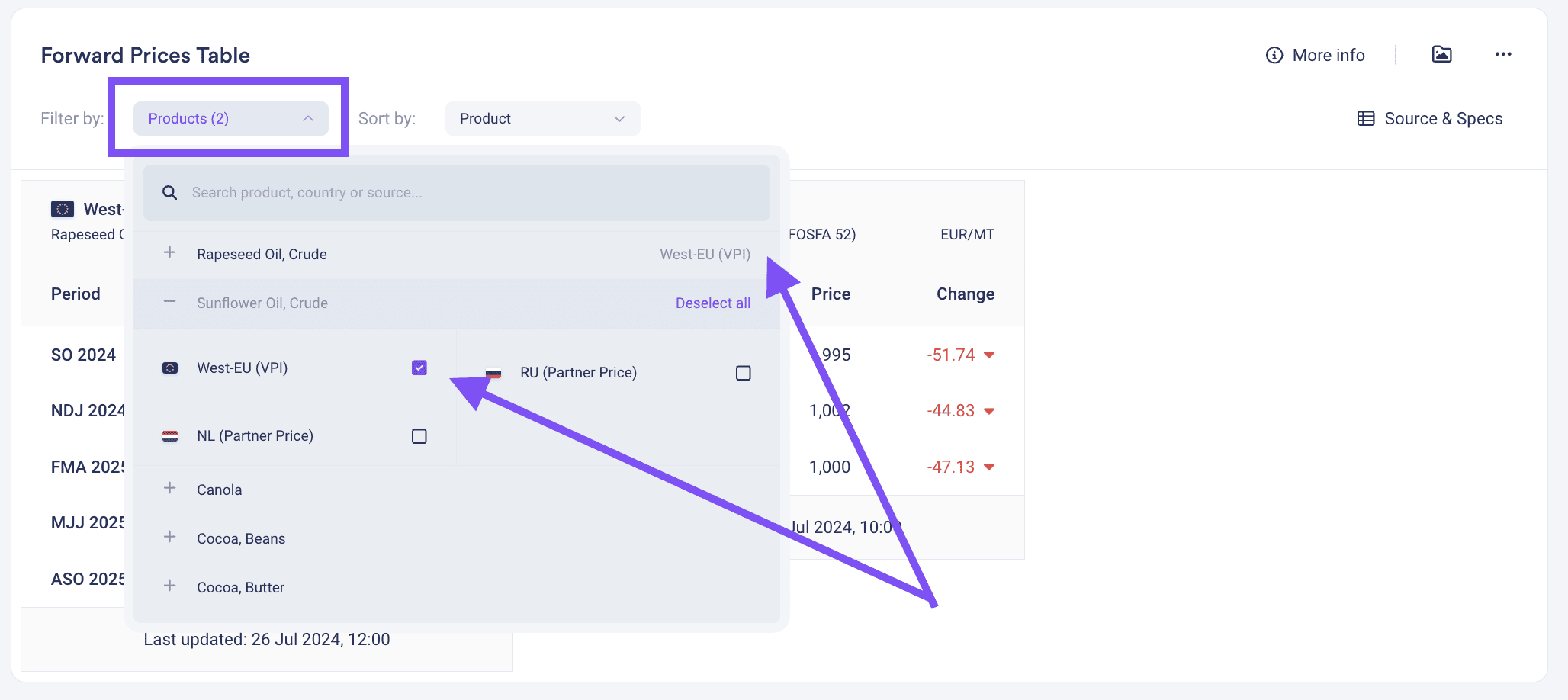
You can sort the order of the table by:
- Product: In alphabetical order
- Delivery: In alphabetical order
Each table has 3 columns which display:
- Period: The month or run the price is for
- Price: the most recent available price
- Price change: Difference of most recent price vs the last available before.
3. Forward Prices Positions
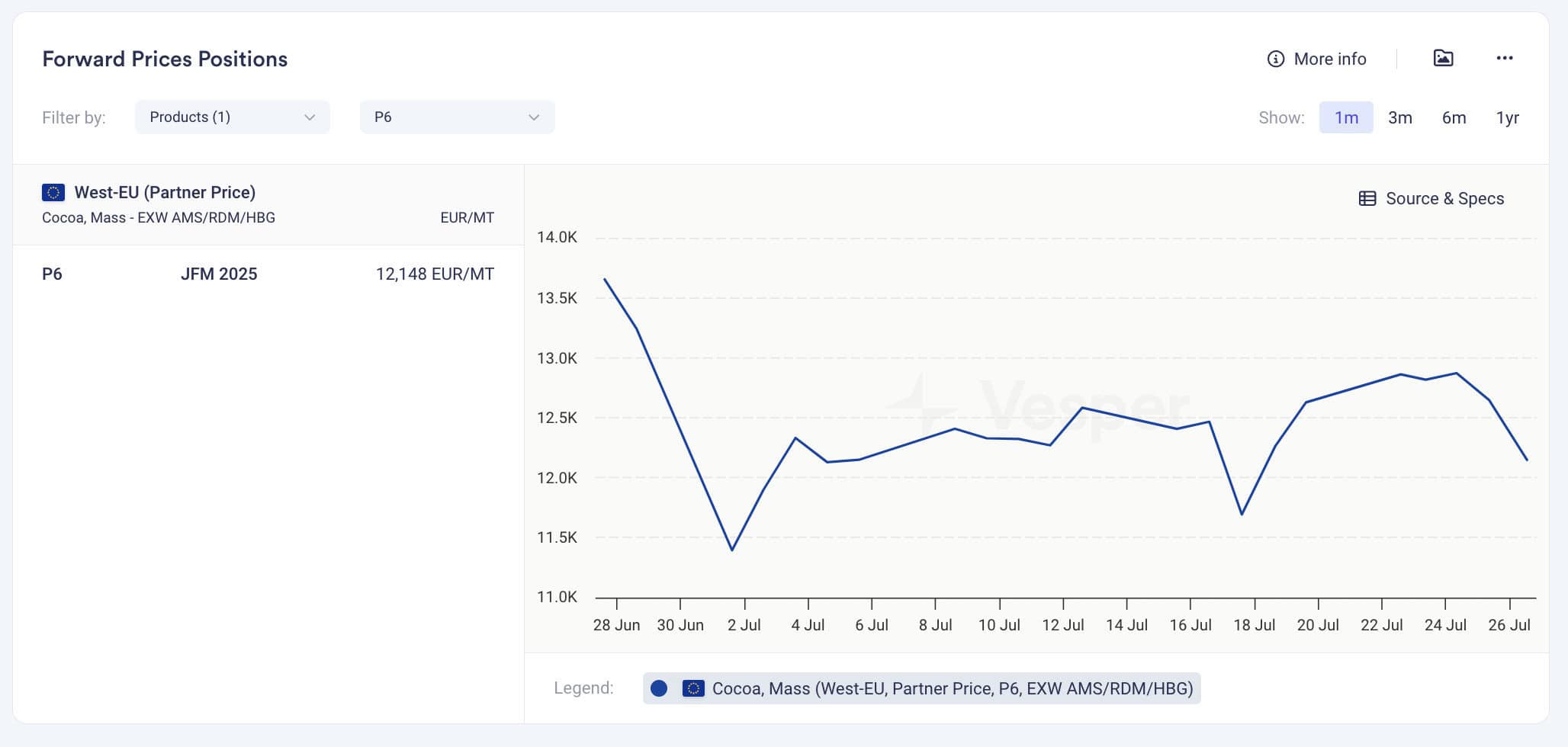
In this widget, we showcase the Forward Vesper Price Index per position. This allows you to analyse the contract month over time.
How positions are defined:
- Float = current month (“Float” means that a product is already shipping from one place to another, but for some products these containers can still be bought/sold.)
- P1 = price for the contract one month ahead, e.g., a price published in April for May
- P2 = price for the contract two months ahead, e.g., a price published in April for June
- P3 = price for the contract three months ahead, e.g., a price published in April for July
- P4 = price for the contract four months ahead, e.g., a price published in April for August
- P5 = price for the contract five months ahead, e.g., a price published in April for September
- P6 = price for the contract six months ahead, e.g., a price published in April for October
In the example below, we are looking at West-EU Cocoa mass, analysing the historical forward prices for P6, contract for delivery always six months ahead.
Use cases for analyzing forward commodity prices
Procurement Manager
Procurement managers can use forward prices to secure favourable terms for future deliveries, locking in costs and protecting against price volatility. This helps in budgeting and planning, ensuring cost efficiency and stability in supply chain management.
Sales Manager
Sales managers can leverage forward prices to set competitive pricing strategies for their products. By understanding future market conditions, they can offer attractive prices to customers while safeguarding their profit margins.
Market Analyst
Market analysts use forward prices to forecast future market conditions and identify emerging trends. This insight helps in advising stakeholders on potential market movements and opportunities.
Risk Manager
Risk managers can utilise forward prices to develop hedging strategies that protect the company from adverse price movements. This ensures financial stability and minimises exposure to market volatility.
Frequently asked questions
How are commodity forward prices different from spot prices?
A spot price reflects what a commodity costs for immediate delivery today, while a forward price is the agreed price for a transaction settled at a future date, sometimes months or years ahead. Forward prices bake in expectations about future conditions like energy costs, logistics, and supply disruptions, so they help you plan procurement and budgets rather than just buy now.
What do the position labels like Float, P1 and P6 mean in forward pricing?
Float is the current month, meaning a product already shipping that can in some cases still be traded. P1 through P6 are contracts for delivery one to six months ahead: a price published in April for May is P1, for June is P2, and so on through October as P6. Tracking a single position over time lets you analyse how that delivery month moves.
How often does Vesper update its forward prices?
Forward prices on the platform refresh up to six times a day, which matters in volatile markets where trades happen multiple times daily. Frequent updates mean you are reviewing the most recent completed trades rather than stale quotes, helping you track price differences over time accurately. You can explore this further on Vesper's oils and fats price data pages.
How can a procurement manager use forward prices to manage risk?
Procurement managers can lock in costs for future deliveries by acting on forward prices, securing favourable terms and protecting against price volatility. Entering forward contracts effectively hedges against adverse movements, stabilising supply costs and protecting margins. This supports more reliable budgeting, financial forecasting, and resource allocation, which is especially valuable in markets highly sensitive to commodity price swings.