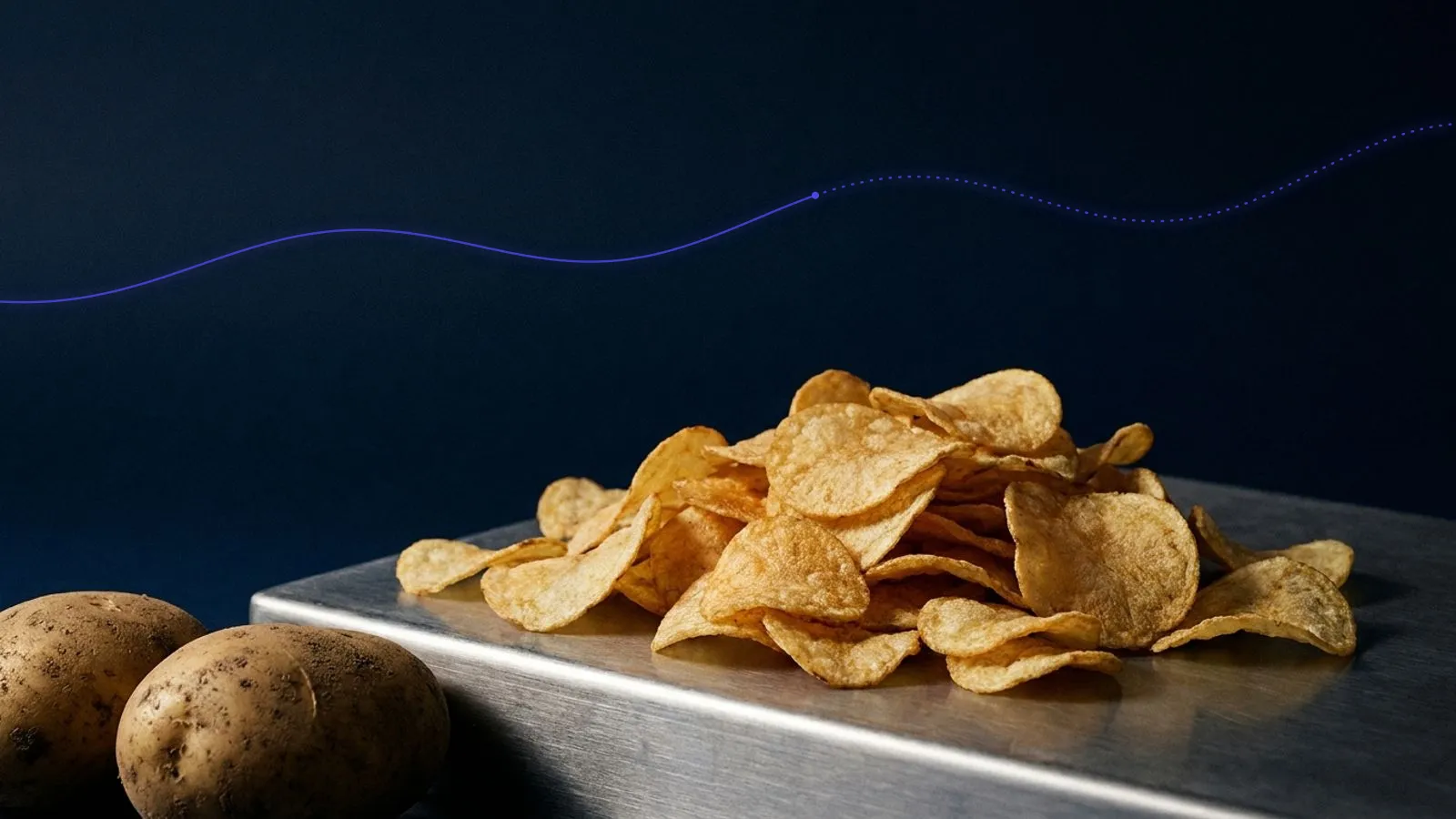
Ask what drives the cost of a bag of crisps and the answer sounds obvious: potatoes. Then look at the potato market. Dutch free-buy prices for fry potatoes fell by about 90% between mid-2024 and mid-2025, then nearly quadrupled in the 12 months to October 2026.
If your crisp cost had followed that, it would have been the wildest line in your whole category. For most crisp makers it didn’t, because most crisping potatoes are grown on contract. Understanding why is the key to understanding potato chips production cost.
This post takes a standard salted crisp apart, layer by layer. It shows what each input is, how big a share of unit cost it carries, what happened to it over the past year, and which levers change your exposure. It is one worked example of should-cost analysis: estimating what a product ought to cost from its inputs, rather than taking the quoted price as given.
It is written for procurement and finance teams at snack manufacturers, and for retail buyers sourcing private-label crisps. It is not about building a plant.
What does it cost to make potato chips?
The potato chips production cost is mostly the cost of potatoes and oil. In our illustrative model, potatoes are 30% of unit cost and frying oil 20%. Packaging adds 15%, energy 5%, salt and seasoning 5%, and labour, overhead, logistics and margin the remaining 25%. Potatoes and oil set the level. Energy is a small share, but its price can swing hard.
These shares are an assumption for teaching, not a measured industry average. A public rule of thumb puts potatoes higher. Tom Lock of the British Snack Co. told The Wall Street Journal in 2022 that potatoes make up about 60 to 70% of the cost of a bag of chips and cooking oil another 20 to 25%. That leaves very little for packaging, energy and labour, so we read it as a share of materials rather than of full unit cost. Either way, potatoes and oil come first.
The cost stack of a bag of crisps
| Cost layer | Share of unit cost (illustrative) | What sits in it |
|---|---|---|
| Potatoes | 30% | Crisping varieties, mostly on contract, delivered from store |
| Frying oil | 20% | Sunflower, high-oleic sunflower, rapeseed or RBD palm olein |
| Salt and seasoning | 5% | Salt for ready salted; a seasoning blend for flavours |
| Packaging | 15% | Printed laminate film, plus cases and pallet wrap |
| Energy | 5% | Mostly gas for the fryer, plus power for slicing, packing, storage |
| Labour, overhead, logistics, margin | 25% | Line staff, maintenance, depreciation, transport and the maker’s margin |
| Total | 100% |
Cost shares are illustrative, our estimate for a standard ready salted crisp in a mid-size bag.
Three things stand out.
Oil costs more per kilo than the potato. About a third of the crisp’s weight is oil and nearly two thirds is potato solids. Yet oil carries 20% of unit cost against 30% for potatoes, so kilo for kilo, the oil in a crisp costs more than the potato solids it replaces.
Packaging carries a real share. Crisps are light and bulky. A bag holds a lot of air and very little product, so film per kilo of crisps is high, and multipacks of small bags push it higher.
Energy is small but volatile. At 5%, it ties with salt and seasoning as the smallest line in the stack. Yet apart from free-buy potatoes, it is the input whose price moved most this year, as we show below.
The recipe: from potato to crisp
A crisp has a very short ingredient list: potatoes, oil and salt. The cost is in the transformation, because most of what you buy is water.
The Dutch crisp maker Hoeksche Chips puts it simply in an interview with FavorFlav: a crisping potato is about 78% water, the crisps are about 30% sunflower oil, and it takes more than three kilos of potatoes to make one kilo of crisps.
Academic work gives similar figures. A review by Pedreschi and Zuñiga, Acrylamide and oil reduction procedures in fried potatoes, puts the typical oil content of potato chips at about 35% by weight, against about 15% for French fries.
Here is what a kilo of crisps is made of, in our calculation:
| Per 1 kg of finished crisps | Amount (our calculation) | Basis |
|---|---|---|
| Oil in the crisp | about 0.35 kg | Typical oil content of ~35% |
| Potato solids in the crisp | about 0.63 kg | What is left after oil and ~2% moisture |
| Sliced potato needed | about 2.9 kg | 0.63 kg of solids at 22% dry matter |
| Raw potatoes bought | about 3.4 to 3.6 kg | Adding peel, trim, rejects and washing losses |
| Water fried off | about 2.2 kg | Water in the slices, minus what stays in the crisp |
Our calculation from the oil and dry matter figures above. Peel and trim losses are our estimate and vary with tuber size, shape and storage.
That is where the “roughly 3 to 4 kg per kilo” rule comes from. Two consequences follow.
Dry matter is money. The solids in the crisp come from the potato’s dry matter. A potato at 24% dry matter instead of 22% needs about 8% fewer kilos of sliced potato per kilo of crisps (our calculation). It also leaves less water to fry off. And it tends to absorb less oil: a 2011 study of Kenyan varieties in the African Journal of Food, Agriculture, Nutrition and Development found tuber dry matter from 20.8% to 25.8% and crisp oil content from 31.3% to 36.8%, with higher dry matter linked to lower oil.
Storage decides quality. Crisping potatoes are stored warmer than other potatoes, around 10°C according to PotatoPro, because cold storage builds up reducing sugars, which turn crisps dark when fried. Potatoes that fail the colour spec are rejected or downgraded, and that loss sits inside your potato cost.
How crisping potatoes are bought
Before looking at the price moves, it helps to know how the main input changes hands.
Crisping potatoes are a specialist crop. Most are grown on contract for a named processor, with an agreed variety, volume and price, often with bonuses or penalties for dry matter and fry colour. Contracts are usually set before planting for the following storage season.
Anything a processor needs beyond its contracts, or a grower has beyond them, trades on the free-buy market. Both sit apart from the fresh table-potato trade, which Vesper follows separately with price data for fresh potatoes in Austria, South Africa and the United States. The free-buy market is thin and volatile. It reacts to the size of the harvest across the whole North-West European potato zone, not just the crisp sector.
The 2025 harvest showed how volatile. In November 2025 the North-Western European Potato Growers (NEPG) estimated the crop of consumption potatoes in Belgium, Germany, France and the Netherlands at 27.2 Mt, 10% above 2024, after a 7% increase in area and a 5% rise in yields. Demand for frozen fries had weakened at the same time. NEPG described free-buy prices as dramatically low, with no real buyer interest, and said processors would cut both contract prices and contracted volumes for the 2026-2027 season.
For a crisp maker, that means two separate questions: what happened to the open market, and what happened to your contract?
What moved in the last 12 months
Potatoes
Two series on Vesper show both the collapse and the rebound.
The PotatoNL free-buy price for Dutch potatoes for fries rose 280.0% between 27 October 2025 and 26 October 2026. That is a rebound from a very low base, not a boom. Between mid-2024 and mid-2025 the same series fell by about 90%, and even after the rebound it is still far below its 2024 high.
The EEX series for the processing potato market (Europe) tells the old-crop side of the story: its latest print, from 5 June 2026, was 85.1% below a year earlier.
Two caveats before you use these numbers. First, they measure fry potatoes, not crisping varieties. Crisping potatoes are a smaller, mostly contracted market, and we know of no public free-buy quote for them, so we use the fry market as the indicator of where the open market is heading. Second, the base matters enormously: a series that falls 90% and then rises 280% has still lost more than half its value.
Oil, packaging and energy
The details behind each bar:
- Sunflower oil. Refined sunflower oil prices in Spain (VPI, EXW) rose 12.7% between 1 October 2025 and 21 October 2026. The West-EU crude sunflower oil market (VPI, FOB 6 Ports, FOSFA 52) rose 16.7% over the same period, and its 12-month high was 22.7% above its low.
- High-oleic sunflower oil. The Spanish high-oleic sunflower oil market (refined, VPI, EXW) rose only 4.1%, with a 12-month range of 10.6%.
- Rapeseed oil. The West-EU crude rapeseed oil market (VPI, FOB Dutch mill) rose 24.8% to 27 October 2026, the biggest oil move in the basket, and its high was 34.4% above its low. In Germany, refined rapeseed oil quotations (partner price, FOB Hamburg) rose 24.2%.
- RBD palm olein. The RBD palm olein market in Turkey (VPI, CIF Marmara) rose 11.7%. Vesper has no West-EU RBD palm olein series for the period, so treat this as a direction, not a delivered EU price.
- Packaging film. West-EU OPP film price data (15 micron, partner price, EXW) shows a 17.3% rise from October 2025 to October 2026.
- Energy. German THE natural gas futures (front month, EEX) rose 115.3% in the 12 months to October 2026, more than doubling.
We hold salt and seasoning flat below. Vesper’s EU salt series (Eurostat) runs only to August 2026, when it was about 10% below a year earlier, and seasoning blends vary too much by flavour to track with one index. At 5% of unit cost, even a 10% fall across the whole line would take only half a point off.
What that did to unit cost
To turn price moves into a cost change, weight each one by its share of unit cost and add the results. The method is the same one we use to check a supplier price increase.
The potato line needs one extra step, because the contract and the free market moved differently. For the base case we assume 90% of potatoes on contract at last season’s price and 10% bought free-buy, following the PotatoNL move. That gives a blended potato move of 0.9 × 0% + 0.1 × 280.0% = +28.0%.
| Input | Share of unit cost (illustrative) | 12-month move | Effect on unit cost |
|---|---|---|---|
| Potatoes (90% contract, 10% free-buy) | 30% | +28.0% blended | +8.40 points |
| Frying oil (refined sunflower, Spain) | 20% | +12.7% | +2.54 points |
| Salt and seasoning | 5% | held flat | 0 points |
| Packaging (OPP film as proxy) | 15% | +17.3% | +2.60 points |
| Energy (THE gas as proxy) | 5% | +115.3% | +5.77 points |
| Labour, overhead, logistics, margin | 25% | held flat | 0 points |
| Total | 100% | +19.3% |
Our calculation from Vesper and EEX price changes to October 2026. Cost shares and the contract split are illustrative.
The free-buy tenth of the potato volume adds more to unit cost than all the oil. That is the effect of a 280% move: even a small open-market share carries real weight.
The contract share decides the answer
Change only the potato assumption and the result moves a long way:
| Potato buying assumption | Potato move (blended) | Effect on unit cost | Total change in unit cost |
|---|---|---|---|
| 100% contract, price cut 10% | -10.0% | -3.00 points | +7.9% |
| 100% contract, price flat | 0% | 0 points | +10.9% |
| 90% contract, 10% free-buy | +28.0% | +8.40 points | +19.3% |
| 75% contract, 25% free-buy | +70.0% | +21.00 points | +31.9% |
Our calculation. Contract prices are held flat except in the first row, which shows what a 10% contract cut would do. We have no public figure for the 2026-2027 contract cuts NEPG announced.
So the same year can justify anything from under 8% to over 30% on a bag of crisps, depending on how the potatoes were bought. That is the first thing to ask a supplier about.
To put it in money: if a private-label multipack costs the manufacturer €2.00 to make (a made-up round number), +19.3% is about 39 cents. Potatoes account for 17 cents of that, gas for 12.
Three honest limits on this example:
- Energy is a proxy. The spot gas move is applied to the whole 5% energy share. Most plants buy part of their gas forward, and power follows its own path.
- Packaging is a proxy too. OPP film fits the bag, but cases and pallet wrap are in the same 15%. If film is two thirds of packaging cost, the packaging effect drops to about 1.7 points.
- The free-buy series is for fry potatoes. It shows the direction of the open market. A crisp maker buying free-buy crisping varieties should use its own purchase prices.
If you want this as a model you can rerun every month, here is how to build a should-cost model from scratch.
The levers: what changes your exposure
Price is only one input. These choices change how much each market move reaches the cost of a bag.
Lever 1: the potato contract
The table above is the lever. A high contract share protects against a year like this one and loses out in a year like 2025, when the open market fell far below contract prices. Most crisp makers accept that trade, because a fully contracted crop also secures the variety, dry matter and storage quality they need.
The questions to ask: what share of next season’s volume is contracted, at what price, and with which dry matter and fry-colour terms.
Lever 2: the frying oil
Oil is 20% of cost, and the choice of oil changed the outcome this year:
| Frying oil | 12-month move | Effect on unit cost (20% share) |
|---|---|---|
| High-oleic sunflower, refined, Spain | +4.1% | +0.82 points |
| RBD palm olein, Turkey | +11.7% | +2.34 points |
| Sunflower, refined, Spain | +12.7% | +2.54 points |
| Rapeseed, refined, Germany | +24.2% | +4.84 points |
Our calculation from Vesper price changes to October 2026.
The two base oils answer to different markets. Standard and high-oleic grades both sit inside the wider sunflower oil trade, where Ukraine and Russia supply most exports, while European rapeseed oil supply leans more on the EU’s own crop. A buyer with both oils approved on the spec can follow whichever market is weaker.
Swapping oil is not only a price decision. It affects taste, shelf life and the claims on the pack. In a 1996 industrial frying trial published in Grasas y Aceites, Lahtinen, Wester and Niemelä found crisps fried in high-oleic sunflower oil almost as stable against oxidation in storage as crisps fried in palm olein. Crisps fried in standard sunflower oil were the least stable. That is one reason high-oleic oil is widely used for frying snacks, and why switching to standard sunflower oil to save money can cost shelf life.
Lever 3: dry matter and oil uptake
Higher dry matter means fewer potatoes per kilo of crisps, less water to fry off and, as the Kenyan study found, less oil uptake. In our calculation, moving from 22% to 24% dry matter at the same price per tonne takes about 2.5 points off unit cost through the potato line alone, before any saving on gas.
Cutting oil content on its own is a different story. Because crisps are sold by weight, every gram of oil taken out has to be replaced by potato solids. In our illustrative stack, taking the crisp from 35% to 30% oil saves about 2.9 points on oil and adds about 2.4 points on potatoes, so it nets to less than half a point (our calculation). Lower-fat crisps are a product and health decision, not a cost saving.
Lever 4: how gas is bought and used
According to Wu, Jouhara, Tassou and Karayiannis in Applied Energy, frying is responsible for more than 90% of the energy used on an industrial crisp line. Most of that heat goes into evaporating water from the slices. The authors estimated the overall efficiency of the frying process at around 70%, and pointed to exhaust heat recovery as the main way to improve it.
That gives two levers:
- Buying. A plant that fixed part of its gas ahead did not pay the 115.3% rise on all its volume. Our guide to forward buying with layered cover shows how to stage it. If you buy finished crisps, ask your supplier how much of its next 12 months of gas is already fixed.
- Using. Every point of dry matter means less water to evaporate. Heat recovery from fryer exhaust and steady, long runs lower gas per tonne further.
Lever 5: pack format
Packaging is 15% in our example, and the share rises as the bag shrinks. A multipack of small bags uses far more film per kilo of crisps than a large sharing bag. Crisp bags are often lined with metallised plastic, which keeps out light and oxygen. As Braintree District Council notes, that layer is not easily separated from the plastic, which makes the bags very difficult to recycle. Any move to mono-material film changes the film price you are exposed to, so cost it as a pack decision, not only a sustainability one.
What this means for your next supplier conversation
For a private-label buyer, the useful question is not “did potatoes go up?”. It is “how much of your potato volume was exposed to the open market, and when?”.
Before you accept or push back on a crisp price change, get:
- The supplier’s cost shares for potatoes, oil, packaging and energy, in %.
- The contract share of its potato volume for the current and next season, and the contract price change.
- The frying oil it uses, and whether that has changed.
- The base month for each price move, and how much gas was bought forward.
Then run the share × move sum yourself. A fully contracted maker frying in high-oleic sunflower oil and a maker buying a quarter of its potatoes free-buy and frying in rapeseed oil can justify very different increases this year.
The same arithmetic applies to other fried and baked products. Our butter biscuit production cost breakdown shows it for a bakery product where energy, not potatoes, drove the year.
Next steps
Pick your two highest-volume crisp SKUs and fill in the share table above with your own recipe, contract terms and pack.
Vesper also tracks consumer prices for potato chips in the United States and Switzerland, a useful check on how shelf prices are moving while your built-up cost changes.
To keep the calculation live, Vesper Cost Models link every ingredient in your recipe to a current price, add energy, labour and overhead, and show how your unit cost moved since the last negotiation.
Frequently asked questions
What does it cost to make potato chips?
It depends on the recipe, the pack and how the potatoes are bought, so the useful answer is the cost structure. In our illustrative crisp, potatoes are 30% of unit cost, frying oil 20%, salt and seasoning 5%, packaging 15%, energy 5%, and labour, overhead, logistics and margin 25%. Replace these shares with your own supplier's breakdown as soon as you have it.
How many potatoes does it take to make a kilo of crisps?
Roughly 3 to 4 kg of raw potatoes for 1 kg of crisps. A crisping potato is about 78% water, and most of that water is fried off. Peel, trim, rejects and starch washed off the slices take a further share. The finished crisp is around a third oil by weight, which puts some of the weight back.
Did potato prices really rise 280%?
On the open market for fry potatoes, yes, but from a very low base. The PotatoNL free-buy price for Dutch fry potatoes rose 280.0% between 27 October 2025 and 26 October 2026. Between mid-2024 and mid-2025 it had fallen by about 90%, and it is still far below its 2024 high. Most crisping potatoes are grown on contract, so a crisp maker only feels the free-buy move on the share it buys in the open market.
What is the biggest cost in making crisps?
Potatoes, then frying oil. In our illustrative stack they are half of unit cost together. Oil is a third of the crisp by weight and costs more per kilo than the potato solids it sits on, so the choice of frying oil matters almost as much as the potato contract.
How can a buyer check a crisp supplier's price increase?
Ask for the supplier's cost shares, how much of its potato volume is on contract, and which frying oil it uses. Then multiply each share by that input's price change from an independent index over the same period and add the results. Compare the total with the increase the supplier asked for.