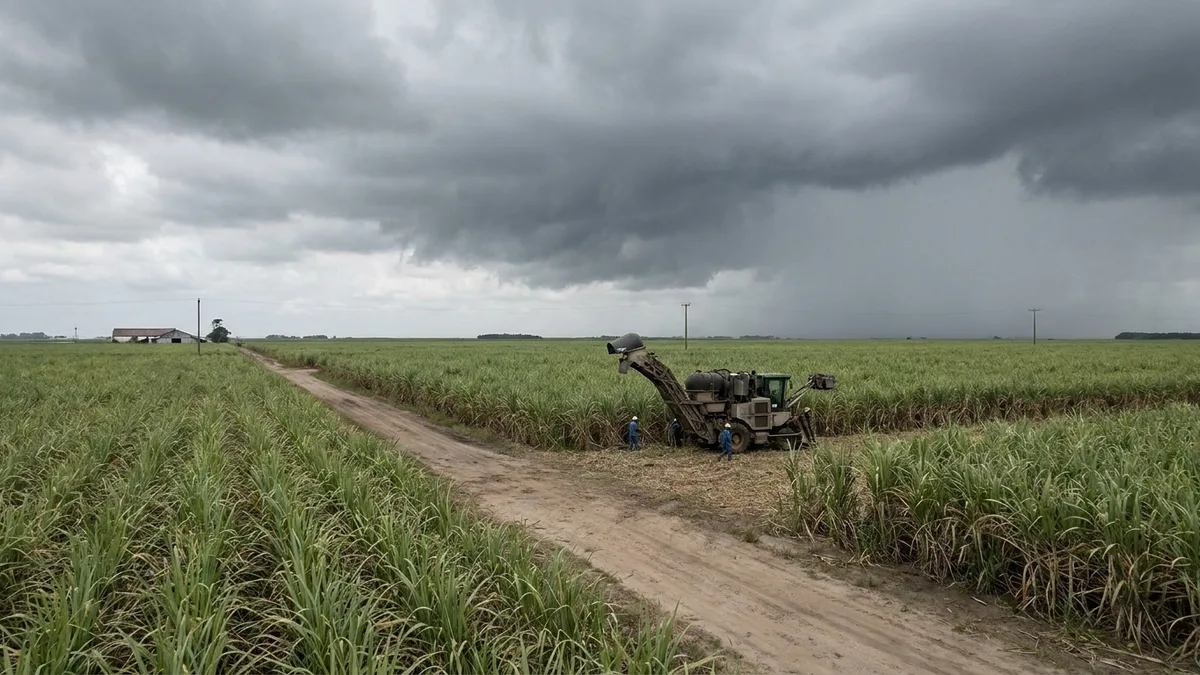


Raw sugar edged higher this week, supported by Brazil’s planned anhydrous ethanol blending rate increase from 30% to 32% (pending formal approval at a CNPE meeting on 7 May) and a recovery in crude oil prices on Middle East tensions. The Sugar No. 11 (Raw) settled at 14.11 cents/lb, while Sugar No. 5 (White) closed at $433/mt.
The recovery remains fragile against a backdrop of ample global supply and a speculative community that has expanded its net short position back toward record levels, suggesting the market has yet to commit to a directional move.
The more strategic story is building in the background. El Niño probability has now crossed 80% from August 2026 onwards, introducing downside risk to cane yields across Brazil, India and Thailand at a time when most forecasting models are converging toward a 2026/27 global deficit. With world stocks at low levels and the market’s capacity to absorb new supply shocks limited, any weather-driven crop disappointment in the second half of the year could provide a trigger for a more sustained price recovery.
Europe is already pricing in tighter supply for 2026/27. EU sugar stocks as of January 2026 stood at 14.0 MMT, up 5.1% year on year from 13.3 MMT, with accumulated 2025/26 imports (October to February) reaching 1.01 MMT, 58.6% above the same period a year earlier. For 2026/27, beet area is tracking a 6–8% contraction, with the market converging on a central estimate of -7.5%. Assuming trend yields, sugar production is projected to fall to approximately 15 MMT, the lowest in recent years. New-crop 2026/27 EU white sugar is indicated at 500–550 EUR/mt, reflecting forward recognition of tightening supply.
A vote on Inward Processing Relief (IPR) import suspension is expected in the coming days. IPR accounted for around 70% of total raw sugar imports in the first four months of 2025/26. The European Commission has proposed a suspension of at least one year, but no final decision has been reached. Separately, the EU-Mercosur provisional application from 1 May adds 180,000 MT of Brazilian sugar duty-free and a new 10,000 MT quota for Paraguay. Ukraine’s 2026 sugar import quota has been set at 100,000 tonnes.
In Brazil, April Center-South exports have reached 921,000 tonnes, down 25.7% year on year from 1.24 MMT in the same period last season, the slowest April export pace in two years. Despite the rise in crude oil prices, Petrobras has held off on adjusting domestic fuel prices, with gasoline 41.0% below import parity and diesel 24.5% below. This continues to suppress the ethanol price signal and limit mill incentive to shift mix toward biofuel. Hydrous ethanol is already outcompeting sugar on a parity basis, and any meaningful Petrobras price adjustment would rapidly redirect cane allocation toward ethanol and tighten sugar availability.
In the United States, Florida cane crop damage from the late February freeze is still being assessed, with some reports indicating production losses as high as 35% in the most affected areas. Sugar beet planting is running well behind schedule at only 12% of the crop planted as of 19 April, against a year-ago pace of 20% and a five-year average of 18%. The American Sugar Alliance filed a formal complaint with the USTR on 15 April, requesting Section 301 duties against cheap foreign sugar.
For the full sugar forecast, visit: https://app.vespertool.com/market-analysis/2934