


What are Oils and Fats Price Forecasts?
Oils and fats price forecasts are predictive analyses that estimate future prices of commodities within the oils and fats market, including vegetable oils, animal fats, and related products. These forecasts are crucial for various industry stakeholders, such as producers, buyers, sellers, and traders, as they provide valuable insights for making informed decisions about production, procurement, pricing strategies, and investment opportunities.
Forecasting in the oils and fats market can range from short-term predictions to long-term projections, with some extending up to two years into the future. However, the most effective and actionable forecasts are often those that predict prices up to 6 months in advance. These forecasts are particularly useful for managing immediate supply chain needs, responding to market fluctuations, and optimizing operational strategies.
Vesper’s state-of-the-art AI-driven price forecasts excel in providing these precise, short- to medium-term predictions. For example, the figure below illustrates historical price trends for crude palm oil in Malaysia, alongside Vesper’s forecasted price trajectory for the coming months.
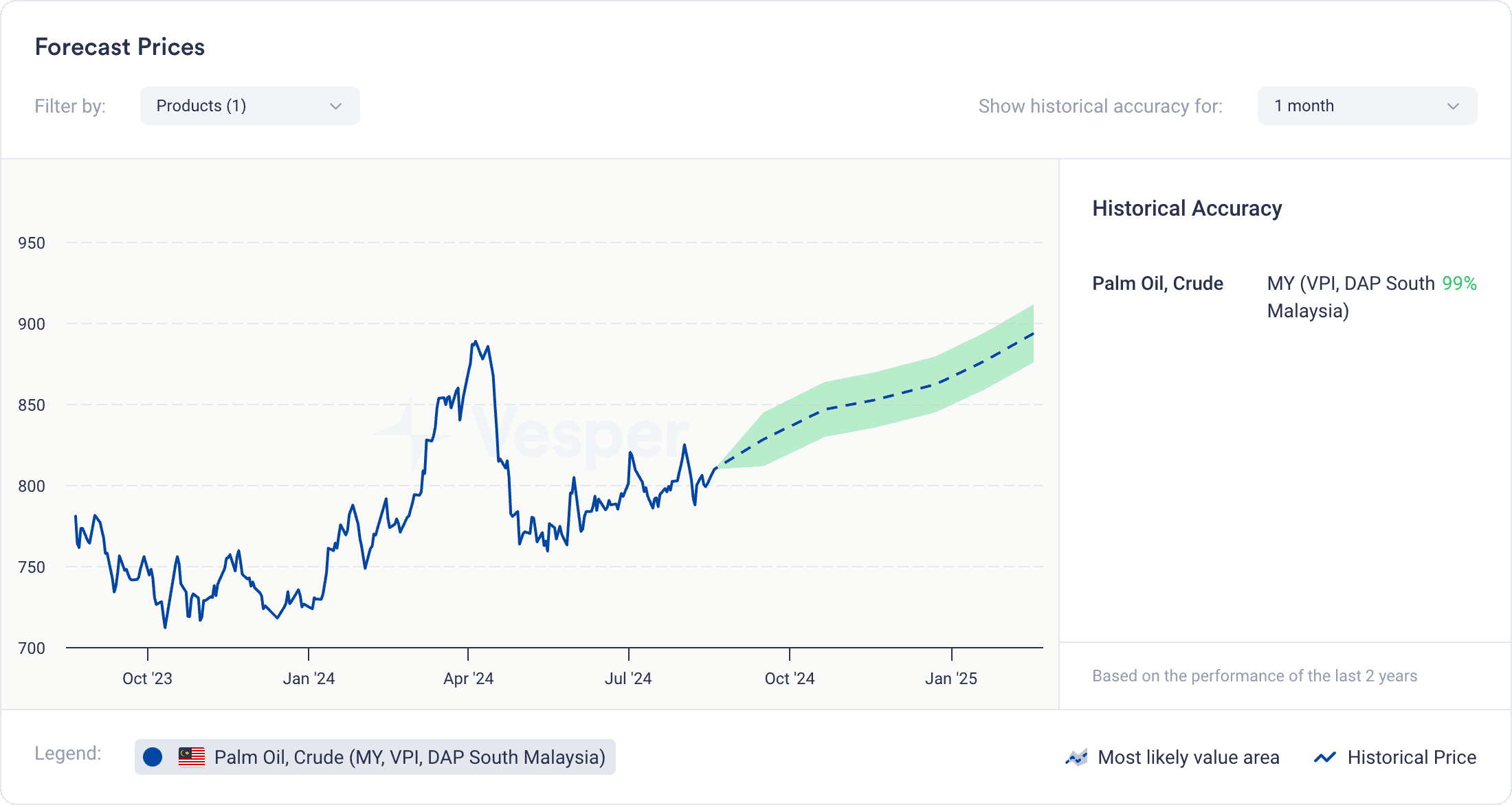
The forecast is visualized with a shaded area representing the most likely price range, while a dotted line marks the central prediction. With a 99% historical accuracy rating, Vesper’s model stands out for its reliability, leveraging an extensive database of historical prices and sophisticated machine learning techniques to continually refine its predictions. This advanced forecasting approach not only enhances the accuracy of price predictions but also increases their practical utility for a diverse range of users in the oils and fats market.
TIP: To explore Vesper’s cutting-edge forecasting capabilities for a wide range of vegetable oils and related products, start a free trial here.
What’s the Difference Between Traditional Oils and Fats Price Forecasts and AI-driven Oils and Fats Price Forecasts?
Traditional Oils and Fats Price Forecasts
Traditional oils and fats price forecasts typically rely on fundamental and economic indicators. These include factors like:
- Inflation Rates
- Energy Prices
- Oil and Gas Prices
- Exchange Rates
- Supply and Demand Dynamics
- Weather Predictions
Analysts using these methods often depend on their understanding of these indicators to make predictions, which can be subjective and limited by the complexity of the market. More advanced traditional forecasting methods incorporate technical indicators such as:
- Relative Strength Index (RSI)
- Bollinger Bands
- Moving Averages
- Oscillators
These tools help in identifying market trends and potential price movements, offering a more refined forecast than those based solely on fundamental and economic factors.
AI-driven Oils and Fats Price Forecasts
AI-driven oils and fats price forecasts, such as those provided by Vesper, take forecasting to the next level by integrating all the aforementioned indicators, fundamental, economic, and technical, along with machine-derived technical indicators. These unique indicators are generated by machine learning models that:
- Analyze Historical Price Patterns
- Assess Correlations with Other Commodity Prices
- Utilize Vast Amounts of Data from Extensive Databases
The AI model learns from this data, continuously improving its accuracy and making predictions that are often far superior to those generated by traditional methods.
Why Are Price Forecasts Important in the Oils and Fats Industry?
Price forecasts in the oils and fats industry are essential for several reasons:
- Buyers: Use price forecasts to make informed purchasing decisions, ensuring they buy at the most cost-effective times and avoid overpaying for commodities.
- Sellers: Rely on forecasts to set competitive prices that maximize profit margins while remaining attractive to buyers. Accurate forecasts help them manage inventory and production levels efficiently.
- Traders: Use these forecasts to anticipate market movements, making strategic trades that capitalize on predicted price changes. This can significantly increase their profitability and reduce risk.
Accurate price forecasting helps all stakeholders navigate the complexities of the global oils and fats market, ensuring they stay competitive and responsive to market shifts.
How Accurate Are Price Forecasts in the Oils and Fats Sector?
The accuracy of price forecasts in the oils and fats sector varies depending on the methods used:
- Traditional Forecasts: Especially those based solely on fundamental and economic indicators, tend to be less accurate due to the complexities and volatility of the market.
- Technical Indicator Forecasts: Forecasts that incorporate technical indicators alongside fundamental and economic data generally offer improved accuracy.
- AI-driven Forecasts: Tend to outperform traditional methods significantly. By leveraging machine learning, these forecasts can analyze vast amounts of data, uncover hidden patterns, and continuously refine their predictions, leading to higher accuracy levels.
Ready to stay ahead with accurate price forecasts? Discover how our AI-driven insights can refine your pricing strategies and optimize your decision-making. Start a free trial or request a personalized demo to access cutting-edge price predictions and enhance your market planning.
Frequently asked questions
How far ahead can oils and fats prices be reliably forecast?
Forecasts in the oils and fats market can range from short-term predictions to long-term projections extending up to two years. The most actionable forecasts, however, are usually those looking up to six months ahead. That horizon is best for managing immediate supply chain needs, responding to market fluctuations, and optimizing day-to-day procurement and operational strategies.
What makes AI-driven forecasts better than traditional methods for vegetable oils and animal fats?
Traditional forecasts lean on fundamental, economic, and sometimes technical indicators that an analyst interprets, which can be subjective. AI-driven forecasts integrate all those inputs plus machine-derived indicators, analyzing historical price patterns, correlations with other commodities, and large databases. The model keeps learning from new data, so its oils and fats price forecasts tend to outperform manual approaches significantly.
How should buyers and traders actually use these price forecasts?
Buyers use forecasts to time purchases for the most cost-effective windows and avoid overpaying. Sellers set competitive prices that protect margins while managing inventory and production levels. Traders anticipate market movements to make strategic trades on predicted price changes, reducing risk. Across the oils and fats market, accurate forecasts help every stakeholder stay competitive and responsive to shifts.
Which factors influence oils and fats price forecasts?
Traditional forecasting weighs inflation rates, energy and oil-and-gas prices, exchange rates, supply and demand dynamics, and weather predictions, often alongside technical indicators like moving averages, RSI, Bollinger Bands, and oscillators. AI models layer machine-derived signals on top, assessing correlations across the broader oils and fats market to refine predictions beyond what any single indicator reveals.