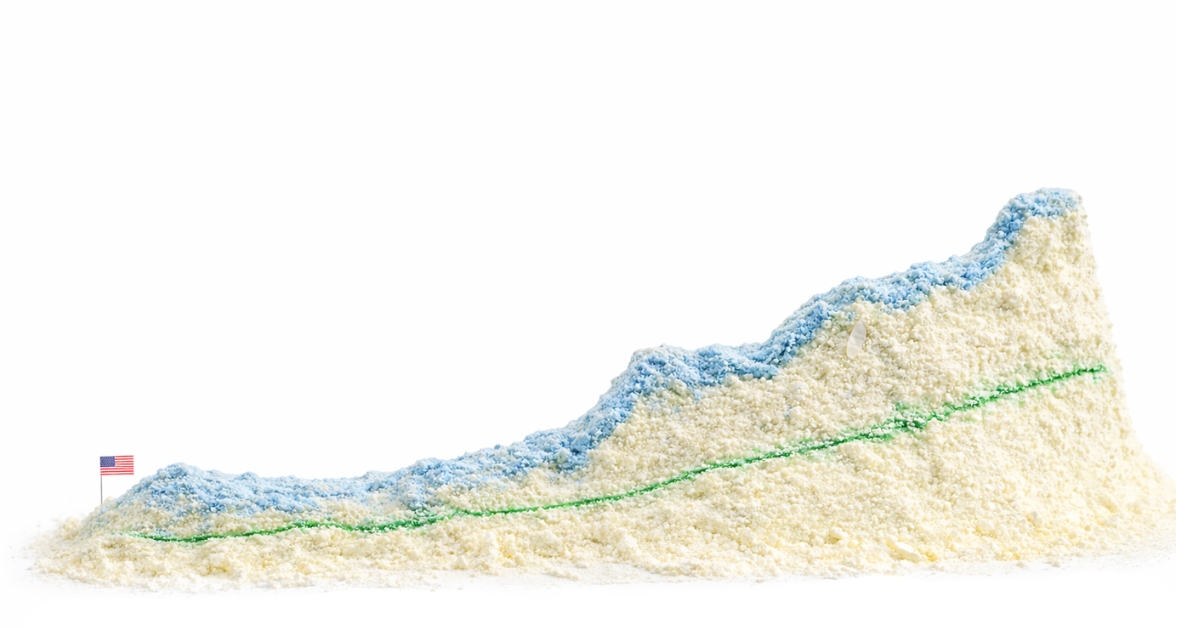
US milk production was up 3.2% in January 2026, herds were at their largest since the early 1990s, cream was cheap, milk was flowing freely across every region, and NFDM prices doubled. From $1.11/lb in Q4 2025 to over $2/lb by April 2026, the rally pushed NFDM to its highest level in 12 years, higher than butter, higher than anyone in the market had modeled.
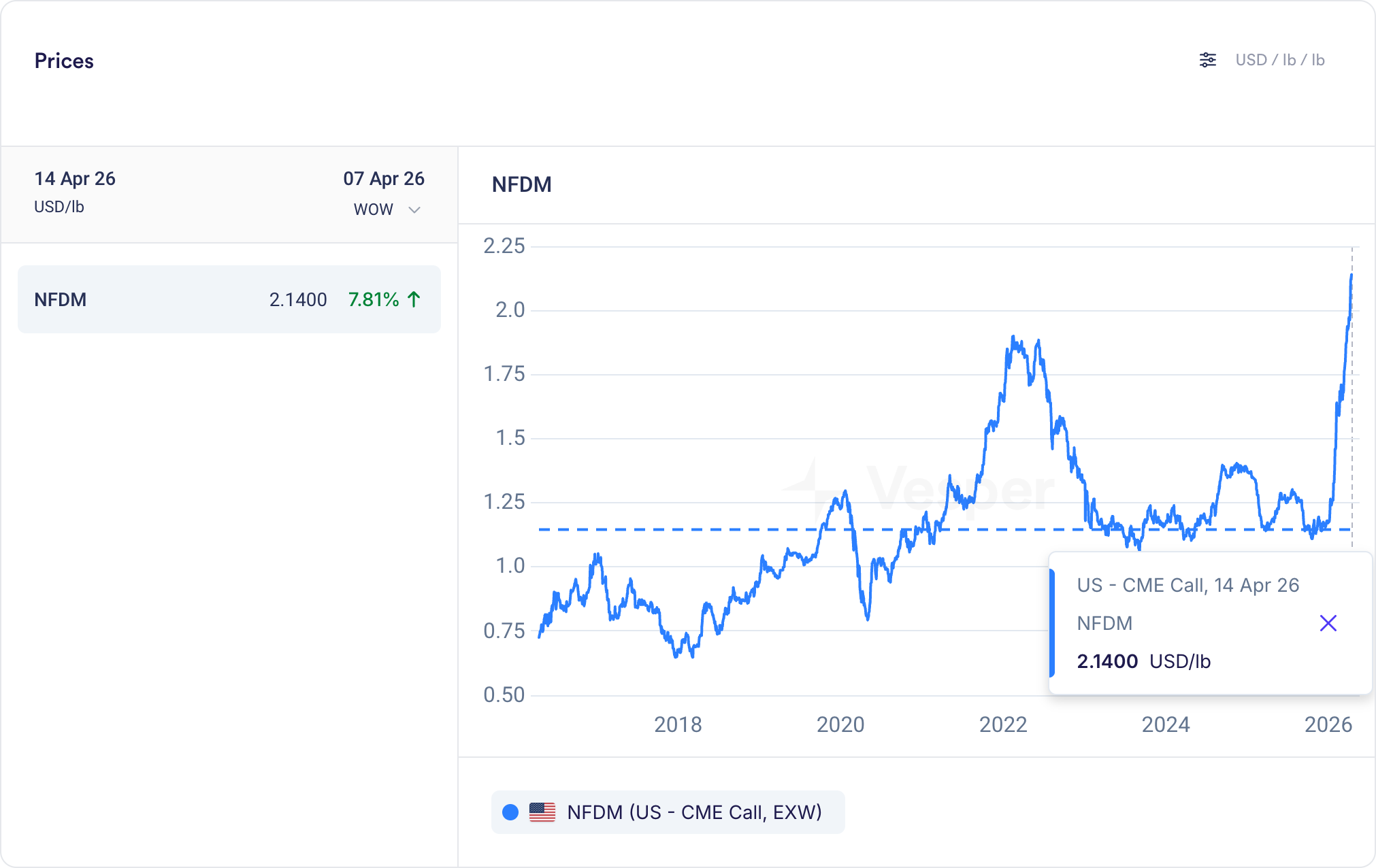
NFDM prices according to CME call in USD/lb
The counterintuitive part: there was no shortage of milk. There was a shortage of willingness to turn it into powder. This is the story of how plenty of milk produced almost no NFDM, and what that did to prices.
Why processors stopped making powder
The NFDM rally didn’t start with a demand shock or a supply disruption in the traditional sense. It started with processors deciding, one by one, that NFDM wasn’t worth making.
Through 2025, every alternative paid better. WPC80 hit $10.50/lb, making whey protein the most lucrative use of the milk stream. Cheese margins, supported by whey protein byproduct revenues, kept cheese plants running full. MPC production had surged 52.61% in 2024 as the higher-value protein alternative. NFDM, sitting between $1.11 and $1.40/lb while EU SMP undercut US pricing and the strong dollar made exports harder, was the lowest-margin option on the board.
So processors rotated away from it. Not all at once, but steadily. NFDM production had been declining since 2022, and the shift accelerated through 2025 as higher-value products pulled milk in every other direction. By Q4 2025, NFDM output had quietly dropped well below expectations, with November numbers coming in remarkably low. Nobody panicked because the assumption was that production would catch up when it needed to.
It didn’t.
The short squeeze that lit the fuse
When Q4 production data confirmed just how little NFDM had been made, the market broke.
Several contracts couldn’t be honored. Traders and buyers who had been counting on those volumes went back to the market looking for product that wasn’t there. Two Global Dairy Trade auctions in January, on the 6th and the 20th, concentrated Chinese, Middle Eastern, and Southeast Asian demand into events where not much was on offer, pushing NZ prices to the $2,600/mt range and pulling European and US prices along.
Those caught short scrambled to cover positions, triggering aggressive buying across both NFDM and SMP. In a market with thin liquidity and few sellers, every bid cleaned the board. NFDM gained 30% in January alone. By early February it had posted another 30% on top of that.
The fundamental question was how much of this was real tightness versus sentiment, because milk was running plentiful and skimmed milk was cheap, yet processors kept choosing to send that milk elsewhere. NFDM+SMP combined production was down 1.3% year-over-year in January 2026, and MPC production dropped 11.8%, meaning neither product was picking up the slack. The rotation away from commodity powders toward higher-value proteins, with WPC80 production jumping 12.2%, was accelerating even as prices surged.
Three tight markets at once
In most years, at least one of the three major producing regions has surplus powder. If the US is tight, Europe or New Zealand fills the gap. If NZ is in its seasonal wind-down, the US and EU pick up the slack. That’s what keeps NFDM as one of the most globally commoditized dairy products.
In early 2026, all three were simultaneously tighter than expected. NZ was in its seasonal wind-down with limited volumes available. European SMP stocks sat lower than anticipated after strong 2025 exports. And US production was falling for the structural reasons already described. Three tight markets reinforced each other instead of offering alternatives. Oceania prices climbed on strong Chinese and broader Asian demand, European tightness removed the usual safety valve, and the US kept surging.
By mid-March, NFDM hit $1.765/lb, a 59% increase from Q4 2025. By late March it reached $1.9375/lb, the highest since 2014 and, for the first time, more expensive than butter. In the first week of April it touched $1.9725/lb before finally breaking through $2/lb by mid-April, short-squeezed above the line on the CME Call as supply ran very short and buyers were still caught on the wrong side of volumes they needed.
The decoupling that broke every historical pattern
The most unusual feature of this rally wasn’t the price level but the spread between the US and the rest of the world. In 227 weeks of data, only three times had any region held a meaningful premium to the group average for more than a couple of weeks. The longest was an 8-week US premium in late 2024, peaking at $0.114/lb above the three-region average, and within a month of that peak the spread was back to zero.
By early April 2026, the US NFDM premium to the three-region average hit $0.31/lb, nearly three times larger than any prior decoupling, and it had been widening for six consecutive weeks. Through February and into early March, EU and NZ prices appeared to rally in sympathy with the US, but that stopped over the final weeks of March as both flattened while the US kept climbing. The sympathy rally was exactly that: sympathy, not fundamentals.
The reason this decoupling was different: domestic constraints were absorbing the supply that would otherwise compete globally. Processors were choosing fresh products, cheese, and whey proteins over powder. The US wasn’t just tight relative to global markets. It was tight because the production mix had structurally shifted away from NFDM, and that shift was unique to the US market.
Geopolitics and energy poured fuel on the fire
On March 1, a joint US and Israeli military operation against Iran sent commodity markets into turmoil. Oil surged with crude briefly touching $118/barrel before pulling back and then climbing back above $110/barrel, while European Forties Blend reached $140/barrel. Roughly 20% of global oil supply originates from the affected region.
For dairy, the flight to safety meant buyers secured supply first and asked questions later. NFDM, already the tightest dairy market in the US, absorbed the additional uncertainty without flinching. The US Weekly noted that putting SMP and crude oil in the same price comparison chart “only amplifies the fact that commodity markets can react to similar things, no matter the type of commodity.”
The Fed revised its 2026 inflation forecast to 2.7% and the ECB projected 2.6%, with energy costs trickling through every supply chain. Higher oil prices feed directly into fertilizer, logistics, and processing costs, and the general flight to safety in commodities added a risk premium on top of fundamentals that were already stretched.
Currency played a role too. The US dollar had weakened significantly in late 2025 and early 2026 with EUR/USD touching 1.20 in January before falling back. A weaker dollar normally should have pressured NFDM prices lower by improving the export picture, but instead it contributed to higher domestic prices while European and NZ exporters benefited from favorable exchange rates.
The math that explains the paradox
US milk production was up 3.2% year-over-year in January 2026 and February came in at 2.87%, with herds expanded to 9.58 million cows, the largest since the early 1990s. All that extra milk went somewhere: butter production was up 6.0% year-over-year in January, cheese was up 4.7%, WPC80 jumped 12.2%, and dry whey gained 7.5%. NFDM+SMP fell 1.3%.
The milk wasn’t missing. It was being routed away from powder. Fresh and Class II products claimed priority, cheese operations kept expanding, and MPC took some of the skim, though even MPC production dropped 11.8%, suggesting the skim wasn’t finding any commodity home at all.
Only about 10% of the total milk pool goes into commodities, which means that when milk production rises 3%, that additional volume is disproportionately large relative to the commodity segment. But when processors actively choose not to make NFDM with that additional milk, the surplus never reaches the powder market. Plenty of milk, no powder.
CME futures told an interesting story even at $2/lb: the forward curve didn’t reach $2/lb for May contracts, meaning the market was pricing the squeeze as temporary even as it kept getting squeezed. Whether that bet pays off depends on whether the structural forces that created the rally, production rotation, byproduct economics, and global synchronization, reverse or persist.
What this means for procurement teams
The NFDM rally of early 2026 challenges standard commodity thinking in several ways.
Production data alone doesn’t predict price. Milk production was at record highs and total dairy output was growing, but the product mix had shifted so far away from NFDM that aggregate supply numbers were irrelevant to the powder market. Tracking total milk production without tracking where that milk goes creates blind spots.
Byproduct economics drive allocation decisions. When whey protein prices make cheese production profitable regardless of cheese prices, processors choose cheese. When MPC margins beat NFDM margins, processors choose MPC. The lowest-margin commodity gets whatever milk is left over, and in a market where alternatives pay better, “left over” can be very little.
Short squeezes don’t need shortages. The absolute supply of NFDM wasn’t catastrophically low, but it was lower than buyers had contracted for. In a thin market, the gap between “slightly short” and “squeeze” is small, and several unfulfilled contracts were enough to trigger aggressive buying that moved prices 30% in a month.
Global decoupling is rare but real. NFDM is the most commoditized dairy product globally, and decoupling between regions almost never lasts. The early 2026 US premium was three times larger than any prior episode, and for procurement teams who priced NFDM based on global SMP benchmarks, the disconnect was painful.
Geopolitical risk compounds commodity tightness. The Middle East conflict didn’t cause the NFDM rally, but it accelerated it. Higher energy costs, supply chain uncertainty, and a general flight to safety in commodities all added fuel to a market that was already running hot.
What’s next for US NFDM?
The US NFDM market moves fast. Every week, new production data, trade flows, and global SMP pricing reshape the picture.
Our US Weekly covers all of it: NFDM, cheese, butter, whey, milk production, and the global forces pulling US dairy prices in every direction. Written by Vesper’s dairy team, delivered to your inbox every Friday.