


GLP-1 drugs are everywhere right now.
All food stakeholders keep a close eye on them. And if you’re a buyer, seller, or trader of agricultural commodities, you’ve probably been asked the same question more than once:
“What does this actually mean for demand?”
The thing is, most articles on this topic reference the same handful of studies. You’ll see the same data points pop up across dozens of different pieces, often without much context around the full picture.
We wanted to bring it all together.
We went through every major piece of research published on GLP-1s and their impact on food consumption, purchasing behavior, and commodity demand. Then we organized it all in one place so you can see the full picture and draw your own conclusions.
Here’s what the data actually says.
Every study we reviewed, in one table
Before we dig into the details, here’s a summary of every study we reviewed, what it measured, and the key takeaway.
| Study | Published | What it measured | Key finding | Commodity relevance |
| farmdoc daily (University of Illinois) | Mar 2025 | Consumer expectations about GLP-1 economic impact | Consumers who use or plan to use GLP-1s expect significant changes across the food supply chain. | All categories: signals broad demand shifts ahead. |
| ScienceDirect – Food Preferences (Appetite journal) | 2025 | Survey of current, former, and potential GLP-1 users | Users cut 720–990 calories per day. Biggest reductions: processed foods, sugary drinks, refined grains, and beef. | Sugar, grains, beef: direct downward pressure. |
| ScienceDirect – Protein Demand (Food Policy journal) | 2025 | How GLP-1 use affects willingness-to-pay for protein | GLP-1 users show higher willingness-to-pay for protein products. Price elasticities become up to 0.22 more inelastic. | Dairy, whey, meat: rising demand and less price sensitivity. |
| Wells Fargo Agri-Food Institute (with NielsenIQ) | 2025 | Grocery purchase patterns by GLP-1 use case | New weight-loss users initially spent 22% more at grocery stores. Health & beauty, non-alcoholic beverages, and energy drinks saw biggest gains. | Fresh produce, dairy, fruits: strong volume gains. |
| AIFI (American International Foods) | Oct 2025 | GLP-1 market size and food industry implications | GLP-1 weight-loss market: $20.86B in 2025, expected to reach $48.84B by 2030 (CAGR ~18.5%). | All categories: market scale confirms this is not a passing trend. |
| Circana (Sally Lyons Wyatt) | Nov 2025 | US household purchase data from GLP-1 users | GLP-1 households (23% of US) projected to represent 35% of all food & beverage units sold by 2030. | Sugar, snacks: declining. Protein, fiber, fresh produce: growing. |
| JAMA Network Open (Sørensen et al.) | Jan 2026 | Actual supermarket receipt data from 1,177 Danish consumers | After starting GLP-1s: energy density, sugar, and carbs dropped. Protein rose. Clear shift from ultraprocessed to unprocessed foods. | Sugar, vegetable oils (saturated fats): modest decline. Dairy protein: upside. |
| ING Think (Thijs Geijer, Diederik Stadig) | Mar 2026 | Impact of GLP-1s on European food demand | Current EU impact is ~0.25% of total calorie demand. Could reach 2.5–3.5% by 2030 in a high-adoption scenario. | Snacks, confectionery, alcohol most exposed. Grains and dairy more resilient. |
| Acosta Group | Apr 2026 | Shopping and lifestyle changes among 2,117 US adults | 55% buy more fresh produce. 32% more yogurt. 31% more fresh chicken. 30% more protein shakes. | Dairy (yogurt, whey), poultry, fresh produce: clear beneficiaries. |
What people actually eat changes. Here’s how.
Multiple studies now confirm the same pattern: GLP-1 users don’t just eat less. They eat differently.
The JAMA Network Open study is particularly interesting because it used actual supermarket receipt data rather than self-reported surveys. After starting GLP-1 medication, Danish consumers purchased foods with less sugar, fewer carbohydrates, and less saturated fat per 100 grams. Protein content per 100 grams went up.
At the same time, the share of ultraprocessed foods in their baskets dropped, replaced by unprocessed and minimally processed items.
The ScienceDirect food preferences study found a similar pattern through a different lens. GLP-1 users reduced their daily intake by 720 to 990 calories. The biggest drops were in processed foods, sugar-sweetened beverages, refined grains, and beef.
And here’s what makes this relevant for commodity markets: these changes aren’t just about eating less. They’re about eating different things.
The protein effect
One study deserves special attention if you’re in the protein or dairy space.
The ScienceDirect protein demand study (published in Food Policy) found that GLP-1 users show a higher willingness-to-pay for protein products across the board. Their price elasticities become up to 0.22 more inelastic, meaning they’re less sensitive to price increases on protein.
This has direct implications for dairy, meat, and plant-based protein markets.
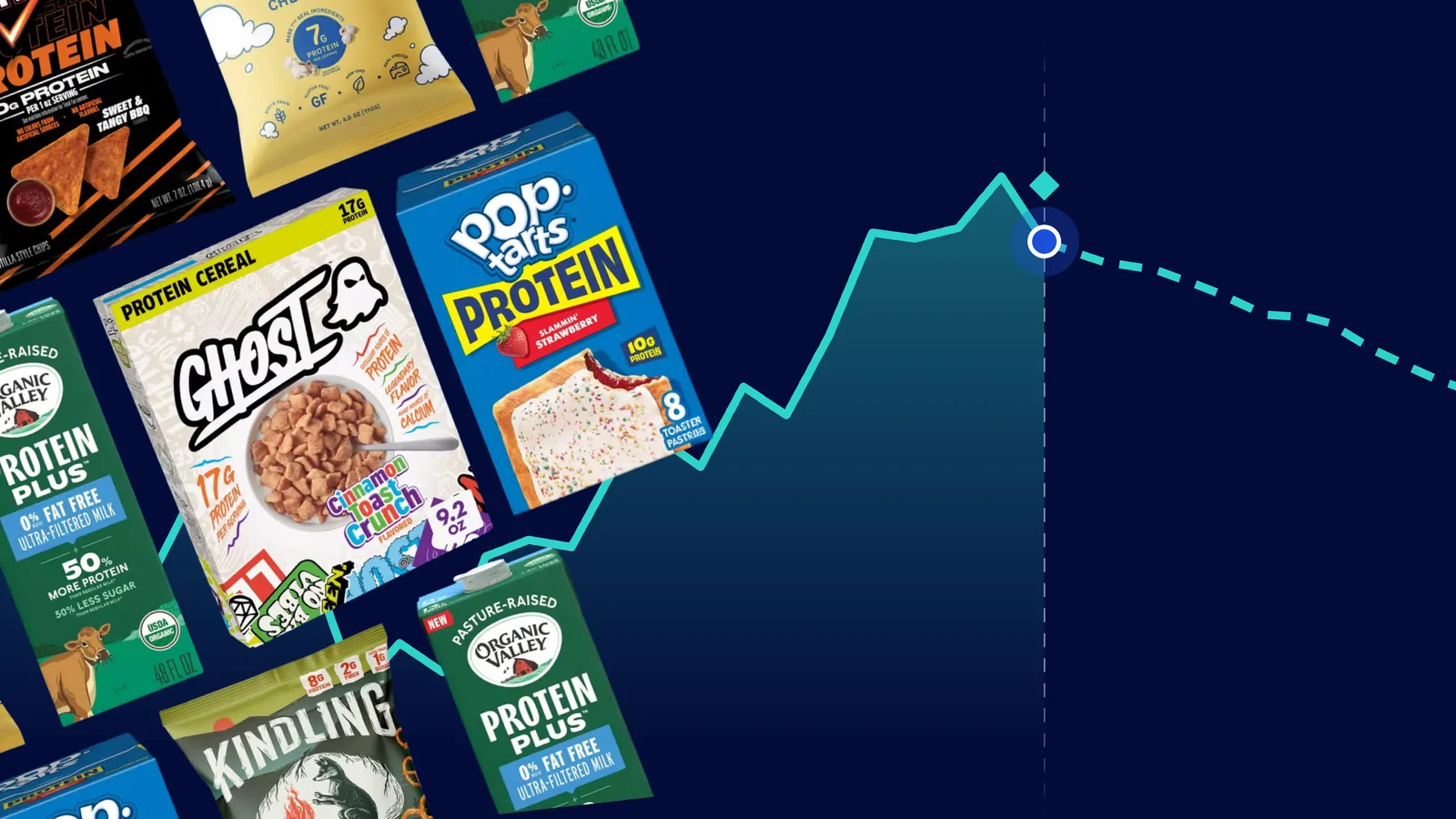
The Acosta Group data backs this up with purchase behavior: 32% of GLP-1 users say they’re buying more yogurt, 31% more fresh chicken, and 30% more protein shakes and powders.
Meanwhile, Wells Fargo’s research with NielsenIQ found that categories like avocados (+198%), kiwi (+74%), and frozen fruit saw large gains among GLP-1 weight-loss users. Fresh meat was up 15%, cheese up 16%, and milk products up 17%.
If you’re trading or sourcing dairy ingredients, whey protein, or fresh produce, this is a demand signal worth watching.
The scale: how big is this, really?
Here’s where it gets interesting for anyone trying to forecast demand.
Right now, the impact is relatively small. ING estimates that with roughly 2% of EU adults using GLP-1s, the total impact on European calorie demand is about 0.25%. That’s not a number that keeps food manufacturers up at night.
But the trajectory matters.
Circana found that GLP-1 households already account for 23% of all US households. By 2030, they project these households will represent 35% of all food and beverage units sold. That’s not a niche market.
The GLP-1 weight-loss drug market itself is growing at a CAGR of roughly 18.5%, from $20.86 billion in 2025 to a projected $48.84 billion by 2030 (per AIFI, citing Grand View Research).
And ING estimates the broader GLP-1 market (including diabetes treatment) will hit $100 billion by end of 2027.
Three factors will accelerate adoption further:
Oral medications. The GLP-1 market will shift from injectable to oral in the US (2026) and Europe (2027). That means prices drop by up to 50% and convenience goes up.
More competition. New pharmaceutical companies are launching their own GLP-1 drugs, creating price pressure.
Government reimbursement. If sustained weight loss proves to reduce healthcare costs, more European governments may cover the drugs for a wider population.
ING’s four scenarios for food demand by 2030
ING proposed a useful framework for thinking about where this goes. They built four scenarios based on two dimensions: how long the weight-loss effect lasts and how concentrated the dietary shifts are across categories.
In their most transformative scenario, calorie intake could drop by 2.5–3.5% across Europe by 2030, with significantly higher percentages for the most affected categories (snacks, confectionery, alcohol).
In their most conservative scenario, usage stays limited to the most pressing medical cases and the impact on food demand remains minimal.
The reality, ING argues, will likely be a combination across different European countries. Because each market has a different healthcare system, different obesity rates, and different government appetite for drug reimbursement.
For commodity buyers and sellers, this means the impact won’t be uniform. It will vary by geography, by category, and by time horizon.
People cycle on and off
One pattern that keeps showing up across studies: GLP-1 usage isn’t permanent for most people.
About 50% of users discontinue within the first year, according to research cited by both ING and Circana. Reasons include cost, side effects, or reaching a target weight.
But here’s the nuance: 50% of previous users say they’re likely to restart the medication in the future (Circana). And some behavior changes stick even after stopping. Circana found sustained growth in produce, personal care, and household purchases after discontinuation, even as purchases of beverages and frozen foods rebounded.
For food companies and ingredient suppliers, this creates a fluctuating demand pattern rather than a one-directional decline. Consumers cycle on and off the drugs, and their baskets shift accordingly.
What this means if you buy, sell, or trade commodities
The research is consistent on a few things:
GLP-1 users eat less overall, but they shift what they eat toward protein, fiber, fresh produce, and minimally processed foods. They move away from sugar, refined carbs, processed snacks, and (to some extent) beef.
For sugar traders, this adds another variable to consumption forecasts in North America and Europe. Some traders have already adjusted their numbers downward.
For dairy, the picture is more positive. Protein demand is growing among GLP-1 users, and willingness-to-pay is rising. Yogurt, cheese, and whey-based products are direct beneficiaries (see our dedicated look at GLP-1’s impact on dairy protein pricing).
For grains, the effect depends on the product. Refined grains face headwinds. Whole grains and fiber-rich products may benefit.
For meat and poultry, the picture is split. Beef consumption drops among GLP-1 users, but fresh chicken is one of the top gainers. Acosta found 31% of users buying more fresh chicken, and Wells Fargo saw fresh meat up 15% overall. The shift is away from red and processed meat, toward lean protein.
For fresh produce, the signal is strong. Multiple studies show GLP-1 users loading up on fruits and vegetables. Acosta reports 55% buying more fresh produce, and Wells Fargo found avocados up 198% and kiwi up 74% among weight-loss users.
For snacks, confectionery, and alcohol, the outlook is tougher. ING identifies these as the most exposed categories. GLP-1 users consistently move away from processed snacks and sugary treats, and multiple studies flag reduced alcohol consumption.
For oils and fats, the data is less clear-cut. Saturated fat purchases decline modestly, but total fat consumption changes are smaller than sugar or carb changes.
The bottom line: the impact is real, it’s growing, and it’s category-specific. The studies disagree on speed and scale, but they agree on direction.
Whether you’re building a budget for next year or evaluating a long-term sourcing strategy, GLP-1 adoption is now a variable you need to factor in.
For a look at how food manufacturers are already responding to these shifts, see our company-by-company breakdown.
Want to stay ahead of how GLP-1 adoption is shaping agricultural prices?
Vesper tracks the commodities most affected, from dairy and sugar to grains and oils, with real-time price benchmarks, AI-driven forecasts, and expert analysis.