US butter production was up 5.68% in 2025, adding 27 million extra pounds to the market. January 2026 pushed the pace even higher at 6.0% year-over-year with output reaching 231 million pounds. Record production, record milkfat yields, cheap cream, every incentive to stock up. And yet by January 2026, cold storage showed butter stocks 17% below the prior year.
This shouldn’t happen. When you produce more of something, you should have more of it sitting in storage, unless someone is taking it faster than you can make it.

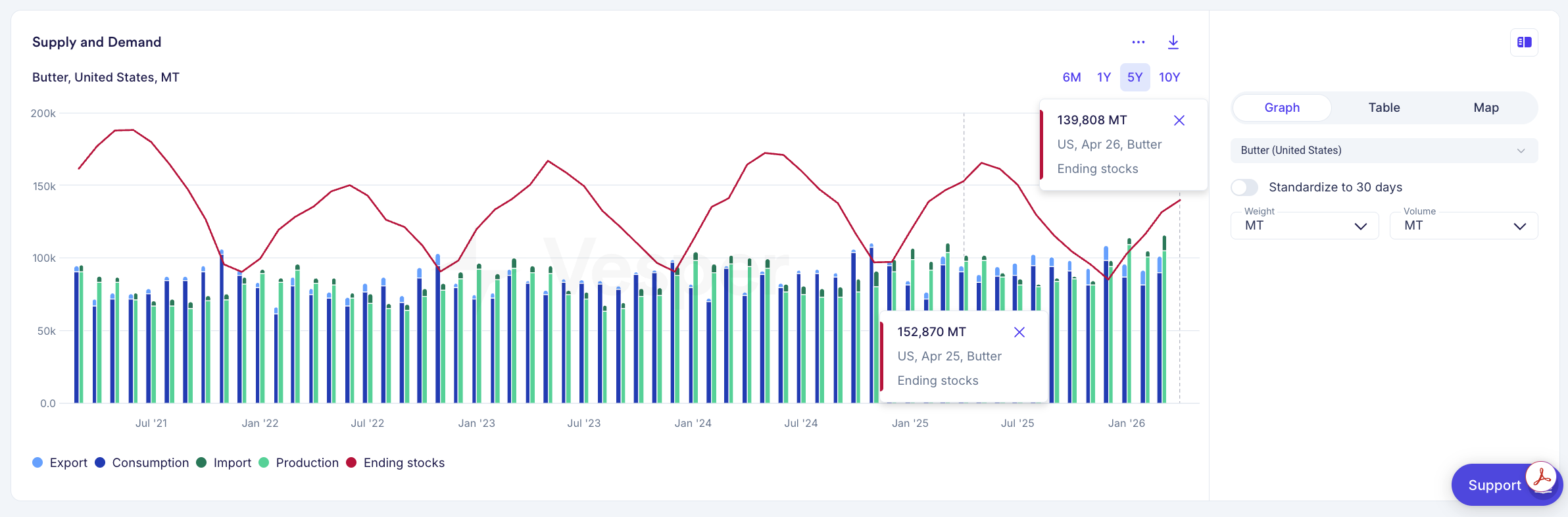
US Butter stocks over the past 5 years in lb
That’s the story of US butter in 2025 and early 2026. Domestic consumption surged at lower price points, an entirely new export channel opened up as US butter became the cheapest in the world, and a government purchasing program added volume on top.
Each force alone was manageable. Together, they drained every extra pound faster than processors could churn it.
The demand that outran record supply
The setup in early 2025 looked straightforward. Milkfat production on US farms was running well ahead of milk volume, about two percentage points faster through the year, and cream was so abundant that cream multiples dropped to levels making butter one of the most attractive processing options available. Intra-state cream trade opened up because price incentives were strong enough to justify the shipments, and butter processors churned hard. By February, cold storage showed stocks up 9% year-over-year. More cream goes in, more butter comes out, stocks build through spring, comfortable cushion for summer. That was the assumption.
What the assumption missed was that lower prices would unlock demand on two fronts simultaneously. Domestically, American butter consumption had been rising for years, and 2025 accelerated the trend as lower prices meant more butter in shopping carts, restaurant kitchens, and food manufacturing formulations. From April onwards, butter stocks were lower year-over-year every single month, even as production kept growing. When milkfat production was up 5.52% year-over-year in June and butter production was up as well and stocks still drew down, the math was clear: demand was absorbing everything and then some.
The second front was international, and nobody saw it coming.
How the US became the world’s cheapest butter
US butter had long been a domestic-first product. The US was traditionally a net importer, not a net exporter, and global buyers knew Kerrygold, NZ butter, and European brands while US butter wasn’t on their radar. The product was the “wrong color.” It didn’t suit international tastes. Those were the accepted truths.
Then US prices fell far enough that none of that mattered. Through 2025, US butter became not just competitive but the cheapest in the world, and that price advantage opened doors that had been closed for decades. Butterfat exports hit all-time highs in both November and December 2025 with annual shipments surging 166% compared to 2024.
The destination data told the real story. Canada remained the largest buyer by value at $210 million year-to-date, up 48% year-over-year, but the new markets were the surprise: Saudi Arabia climbed to the number two spot with year-to-date value up over 5,400%, the Netherlands showed up at nearly 399,000% growth from a near-zero base, and Bahrain was up 1,788%. This wasn’t incremental growth from existing partners. This was US butter finding entirely new markets across the Middle East, Europe, and Oceania, proving that the conventional wisdom about US butter melts the moment the price is right.
The January through May period alone showed 25 million additional pounds of butter exports versus the prior year, more than enough to explain the stock deficit, which measured only about 10 million pounds lower in ending stocks over the same period. The extra export volume, by itself, more than accounted for the shortfall.
Government buying at the worst possible time
In late February 2026, the USDA announced purchases under Section 32 totaling $263 million across dairy and agricultural products, with butter receiving $75 million, cheddar and cheese products getting $32.5 million, and Swiss cheese, fresh milk, and UHT milk making up the rest.
These volumes flow to food banks and nutrition assistance programs, representing real demand being added to a market already short on offers. The Section 32 purchases helped people who couldn’t afford dairy products, but they also tightened a market that was already tighter than anyone expected. Coming on top of the -17% stock deficit that had just been reported on February 27, the USDA buying program pushed butter prices sharply higher through late February and into March.
By early March, butter briefly broke $2/lb again as three forces converged in a single week: the cold storage shock pushing sidelined buyers back in, the annual “new crop” cutoff tightening eligible supply for the CME Call, and the Middle East conflict triggering a wave of geopolitical buying across all commodities. Within days prices retreated as cream multiples stayed low and the US dollar strengthened, but the message was clear: the deficit wasn’t theoretical, it was pricing.
Not all milkfat went into butter
One piece of the puzzle that production data alone can’t capture: butter wasn’t the only product competing for cheap cream. Ice cream, cream cheese, anhydrous milkfat, and other milkfat products all pulled from the same abundant cream supply. Butter production grew, but it was sharing the cream pool with every other milkfat product whose margins justified running.
Cold storage isn’t managed like a warehouse. It’s the residual after production, consumption, and exports, and as the US Weekly observed: “Butter production is surely up again… When the supply is much higher than previous years and the stocks still decreased, we can only assume that the demand is off the charts this year.”
Through the second half of 2025, butter prices kept falling, dropping below $2/lb in September and sliding to multi-year lows by December, but the lower prices didn’t reduce demand. They increased it, both domestically and internationally. Global butter markets weakened alongside the US, but the US was falling faster, maintaining and even widening its competitive export advantage. The end-of-December cold storage report confirmed the trend: stocks down 7% year-over-year even at record production.
The problem with being the cheapest option in the world is that export volumes at this scale require continuing to be the cheapest option. The moment European or NZ butter prices drop to competitive levels, those new buyers have no loyalty. They found US butter on price, and they’ll leave on price.
What this means for procurement teams
The butter deficit teaches several lessons for teams buying dairy commodities.
Production growth doesn’t guarantee availability. Record production can coincide with tight stocks if demand is also growing, and tracking production without tracking consumption and exports creates a false sense of security.
New export channels can drain domestic supply fast. When a country goes from net importer to cost-competitive exporter, the adjustment is painful for domestic buyers as volume that used to stay home now leaves. The 166% surge in butterfat exports wasn’t gradual; it was a step change that opened entirely new trade routes in a single year.
Government programs add real demand. Section 32 purchases of $75 million in butter represent meaningful volume in a tight market, and these programs don’t respond to price signals. They buy at whatever the market offers.
Low prices don’t mean loose supply. Butter at $1.30/lb felt like a buyer’s market in early 2025, but by January 2026 the same low prices had attracted so much demand that stocks were 17% below prior-year levels. The cheapest commodity in the world still needs a buyer, and when it gets enough of them, it stops being cheap.
What’s next for US butter?
The US butter market moves fast. Every week, new cold storage data, production figures, export volumes, and cream pricing reshape the picture.
Our US Weekly covers all of it: butter, cheese, whey, NFDM, milk production, and the global forces pulling US dairy prices in every direction. Written by Vesper’s dairy team, delivered to your inbox every Friday.