A US food or feed buyer locking a forward wheat-flour contract this week, building a 2027 Class III milk budget, or renegotiating a beef cutout reset clause has the same problem in front of them. The USDA price they reference is reliable, transparent, and baked into the contract. It is also, by construction, looking backward. The latest published USDA wheat survey is from February. The latest announced Class III price covers last month. Yesterday’s cutout updates this morning, but the trades that will move it tomorrow are not in the data yet.
This article is about the layer procurement managers add on top of USDA data to close that gap: an AI price forecast on the same USDA series, with a published accuracy track record and a forward path running through the next year. USDA wheat is the worked example throughout, and the article closes with a practical view of how procurement managers use the forecasts in negotiations, budgets, and forward contracts.
Why USDA prices anchor US procurement
USDA price data is open source, authoritative, and embedded in almost every US food and feed contract. Anyone can read the reports, download the underlying numbers, and use the prices in contracts and analysis without paying for access. That openness is one of the reasons USDA series sit at the center of so many procurement workflows; both sides of any negotiation can verify the same number from the same authoritative source.
The data lives across multiple sub-agencies inside the department:
- AMS (Agricultural Marketing Service) publishes daily and weekly cash market reports, the Daily Boxed Beef Cutout, the Daily Pork Report, and the FMMO announced Class prices for milk
- NASS (National Agricultural Statistics Service) runs the Quick Stats data tool and publishes the monthly producer surveys, including the wheat price farmers receive
- FAS (Foreign Agricultural Service) publishes weekly Export Sales reports and Global Agricultural Information Network (GAIN) reports covering international markets
Each agency publishes on its own schedule, in its own format, on its own page. Reports arrive as PDFs, web tables, MyMarketNews API feeds, and CSV or spreadsheet downloads from Quick Stats. A buyer who tracks twelve USDA series across dairy, beef, pork, grains, and feed is reconciling twelve separate sources.
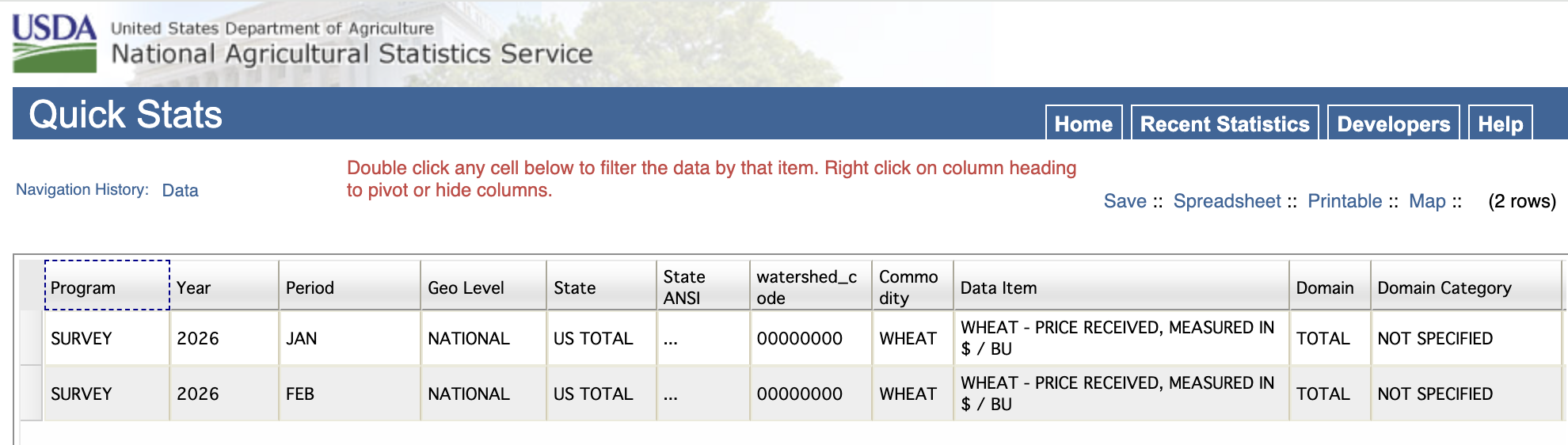
Sample USDA Quick Stats wheat price table, US national
The USDA Quick Stats wheat survey shows what USDA price publication actually looks like. Each row reports the national price farmers received for a specific commodity in a specific period, in standardized units ($ per bushel for wheat). The numbers come from monthly producer surveys validated by NASS and made available through the Quick Stats interface, the MyMarketNews API, and as CSV exports. The format is purposeful: tabular, time-stamped, traceable to the program that produced it. The format is also static, with no chart, no forward view, and limited historical depth on most pages.
The gap a USDA report alone leaves
USDA reports are records of trades that have already cleared. That makes them excellent as a settlement reference and leaves four predictable gaps when a procurement manager tries to use them for forward decisions:
- Where the price is going is a forward-looking question the USDA report does not answer. The monthly wheat survey tells you what happened last month.
- Your delivered cost is the USDA reference plus or minus a basis that reflects freight, regional supply, processor margins, and timing.
- What is happening between releases is invisible. When the most recent USDA wheat print is from February and today is late April, there is no continuously updated USDA reference for the weeks in between.
- Whether the current price is a good buy is a question of context. A $5.12/bushel wheat number is information; whether that is cheap, fair, or expensive against the underlying fundamentals is a separate question the report does not answer.
Each gap has a different fix. The most useful fix, and the one most procurement managers reach for first, is a price forecast on the same USDA series.
How a Vesper forecast on USDA data works
A Vesper price forecast is an AI model trained on the historical USDA series, fundamentals (supply, demand, stocks, weather, trade flows), and macro inputs. The model returns a forward path with a confidence band and a published two-year accuracy track record for each forecast horizon.
Three elements make the forecast useful for a procurement manager.
A continuous chart. Vesper renders the USDA series as a line that includes multiple years of historical prices, today’s most recent value, and the dashed forecast line continuing past today’s date for the next year. Historical, current, and forecasted prices in one view, instead of toggling between USDA pages to assemble the picture manually.
A measured accuracy record. Each forecast publishes its accuracy from the last two years at the one-month, three-month, six-month, and twelve-month horizons. The buyer reads the forecast with a clear sense of how much weight to put on it.
Continuous coverage that fills USDA’s gaps. The forecast extends past the last USDA print and updates between releases, so a procurement manager working with monthly USDA data has a running reference instead of a number that goes stale for weeks at a time.
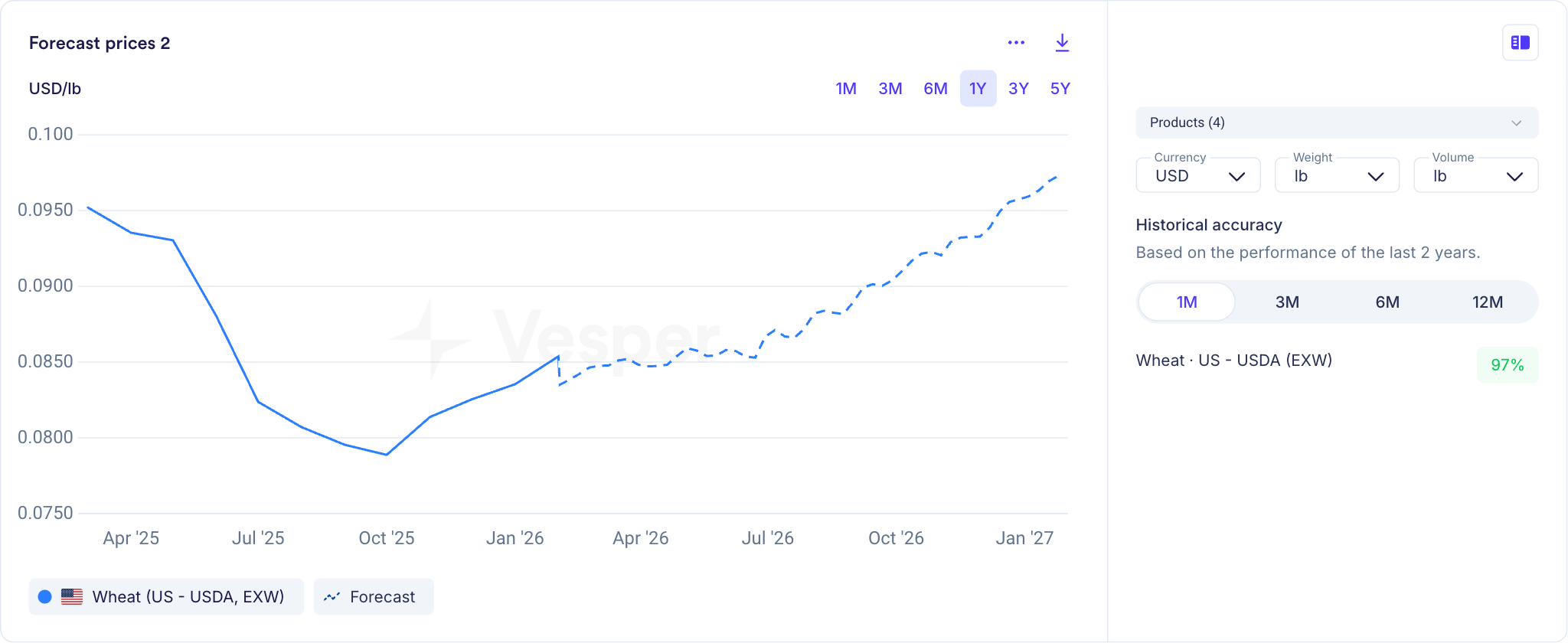
Vesper AI forecast for USDA wheat in USD/lb
Take USDA wheat as the worked example. The USDA publishes the national wheat price as a monthly NASS survey. As of late April 2026, the most recent Quick Stats print is February 2026 at $5.12 per bushel (about 0.0853 USD per pound). The next monthly print arrives in May.
The Vesper USDA wheat forecast plots the same series in USD per pound, from early 2025 through the most recent USDA print. A small marker at February 2026 shows both the actual USDA value (0.0853) and the Vesper historical prediction one month earlier (0.0835), a small gap that reflects the model’s expected accuracy of 97% based of historical accuracy patterns. The dashed line continues past February into a forward forecast running through April 2027.
Two things matter here for the procurement manager.
First, the forecast extends past today’s date. A buyer locking a forward wheat-flour contract has a credible cost number for delivery weeks or months from now. A modeled forecast with a measured accuracy track record is a defensible forward reference for finance, for forward-contract negotiations, and for budget commitments that USDA’s monthly survey alone cannot support.
Second, the forecast fills the data-delay gaps between USDA releases. When the most recent USDA wheat print is from February and today is late April, the model’s forward-running view is the only continuously updated reference a buyer has on the same USDA series. The combination of historical, current, and forecasted pricing in one chart turns a fragmented monthly survey into a continuous procurement signal that does not stop and start with the USDA’s release schedule.
What this means for procurement managers
The way to use Vesper forecasts on USDA data depends on the decision in front of the buyer.
For forward contracts and budgets, the Vesper forecast on the indexed USDA series gives the buyer a defensible cost number for delivery weeks or months ahead, with a confidence band and a measured accuracy record that hold up in front of finance. A 12-month wheat budget built on the Vesper forecast is a different conversation with a CFO than a 12-month budget built on last February’s USDA survey.
For trigger and reset negotiations, the buyer entering a contract with a USDA-indexed reset clause uses the forecast to evaluate where the threshold is likely to be crossed and on whose terms. The forecast gives the buyer the same kind of forward intelligence the supplier may already have through their own analyst desk.
For anticipating monthly Class III and Class IV announcements, the buyer reads the Vesper forecast on the same USDA-announced series to see where the next monthly announcement is likely to land, weeks before USDA publishes it. A dairy ingredient buyer waiting on the next Class III print does not have to wait for the official release to start working with a credible number.
The forecast is the instrument that does the heaviest lifting in a procurement workflow. A USDA report read alone is a backward look. A forecast on top of the same series turns it into a forward-aware procurement decision.
Want a forward view on the USDA series your contracts already reference? Vesper publishes AI forecasts on all USDA benchmarks across dairy, meat, poultry, eggs, lamb, grains, oilseeds, feed ingredients, fresh produce, pulses, and sweeteners, with confidence bands, weekly expert analysis, and a price comparison widget for side-by-side benchmarking. Explore the platform.
Frequently asked questions
How accurate are Vesper’s forecasts on USDA data?
The Vesper USDA wheat forecast holds 97% historical accuracy at the one-month horizon, measured over the last two years. Accuracy for the rest of our USDA coverage (dairy class prices, beef cutouts, pork cuts, fresh produce, forage, and others) is published on the platform alongside each forecast and is available on request. Several of our long-range USDA forecasts hold above 90% accuracy at the twelve-month horizon, which is unusual in commodity forecasting at that horizon.
How does a Vesper forecast on USDA data differ from a USDA outlook report?
USDA’s Economic Research Service (ERS) publishes outlook reports (Wheat Outlook, Livestock Outlook, and others) with qualitative analysis and projections from staff economists. A Vesper forecast is a quantitative AI model output with a continuously updated forward path, a confidence band, and a published accuracy track record for each forecast horizon. The two are complementary: an ERS outlook gives you the analytical narrative, the Vesper forecast gives you the modeled forward number you can use directly in a cost model or contract negotiation.
Why does my actual delivered price differ from the USDA reference?
USDA reports publish prices at specific points in the supply chain, not at your loading dock. Your delivered price is the USDA reference plus or minus a basis that reflects freight, regional supply and demand, processor margins, port premiums, and timing. The Vesper price comparison widget overlays USDA prices against other physical price benchmarks for side-by-side reading; we cover that in a separate article.
Can I integrate USDA data and Vesper forecasts into my internal tools?
Yes. Vesper supports data download, an API, and a Vesper for Excel integration, so the underlying USDA series and our forecasts on top of them can flow into your BI stack, contract pricing tools, or procurement dashboards.