


Every weekday at the late-morning auction in Chicago, dairy buyers across the US watch the same five-minute window. CME cheese blocks trade. CME cheese barrels trade. Butter, nonfat dry milk, and dry whey settle in turn. By 11:30 Central, the day’s CME spot call prices are set, and within hours those numbers are written into cheese contracts in Wisconsin, infant nutrition formulations in California, and ice cream programs in Texas.
In most procurement conversations we have had over the past year, dairy buyers tell us the same thing in different words: the spot call settle is the cleanest physical reference they have, and at the same time it is not enough on its own to commit a contract or a budget several months out. The settle answers what the market cleared at this morning. It does not answer where the market is heading.
This article walks through how the CME spot call works, how the data is published, where the format leaves a gap for procurement teams, and how Vesper visualizes the same daily settle alongside its forward forecast. It closes with a practical view of who in the US dairy industry uses these prices and when.
Where the CME call price comes from
The CME spot call session is a daily auction at the Chicago Mercantile Exchange where five physical dairy commodities trade for prompt delivery: cheese blocks (40 pounds), cheese barrels (500 pounds), Grade AA butter, nonfat dry milk, and sweet dry whey. Trading is conducted in short, structured windows for each product (typically a few minutes each) using a call format where buyers and sellers post bids and offers and the exchange clears trades at agreed prices. The settlement price for each commodity is the last cleared trade or, if no trades clear, the highest bid or lowest offer remaining at the close of the call.
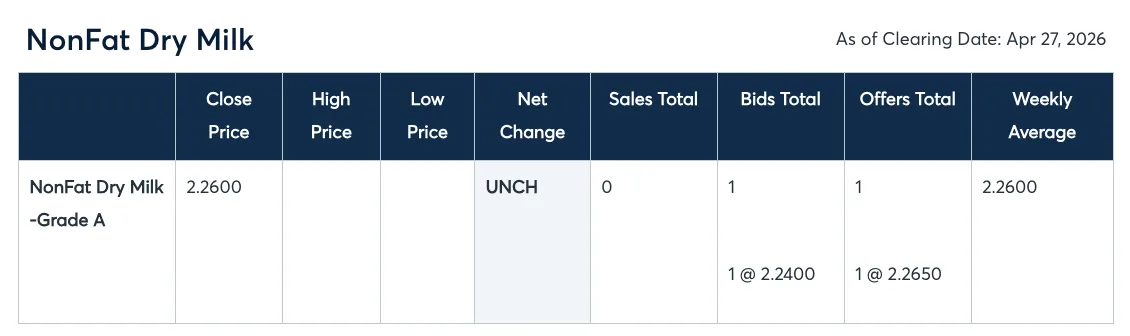
CME spot call session, daily price for NFDM on April 27, 2026.
Here is what a CME call price looks like in practice. The CME nonfat dry milk spot call publishes a single settlement number per trading day, with the volume of pounds traded and the bids and offers from the call window. Each daily settle is a clearing price for physical product that traded, or would have traded, that morning. It is not a forecast, not a long-run average, and not a derivative; it is a cash-market settlement on a small auction window, published the same morning.
That distinction shapes everything else. The CME call price tells you what the physical US dairy market cleared at this morning. It does not tell you where the market is going next.
CME publishes the table; Vesper renders the chart
CME Group publishes the daily spot call data on its website as a static table. For NFDM, the page displays a single row of cells: close price, high, low, net change, sales total, bids total with the bid price, offers total with the offer price, and weekly average. The current week’s table sits next to the previous week’s table for context, and that is the depth of historical view CME provides on its public spot call page. Anything older than the prior week requires pulling a separate historical archive.
Vesper takes the same daily CME spot call settle and renders it as a continuous chart, with multiple years of historical settles plotted as a line. A buyer using Vesper sees not just today’s price but the full trend of where it has been, and for any procurement question that depends on context, the chart answers in seconds what the CME tables answer only with hours of work. Is this price high or low for the time of year? Where did it sit last quarter? How does it compare with the previous protein cycle or the last export-driven move? All of those questions are visible at a glance on the Vesper chart.
The chart adds two more things on top of the historical visualization. The dashed line that continues past today’s date is the Vesper AI forecast for where the model expects the spot call settle to land over the following year. The accuracy panel on the right reports the model’s measured track record over the last two years, with a separate number for one-month, three-month, six-month, and twelve-month horizons. A reader sees the same daily CME spot call number, in the same physical units, but gets a context-rich, forward-aware view rather than a one-row table.
What CME call prices do tell you
They tell you today’s cleared physical price for US dairy. The CME spot call is one of the few daily, transparent, cleared-trade reference prices for physical US dairy commodities. When a contract calls for cheese, butter, NFDM, or dry whey at “CME spot,” it is referring to this number. When NDPSR weekly average prices are calculated, the CME spot call settles are one of the inputs.
They feed the formulas behind USDA Class prices. CME spot call settlements for cheese (blocks and barrels combined), butter, dry whey, and NFDM feed into the National Dairy Products Sales Report. The NDPSR in turn feeds the formulas that calculate the announced USDA Class III and Class IV milk prices, which set the regulated minimum that handlers must pay producers in each Federal Milk Marketing Order. The CME call price is the leading indicator for milk class prices that will not be officially announced until early in the following month.
They tell you intraday market sentiment. The size and direction of bids and offers in the call window, the volume of pounds that actually clear, and whether the price moves significantly between sessions are all readable signals. A cheese block call that opens with thin bids, no offers, and a small clear at a higher level is signaling something different from a call with heavy two-sided participation that clears at the prior day’s level.
They anchor physical contracts up and down the chain. A cheese co-manufacturer prices off CME blocks or barrels. A butter-heavy ice cream program references CME butter. A whey protein supplier anchors to CME dry whey. An infant nutrition formulation prices off a combination of NFDM and other ingredients tied to the CME call. Because these references are baked into contract pricing, a move in the CME call reaches downstream SKUs with a lag that depends on the contract structure.
What CME call prices do not tell you
Reading only the morning call settle is where dairy procurement runs into the limits of what a five-minute auction can actually do.
They don’t tell you where the price is going. The day’s cleared price reflects what the market cleared at this morning, given everything that participants currently knew. It does not tell you what next week will look like, let alone next quarter. A buyer pricing a 90-day forward butter contract against today’s CME call settle is implicitly assuming the market will not move materially over the contract life, or accepting upside and downside risk on the difference.
They don’t tell you your delivered cost. CME call prices settle for physical product at specified delivery points and in specified package formats (40-lb blocks, 500-lb barrels, etc.). The price your plant pays for cheese, butter, or NFDM is the CME call reference plus or minus freight, processor premium, package format adjustment, and regional supply premium. A move in the CME call does not translate one-for-one into a move in your invoice.
They don’t tell you how much volume sits behind the day’s price. A daily CME spot call may clear with a single car of cheese blocks, or it may clear with dozens. The settle is the same number on the screen either way, but a thinly traded call carries less informational weight than a heavily traded one. A buyer who reads only the price loses the volume context that is essential for interpreting whether today’s number is a strong signal or just a quiet day with a default carry-over.
They don’t tell you what is happening between calls. The CME spot call is a five-minute window per commodity per trading day. The other 23 hours and 55 minutes of the day, the physical US dairy market keeps moving, through direct trades, multi-truck deals, and forward bookings that never touch the CME call. Reading only the call settles means missing 99 percent of the actual trading that happens in the broader US dairy cash market.
They don’t tell you whether the current price is a good buy. A CME cheese block settle of $1.85 is information. Whether $1.85 is cheap, fair, or expensive against the underlying milk supply, cheese inventory, export demand, and forward Class III curve is a separate question, and the call settle itself does not answer it.
A spot call settles, it does not predict
The thread connecting the gaps above is simple. A CME spot call settle is the result of an auction, not a forward view of where the market is heading. A daily settle and a model-based forecast can both be plotted on the same chart, but they answer different questions, and pairing them tends to give dairy buyers their cleanest reading of the market.
The forward layer that pairs with the call
Dairy buyers operating against that gap have typically paired the spot call with an independent forward view on the same five commodities. Historically that view came from in-house dairy analysts, bank research desks, or a small set of dedicated consultancies. AI-driven modeling has reshaped the economics of that forward view in recent years, putting it within reach of more teams and, in the cheese, butter, NFDM, and whey series specifically, holding accuracy at levels most participants would not have predicted.
At Vesper, we publish AI forecasts on every CME spot call commodity (cheese blocks, cheese barrels, butter, NFDM, and dry whey) with confidence bands and published accuracy. We are not replacing the call settle; the forecast reads the same daily series and returns a model-based view of where the price is likely to land at the one-month and three-month marks.
Take the CME call NFDM as a worked example. Measured over the last two years, the Vesper CME NFDM forecast has held 95% accuracy at one month and 88% at three months. NFDM is a commodity that moves on a combination of US milk production, cheese-versus-powder yield economics, export demand from Mexico and Southeast Asia, and macro signals like the dollar. Holding 95% accuracy at one month and 88% at three months on a series with that many moving parts is unusual, and it is why we point US dairy ingredient buyers to the NFDM forecast first when they ask how accurate our work really is.
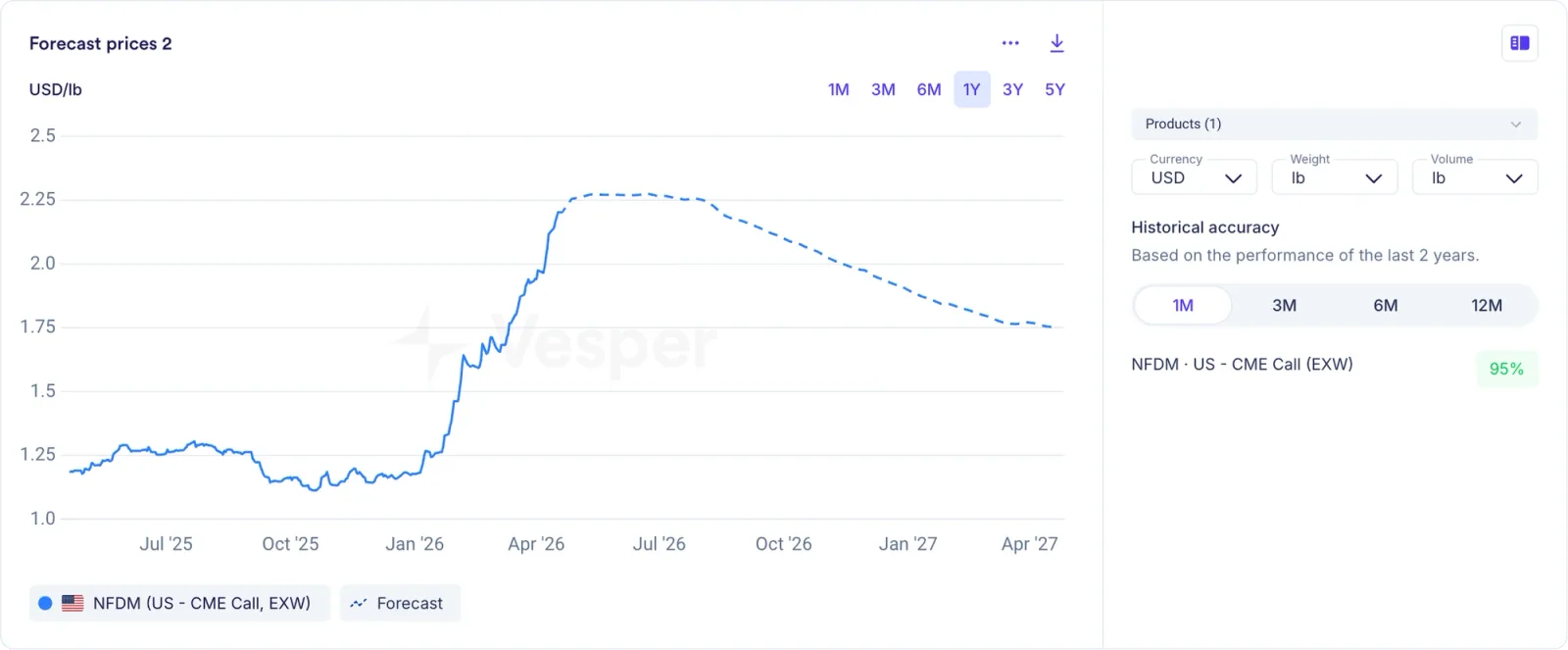
Vesper AI forecast for NFDM by CME Call
The Vesper CME NFDM forecast appears on the platform as a continuous chart, with the dashed forecast line extending past today’s settle. The solid line is historical CME spot call NFDM pricing; the dashed line is the Vesper AI forecast for the next quarter. For a buyer pricing a Q3 NFDM forward contract or budgeting infant nutrition cost into the second half of the year, this combination of a backward-looking CME call reference and a forward-looking forecast is the closest thing to a credible cost picture the dairy market currently provides.
Across the five CME call commodities, the forecast is not a single-point promise of where the price will land. It is a modeled trajectory with a confidence band, ready to be compared against the recent trend of the call settles themselves. When the two agree, the buyer has confirmation. When the two part ways, that is the moment to dig into what the model is seeing.
How dairy buyers actually use CME spot call prices
The CME spot call is read every day by a wide cross-section of the US dairy industry, and the workflow looks different depending on where in the supply chain a procurement team sits.
Cheese co-manufacturers and processors read the CME blocks and barrels settles within hours of the call closing. The settle becomes the reference for the next round of customer quotes, particularly for retail private-label and QSR programs that price weekly or monthly off CME spot. A move in cheese blocks today routes into a co-manufacturer’s quote tomorrow.
Butter-heavy food buyers (ice cream, bakery, confectionery, nutrition bars) treat the CME butter call as the leading indicator for next month’s input cost. Most butter procurement contracts price directly off CME spot or off a short rolling average of the CME settle, so a buyer pricing a 30-day program forward looks at today’s call settle to decide whether to commit, wait, or push back on a supplier’s quote.
Dairy ingredient buyers (infant nutrition, sports nutrition, protein bars, bakery mixes) read CME NFDM and CME dry whey daily as the reference for whey protein, lactose, and milk powder contracts. The settle is the public anchor that suppliers and buyers transact against; reading it off the CME page each day is part of the standard procurement routine.
Dairy traders and hedgers read the CME spot call as the cash benchmark that calibrates their forward decisions. The cash-versus-forward spread is informative on its own; a thinly traded call that clears at a higher level than recent days signals different physical conditions than a heavily traded call that clears at par.
Finance and procurement leadership track the monthly USDA Class III and Class IV announcements, which are themselves driven by NDPSR averages of the CME spot call. Following the daily CME call is a way to anticipate where the next monthly Class price will land several weeks before USDA publishes it.
Procurement teams building forward budgets layer the daily CME call settle with a forecast on the same series. The settle tells them where the market cleared today; the forecast tells them where the model expects it to land at one, three, six, and twelve months out. The combination is what turns a backward-looking reference into a defensible forward number for finance.
For each of these workflows, the daily CME call settle is the starting point. The Vesper chart of that same settle, with the historical context and the forecast line continuing past today, is the version that lets a procurement team commit with confidence rather than commit blind.
Want a forward view on every CME spot call commodity? Vesper tracks cheese blocks, cheese barrels, butter, NFDM, and dry whey with AI forecasts, confidence bands, and weekly expert analysis from our US dairy team. Explore the platform.
Frequently asked questions
What does the CME spot call actually settle?
The CME spot call settles physical trades in five US dairy commodities: cheese blocks (40 lb), cheese barrels (500 lb), Grade AA butter, nonfat dry milk, and sweet dry whey. Each commodity has a short, structured trading window each business day. The settlement is the last cleared trade or, if no trades clear, the highest bid or lowest offer remaining when the call closes. The settled price is published immediately and used as the daily cash-market reference for the relevant commodity.
How does the CME spot call connect to the USDA announced Class prices?
The CME spot call settles for cheese, butter, NFDM, and dry whey feed into the National Dairy Products Sales Report (NDPSR), the weekly USDA-published wholesale survey. The NDPSR feeds the formulas that calculate the monthly USDA-announced Class III and Class IV milk prices. So today’s CME call settles are an early signal for what the next monthly Class III and Class IV announcements will land at, even though those announcements are still weeks away.
Why is volume on a CME call sometimes very thin?
Some commodities trade less actively on the spot call than others, and any individual call window may clear with a small number of trades. A thinly traded call can still produce a settled price (often through a residual bid or offer at the close), but the informational weight of that day’s price is lower than on a heavily traded session. Reading the CME call without considering volume context is one of the more common procurement errors we see.
How accurate are Vesper’s CME call price forecasts?
Our strongest CME spot call forecast sits on NFDM. Measured over the last two years, the Vesper CME NFDM forecast has held 95% accuracy at one month and 88% at three months. Accuracy on the other CME call commodities (cheese blocks, cheese barrels, butter, and dry whey) is published on the platform and is available on request.
Can I integrate CME call data and Vesper forecasts into my internal tools?
Yes. Vesper supports data download, an API, and a Vesper for Excel integration, so the underlying CME spot call series and our forecasts on top of them can flow into your BI stack, contract pricing tools, or procurement dashboards.