


In October 2025, US WPC80 instant traded at $5.80/lb, already a record. By Q1 2026 it hit $10.50/lb, a level where cheese producers were earning more from the whey stream than from the cheese itself. Global food companies were paying whatever sellers asked, and sellers were running out of product to offer.
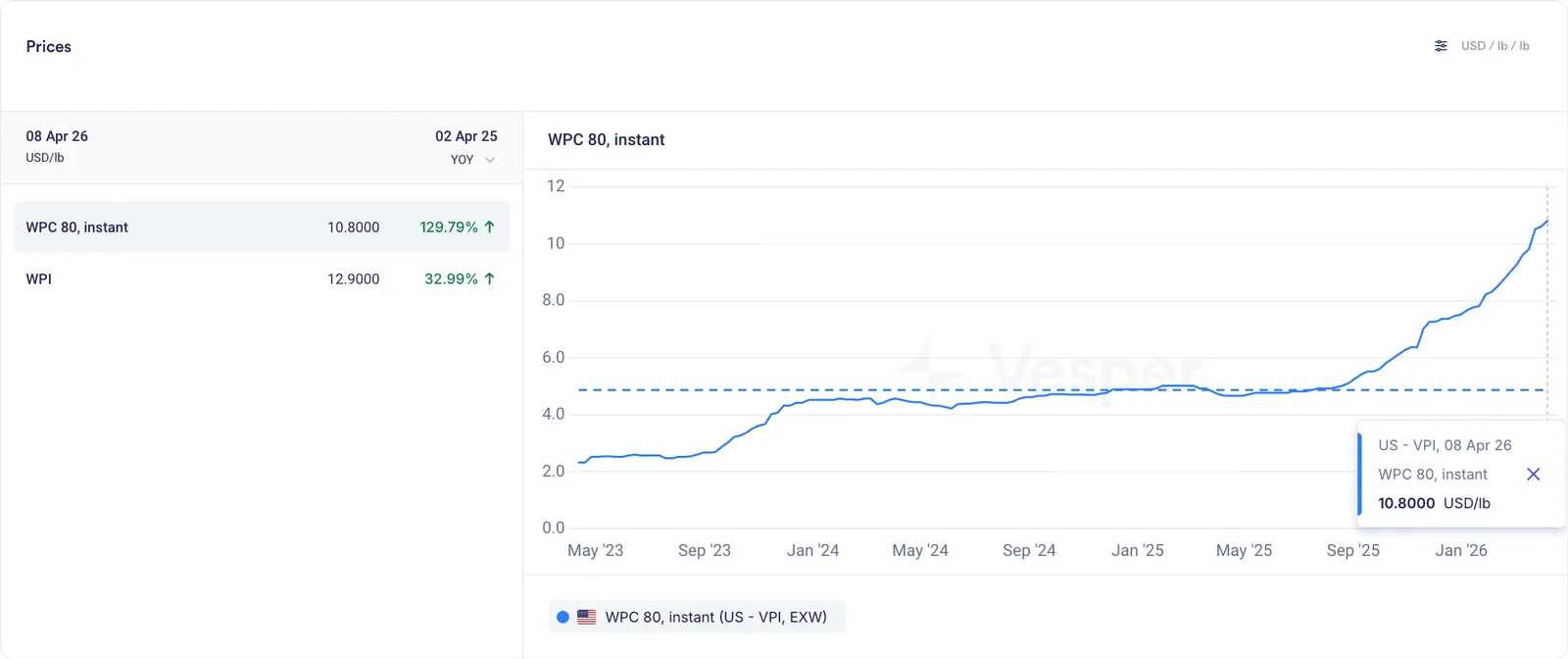
US WPC80, instant prices according to the Vesper Price Index in USD/lb
This isn’t a price spike that corrects in a few weeks. It’s the result of a structural demand shift meeting a production system that physically cannot expand fast enough.
The demand side starts with protein going mainstream across every supermarket category, accelerated by GLP-1 medications reshaping household grocery baskets. The supply side is pure physics: WPC80 is a byproduct of cheese, made with specialized equipment that takes years to build, and existing capacity was maxed out. Billions of dollars in new processing investment have been committed, but the plants won’t produce until 2027 or 2028, leaving the current scarcity to run its course.
How protein demand outgrew the supply chain
WPC80 used to be a niche ingredient, the kind of product that mattered to a small group of buyers in sports nutrition, specialty formulations, and high-end infant formula without moving market-wide pricing. That changed when protein became mainstream. By 2025, high-protein products had spread across every category in the supermarket, from drinks and yogurts to puddings, shakes, meal replacements, bars, ice cream, lemonades, cookies, pancakes, and coffee, and every mainstream consumer goods company had added protein to its reformulation roadmap.
Then GLP-1 medications accelerated the trend further. A 2025 study tracking 150,000 US households found that within six months of starting a GLP-1 medication, households cut grocery spending by 5.3% on average, with the reductions hitting calorie-dense, ultra-processed categories hardest: savory snacks dropped 10.1%, with sharp declines across sweets, baked goods, and cookies. Only a handful of categories grew, among them yogurt, fresh fruit, nutrition bars, and meat snacks. The pattern wasn’t substitution but contraction with a protein bias, where users weren’t swapping chips for protein but buying less food overall while keeping the protein-forward items.
By late 2025, 11.8% of US adults had used a GLP-1 medication and nearly a quarter of all US households had at least one person actively using these drugs. Grocery shopping is a household activity, so one GLP-1 user reshapes the entire purchasing basket, and that translated directly into whey protein demand that exceeded available supply every single month. WPC80 at $5.80/lb was already the highest level on record, and WPI had crossed $10.50/lb, trading above European prices for the first time. Producers had sold through Q4 volumes early, FOMO buying drove everyone to lock in supply before prices went higher, and the consumer side showed no demand destruction because retail prices for whey-containing products hadn’t increased much, leaving consumers with no reason to buy less. Every price dip triggered immediate buying, keeping the market perpetually tight.
The physics of why supply can’t catch up
The core problem with WPC80 supply isn’t willingness but physics. WPC80 is made from liquid whey, a byproduct of cheese production, meaning you can’t make WPC80 without first making cheese. The equipment required to concentrate whey proteins from the ~12% protein level in liquid whey to the 80% level in WPC80 is specialized, expensive, and takes years to build.
Producers had been shifting away from dry whey and toward whey protein concentrates for years because the economics were obvious: WPC80 at $10.50/lb versus dry whey at $0.55/lb. Any manufacturer with the equipment to concentrate whey proteins was doing so, but concentration capacity was capped with existing plants running at full utilization and new capacity requiring two to four years from planning to production.
January 2026 production data showed WPC80 output at 32 million pounds, up 12.2% year-over-year, which sounds like growth but wasn’t enough. Producers themselves said they’d love to have more to sell. Meanwhile, the massive cheese expansion in the US was generating more liquid whey than ever, with cheese production up 4.7% year-over-year in January and creating roughly 300 million additional pounds of liquid whey annually from 40 million extra pounds of cheese. Some of that liquid whey became WPC80, but the rest, because WPC capacity was maxed out, became dry whey. The most valuable product in dairy couldn’t get enough raw material processed while the least valuable product kept getting more.
The byproduct worth more than the product
By early 2026, whey protein prices had reached a point where the byproduct was worth more than the primary product, with WPC80 at $10.50/lb and WPI at $12.75/lb generating substantial whey stream revenues. Industry reporting noted that cheese production stayed elevated through 2025 even as cheese prices fell from $2/lb to $1.47/lb while whey protein prices kept climbing, and the whey complex remained what Vesper’s dairy team called “the bright spot in an otherwise challenging product mix.”
This created an unusual dynamic. Cheese plants were running not for the cheese but for the whey. More cheese meant more liquid whey, but concentration capacity remained the bottleneck, so the abundance of liquid whey didn’t translate into abundant WPC80. Current prices sat at 3x historical lows on a five-year chart, which sounds like they had crashed, but “lows” on a five-year chart were all-time highs in absolute terms. The baseline had shifted permanently.
One of the clearest signals of WPC80 scarcity was the compression of the WPC80-to-WPI spread. Over the three years through 2025, WPI typically traded at a 67% premium to WPC80 with an average multiplier of 1.67x. By Q1 2026, the multiplier had compressed to just 1.21x, with WPI at $12.75/lb and WPC80 at $10.50/lb, driven entirely by WPC80’s sharp run-up as WPI climbed more gradually. For procurement teams evaluating reformulation, the math had changed: a 21% premium for WPI versus a historical 67% premium changes the switching calculation entirely.
The investment race that hasn’t arrived yet
The scarcity triggered an investment response that reads like an arms race: Fonterra committed $50 million to whey facility expansion, FrieslandCampina acquired a US whey supplier, Tirlan invested EUR 126 million in a new processing plant in Ireland, and Amul started doubling its whey protein plant in India. In the US alone, over $11 billion was being directed toward 53 new or expanded dairy factories scheduled to open by 2028, and while not all of those were whey-focused, the whey protein opportunity was a driver for many.
The problem is that these investments take years to deliver production. A plant that broke ground in 2025 doesn’t produce WPC80 until 2027 or 2028, so the current scarcity has to be endured until new capacity arrives. And there was a risk on the other side: as one industry analyst noted, the chase for whey could flood the cheese market. US cheese exports had doubled in five years, but the scale of new capacity could test how much cheese the global market could absorb, since every new cheese plant generates more liquid whey. If whey demand holds, that’s fine. If it doesn’t, the economics unwind quickly.
Why this scarcity is different
Past whey protein rallies corrected as supply caught up and prices came back. This time, several factors suggest the scarcity is more persistent.
Demand isn’t cyclical. The protein trend in consumer products isn’t a fad but a reformulation wave backed by every major food company, with GLP-1 medications adding structural demand on top of an already growing base that affects nearly a quarter of US households.
Capacity takes years to build. Unlike many commodities where production can ramp quickly, WPC80 concentration capacity requires specialized equipment and significant capital investment, and the $11 billion investment pipeline won’t deliver meaningful new supply before 2027-2028.
Cheese economics keep plants running. Even in a weakening cheese market, whey protein revenues keep cheese plants operating, meaning liquid whey supply continues to grow while the bottleneck remains concentration capacity, not raw material.
Switching costs lock in demand. Brands formulated around WPC80 can’t easily switch to alternatives because changing protein sources means new testing, new approvals, new regulatory filings, and new shelf documentation, and most brands aren’t willing to pay those costs.
The proxy relationships broke. Using dry whey as a proxy for WPC80 pricing showed only a 0.53 correlation in 2025, with the multiplier ranging from 6.68x to 10.83x, meaning anyone using a fixed factor was substantially mispricing at some point during the year. WPC 34 to WPC80 showed a negative correlation of -0.72, with the two products moving in opposite directions for much of the year.
What this means for procurement teams
The WPC80 market of 2026 is a procurement challenge with no easy solutions.
Availability matters more than price. When sellers are running out of product, negotiating a better price per pound is secondary to securing supply at all, and buyers reported being “grateful to secure product” regardless of cost.
Forward coverage is expensive but necessary. Waiting for prices to drop is a bet against structural scarcity, and every prior price dip was met with immediate buying that prevented any meaningful correction, leaving unhedged buyers facing both price risk and supply risk.
Monitor the cheese-whey economics. The whey stream is now driving cheese plant economics, and when cheese producers earn more from whey than from cheese, production decisions follow whey protein margins rather than cheese margins. Understanding this dynamic is essential for anticipating WPC80 supply.
Watch the investment pipeline. The capacity additions scheduled for 2027-2028 could eventually ease supply, but there’s a gap between now and then, and the risk of overcapacity in cheese while whey demand holds creates its own set of pricing dynamics.
Reformulation decisions carry long-term implications. With the WPC80-to-WPI spread at historic lows, the cost case for WPC80 over WPI has weakened, and milk protein concentrates and isolates offer alternative protein sources at lower price points, though customer specifications and switching costs limit how much substitution is possible in practice.
What’s next for US WPC80?
The US whey protein market moves fast. Every week, new production data, trade flows, and global demand signals reshape the picture.
Our US Weekly covers all of it: whey proteins, cheese, butter, NFDM, milk production, and the global forces pulling US dairy prices in every direction. Written by Vesper’s dairy team, delivered to your inbox every Friday.