


At the Sugar and Sweetener Colloquium in Orlando earlier this year, conversations around GLP-1 weight loss drugs surfaced in nearly every discussion. But unlike in dairy or protein markets, where the drugs are often framed as a demand tailwind, the tone in sugar was noticeably different.
Here, the same trend is increasingly being discussed as a headwind.
This article looks at why that shift in sentiment is taking hold, what the research actually says about changes in food consumption, and how those changes are starting to show up in the sugar market, alongside Vesper’s current view on pricing and short-term fundamentals.
Why we are looking at GLP-1 and sugar now
The scale of GLP-1 adoption has moved the topic beyond a niche healthcare trend and into something the food industry is actively tracking.
A 2025 survey by RAND Corporation found that 11.8% of U.S. adults have used a GLP-1 medication. At the same time, consumer tracking and industry analysis suggest adoption is continuing to expand, with growing intent among consumers who have not yet used these drugs.
Research into food purchasing behaviour is starting to quantify what that means. A study published in the Journal of Marketing Research tracked 150,000 U.S. households and found that grocery spending declines after a household member begins using a GLP-1 medication, with the largest reductions concentrated in calorie-dense and ultra-processed categories.
Other industry analyses, including from EY and Euromonitor, point in a similar direction: categories such as snacks, confectionery, and sugary beverages appear more exposed to reduced consumption, while healthier or higher-protein options are comparatively more resilient.
The key point is not that sugar demand disappears, but that multiple datasets now show a measurable shift away from some of the categories where sugar is most heavily used.
Sugar is exposed through multiple demand channels
GLP-1 does not affect the sugar market through a single mechanism. Instead, the impact is being discussed across several overlapping channels.
First, the drugs reduce appetite and overall calorie intake. That alone implies lower consumption of discretionary food categories, including sweets and sugary snacks.
Second, there is evidence that users change preferences, showing less interest in high-sugar and high-fat foods. This has been highlighted in multiple industry reports and is reflected in declining spending on snack and confectionery categories in household-level data.
Third, grocery baskets themselves are shrinking. The Journal of Marketing Research study found that households spend less overall on food after starting GLP-1 medication, which means the effect is not only substitution but also contraction.
Fourth, manufacturers are responding. Food companies are increasingly exploring reformulation, portion control, and new product positioning, particularly in beverages and snacks. This does not remove sugar from the system entirely, but it changes how much is used per unit of product.
Finally, GLP-1 is not acting in isolation. Reuters has highlighted that the impact of weight-loss drugs is being reinforced by existing policies such as sugar taxes, tighter food-labeling rules, and evolving dietary guidelines, all of which are already putting pressure on sugar consumption in developed markets.
Taken together, these channels point in the same direction: a gradual shift in demand dynamics rather than a single, abrupt change.
What the market is already seeing
The conversation has already moved beyond theory.
Reuters reporting in early 2026 pointed to weaker sugar demand as one of several factors contributing to factory closures in the U.S. and Europe, alongside broader structural changes in the industry. At the same time, sugar prices were described as sitting around five-year lows earlier in the year, reflecting a softer demand backdrop.
More recent coverage shows that the U.S. sugar industry is now weighing GLP-1 adoption alongside a wider set of pressures, including new dietary guidelines, school meal standards, and the broader public-health focus on reducing added sugar.
In parallel, earlier reporting has highlighted concern among U.S. beet growers that demand-side changes, including GLP-1 adoption and shifting consumer preferences, are beginning to affect the outlook for the sector.
None of these developments are attributed to GLP-1 alone. But across multiple sources, the direction of travel is consistent: demand growth for sugar is slowing, and the list of contributing factors is expanding.
Adoption will not be uniform
One reason the long-term impact remains uncertain is that GLP-1 adoption is not evenly distributed across regions.
Patent timelines are part of that story. The foundational patent for semaglutide, the active ingredient in widely used GLP-1 drugs, expires as early as 2026 in countries such as India and China, potentially allowing lower-cost alternatives to enter those markets sooner. In contrast, patent protection in the United States and Europe is expected to remain in place into the early 2030s.
This implies that access, pricing, and adoption rates will vary by region.
At the same time, broader demand drivers remain in place. Population growth and rising incomes in emerging markets continue to support baseline increases in food consumption, including sugar. That means any demand slowdown linked to GLP-1 is likely to be uneven globally rather than uniform.
Short-term pricing is still being driven by supply
While the longer-term demand picture is becoming more complex, short-term price formation in the U.S. sugar market is still heavily influenced by supply-side factors.
Vesper’s latest market analysis shows that prices remain supported by a combination of lower production, weather-related losses, and logistical constraints. Florida cane output has been reduced following freeze damage, while beet production faces risks from storage losses linked to unusually warm conditions. At the same time, declining beet acreage and constrained imports from Mexico are tightening the domestic balance.
These factors are providing a near-term price floor.
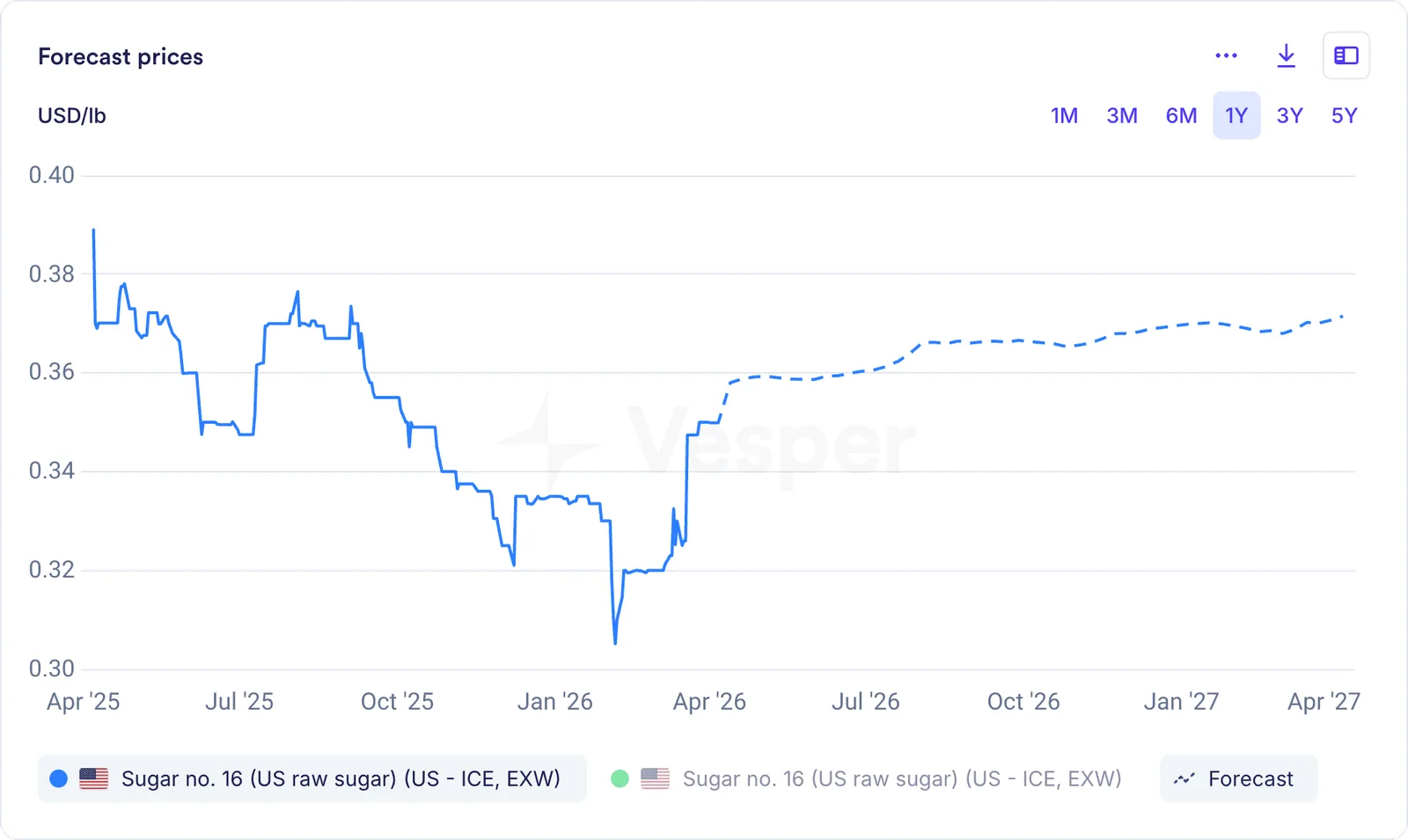
At the same time, elevated inventories, cautious buyer behaviour, and rising high-tier imports are limiting upside. Many buyers remain under-covered for forward needs but are holding back from booking, citing inventory levels and uncertainty around price direction.
The result is a market where short-term firmness is driven by supply constraints, even as the longer-term demand outlook becomes more uncertain.
What this means for the sugar market
GLP-1 is unlikely to be the single factor that determines the direction of sugar prices. But it is increasingly part of the broader set of variables shaping demand expectations.
The emerging picture is not one of immediate disruption, but of gradual structural pressure:
- slower growth in sugar consumption in developed markets
- continued reformulation and reduced sugar intensity in food products
- policy and regulatory pressure reinforcing the trend
- uneven global adoption driven by pricing and patent timelines
At the same time, short-term price dynamics remain tied to production, trade flows, and weather-related risks.
Follow the impact of GLP-1 trends on sugar prices on Vesper’s platform.