


For most of 2025, US NFDM (nonfat dry milk) and SMP (skimmed milk powder) told a story that shouldn’t have happened. Production fell year-over-year. Global stocks of competing products grew tighter. But prices still tanked.
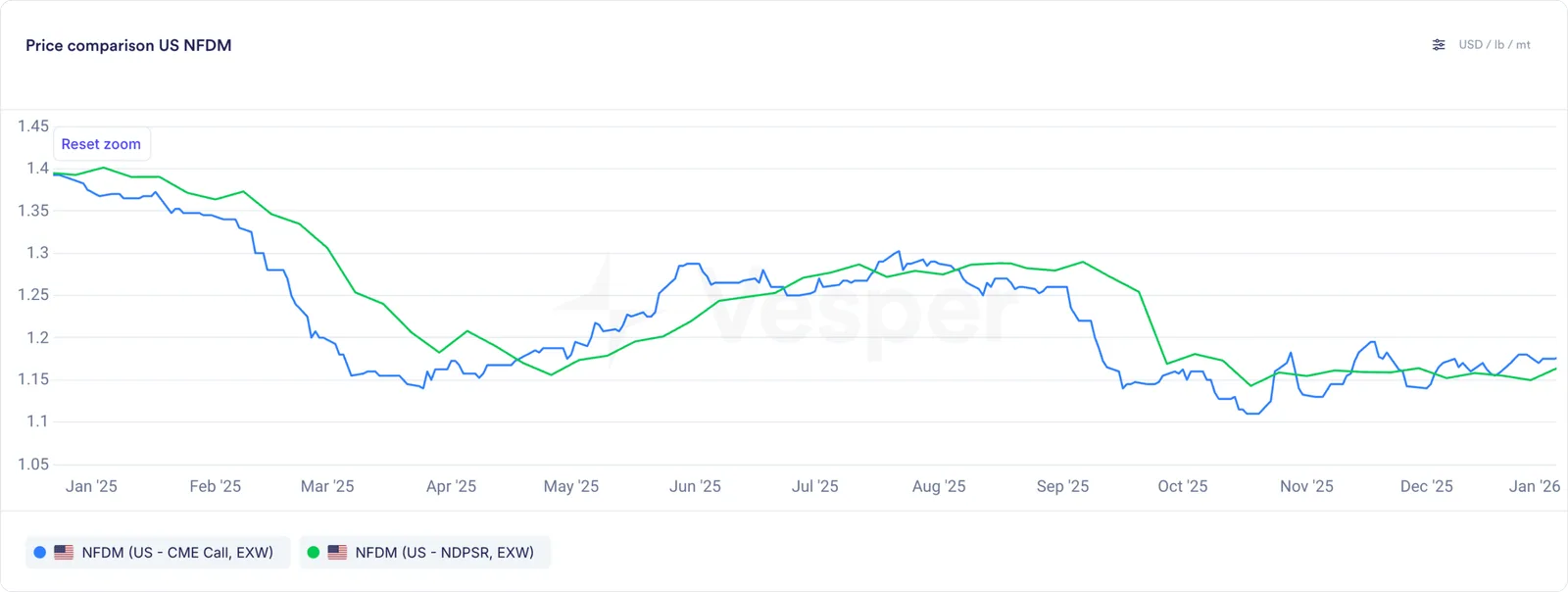
US NFDM prices according to the CME Call and NFDM in USD/lb
By December, NFDM was trading well below where it started. Processors stopped wanting to make it. Exporters couldn’t find buyers at any price that made sense. Mexico, the last loyal customer, couldn’t absorb the volumes. And the rest of the world? They had cheaper alternatives.
This is what happens when the most export-dependent US dairy product meets a year of tariff chaos, global oversupply, and structural market shifts.
Here’s what happened, month by month.
January: The calm before
NFDM opened 2025 holding steady. Prices hovered between $1.35 and $1.40 per pound on the CME.
But there was trouble underneath. US powder prices were already higher than what Europe and Oceania could offer. The strong dollar made that problem worse. A buyer in Mexico choosing between US NFDM at $1.38/lb and EU SMP at $1.28/lb faced a real penalty for buying American.
Stocks were falling in the US. Production had slipped in late 2024. Global competition was starting to cap any upside that lower inventory might have created.
Then FMD (foot-and-mouth disease) flickered in Europe. For a moment, it looked like a real supply shock. US exporters thought the door might open. But the outbreak was contained fast. The window closed.
January ended with NFDM traders waiting to see if tariffs would actually happen.
February: The drop
They did.
Global Dairy Trade prices (GDT) fell hard in early February. CME NFDM followed. In one week, NFDM dropped 4%. Processors watched their margins shrink.
The disconnect between US and global powder markets didn’t shrink. It inverted. US NFDM was trading at a premium over EU SMP. That was unusual. NFDM normally trades at a discount to EU SMP.
At the same time, production data told a different story. Processors were shifting away from NFDM. Skim milk powder was cheaper to make than NFDM in real terms. But milk protein concentrate (MPC) was where the volume went. MPC production was up 52.61% year-over-year in 2024. That trend didn’t reverse in early 2025.
By mid-February, NFDM had been the most expensive market globally for eight consecutive months. At that price point, in that position, NFDM was a product nobody wanted to make and nobody wanted to buy.
March: Tariffs land, Production falters
The US announced 25% tariffs on Canada and Mexico, 10% on China. These weren’t abstract trade policy. NFDM and dry whey were export products, and 80% of US NFDM production was typically exported.
Mexico was the biggest single buyer. A 25% tariff on US powder didn’t eliminate the relationship, but it destroyed the margin.
CME prices fell further. January-through-February production data showed NFDM and SMP combined down 3.1% year-over-year, while MPC was up 33.54%. The shift was clear. Producers were rebalancing their product mix away from the lowest-margin powder.
April: “Liberation day” arrives
China retaliated with 34% tariffs on all US agricultural products, landing on top of existing duties. A total 54% tariff on US NFDM from the largest export destination outside the Americas. That’s not a trade dispute. That’s a wall.
One bright spot: February NFDM production was up 11.02% year-over-year. But skim milk powder production fell 37.59%. The combined product class (NFDM+SMP) actually fell as a volume picture.
The Trump administration announced a 90-day tariff pause. Prices stabilized briefly before resuming their decline.
May: The structural shift
NFDM held up better than expected in May. The Indonesia trade deal framework provided some hope for market access. The US-China tariff pause created temporary breathing room. Markets traded on optimism.
But March production data told a clearer story. NFDM and SMP combined dropped 9.48% year-over-year. Meanwhile, MPC fell 16.01%. That sounds good until you realize MPC production was so far above historical levels (from 2024) that even a 16% drop left it vastly above pre-tariff output.
What was actually happening: processors had excess milk and limited options. They couldn’t sell NFDM profitably. They couldn’t sell SMP profitably. They were being forced into cheese and MPC even though those markets offered only slightly better margins.
Mexico continued to buy US NFDM, but even Mexican importers were exploring alternatives.
June: Lower production creates some support
April production data showed the shift accelerating. NFDM fell 6.1% year-over-year. SMP fell 20.82%. MPC fell 16.01%.
All three product classes were down. That was actually the first month where lower output across the category suggested real supply tightness. But April trade data showed US NFDM exports falling even as production dropped. Buyers were leaving.
The math was becoming obvious: even with lower production, prices weren’t recovering because buyers had alternatives and tariffs made the US alternative expensive.
July: Dollar weakness provides a brief tailwind
The US dollar weakened in July. That should have helped NFDM exporters. A weaker dollar makes US powder cheaper for foreign buyers. And for a moment, it did. NFDM gained slightly on the CME.
But the global milk powder markets were under systematic pressure. The New Zealand Global Dairy Trade auction saw whole milk powder (WMP) prices down 5.1%. Lower WMP prices in NZ pull down SMP globally. Lower global SMP eventually pulls down US NFDM, even if the dollar is helping.
The EU announced a trade deal framework with the US. Details were vague. Uncertainty remained.
August: The H1 picture emerges
First-half NFDM production fell 1.27% year-over-year. MPC fell 5.73%, but from a gigantic 2024 base. The US milk supply grew 1.04% for the first six months of the year. Fat content was up 3.27%. Protein content lagged.
That protein lag mattered. NFDM and SMP are protein products. If protein production isn’t keeping pace with milk supply growth, something structural is happening. Processors are running their milk through different products or different plants.
September: Market share collapse
The Global Dairy Trade event pushed powder prices down 5% across the board. US NFDM followed. CME futures collapsed.
September export data came in and it was brutal. US NFDM exports to Southeast Asia were down 25-30% year-over-year. Exports to China had effectively stopped (because of tariffs). Only Mexico was still a consistent buyer.
But Mexico wasn’t enough. Even with Mexico absorbing the steady flow, US export volumes were down sharply.
Meanwhile, New Zealand was up 11.39% year-over-year in China exports. EU exports to Southeast Asia were up 33.83%. The US was losing market share in almost every non-Mexican destination.
Chinese skim milk powder stocks had peaked in May. They were declining. But at prices so low that Chinese producers could dump massive volumes and still turn a profit.
October: Data blackout
The government shutdown removed October production and trade data. The CME market traded with incomplete information and existing fear.
NFDM hit multi-year lows. The five-year average price of $1.34/lb felt impossibly far away. Import demand from the major destinations (China, Southeast Asia) wasn’t recovering.
Global supply was simply overwhelming. The EU announced a trade deal with Indonesia, expanding EU market access further.
November: The structural problem becomes clear
NFDM bounced briefly on exchange rate moves. The dollar weakened again. Prices ticked up.
Then the dollar reversed. US NFDM fell again.
European SMP prices were plummeting. The US NFDM needed to maintain a discount to EU and New Zealand powder just to compete. But discounting only works if volumes are high enough to absorb the margin loss. US volumes weren’t there.
August production data (released in November) showed NFDM and SMP combined up 0.9% year-over-year. That growth was driven by massive milk production forcing processors into powder output almost against their will. But the structural shift away from NFDM continued. MPC wasn’t absorbing the extra protein. Cheese wasn’t absorbing it either.
Processors were being forced to dump NFDM at any price.
December: The year closes
NFDM ended 2025 weak. Prices were well below year-ago levels. Global competition was overwhelming from every region.
New Zealand skim milk powder commands a $132/mt premium over EU SMP in December. That spread tells you everything. Regional dynamics were fragmenting. US NFDM couldn’t command even a token premium. It was the price-taker at the bottom.
Then China released a shock: WMP exports surged 200% year-over-year (Jan-Aug YTD), while SMP exports were up 743% over the same period. Chinese dairy powders were being dumped at prices 40% below the world market price. China had built a massive dairy powder industry on government support, cheap milk, and state export subsidies. They were becoming a net exporter of dairy powders, not an importer.
That changed the game completely. The US wasn’t just competing against NZ and the EU. It was competing against Chinese government-supported dumping.
Why this happened: The real story
NFDM in 2025 was caught in the worst possible position.
Export dependency. Up to 80% of US NFDM production is exported. That makes NFDM the most vulnerable US dairy product to trade disruption. A farmer can still sell milk domestically if exports close. A cheese maker has a domestic market. But an NFDM plant produces almost entirely for export. Tariffs hit NFDM like a sledgehammer.
Tariff timing. The US tariffs on Mexico came when Mexico was the only significant buyer. The Chinese tariffs eliminated the second-largest market overnight. The EU didn’t retaliate directly on dairy, but they deepened trade relationships with Indonesia and other SE Asia markets that used to buy US NFDM.
Structural shift. The shift from NFDM to MPC started in 2023. Processors found they could make higher-margin products from the same milk. By 2025, that wasn’t a preference. It was structural. NFDM production couldn’t grow even when margins were terrible because processors were running their milk through other products.
Global oversupply. Lower US production didn’t create a shortage. New Zealand was still producing. The EU was still producing. And then China entered the market as an exporter. Global milk powder supply was abundant and getting cheaper.
Pricing pressure from alternatives. EU SMP and NZ WMP set the global baseline. US NFDM couldn’t command a premium. In fact, it traded at a discount. That discount wasn’t enough to move volume because tariffs added a percentage cost on top of it.
The bottom line
The 2025 NFDM story was one of mismatch. Production fell, but not enough to matter. Demand dried up, and tariffs made it permanent. Global competition intensified. And a new competitor entered the market.
NFDM ended the year in a buyer’s market. Prices were low. But that low price reflected real market fundamentals. Producers didn’t want to make it. Exporters couldn’t move it. Tariffs had closed export channels that stayed closed. And Chinese powder exports surging at 40% below the world market price redefined the competitive landscape entirely.
What’s next for US NFDM?
The US NFDM market moves fast. Tariff policy changes overnight. GDT auctions happen every two weeks. Chinese export data arrives monthly. One surprise from any direction can swing prices 5-10% in a week.
Our US Weekly covers all of it: NFDM, cheese, butter, whey, milk production, tariffs, and the global forces pulling US dairy prices in every direction. Written by Vesper’s dairy team, delivered to your inbox every Friday.