
Grain prices across wheat, corn, barley, and soybeans remained elevated this week, with Brent crude oil continuing to provide the primary source of support. However, signals from U.S. officials suggesting the Middle East conflict could conclude within weeks are starting to factor into market expectations, with buyers in physical markets already using the uncertainty as a reason to delay purchases.
Wheat: below-expectation planted area provides partial support
Euronext milling wheat returned to €205/mt, recovering from a dip last fortnight, while CBOT SRW wheat moved slightly higher to 616.25 US cents/bu.
Brent crude oil (May contract) closed at its highest level of $118/barrel, driven by failed diplomacy between the U.S. and Iran, continued attacks on energy infrastructure, and concerns over a potential U.S. ground invasion. However, statements from U.S. President Donald Trump indicating the U.S. will “leave” Iran within two to three weeks, alongside Tehran’s stated willingness to end the conflict, point to a potential easing of crude oil prices that could weigh on grains.
U.S. wheat planted area for 2026 was estimated at 43.8 million acres, below the February estimate of 45.0 million acres and below both the average trade expectation of 44.8 million acres and last year’s 45.3 million acres. All-wheat stocks came in at 1.30 billion bushels, just below the average trade estimate. Supply overall remains ample, with physical market buyers using the current uncertainty as a reason to delay purchases until either prices correct or the conflict eases.
Corn: stocks historically high despite modest price gains
Euronext corn moved to €210/mt from €208/mt two weeks ago, while CBOT corn increased to 457.75 US cents/bu from 454 US cents/bu, though it remains below the 19 March peak of 469 US cents/bu.
U.S. corn planted area for 2026 was estimated at 95.3 million acres, above the average trade expectation of 94.4 million acres and the USDA Ag Outlook Forum estimate of 94.0 million acres, though well below the 2025 level of 98.8 million acres. Corn stocks as of 1 March came in at 9.02 billion bushels, below the average trade estimate but at historically high levels.
Barley: old-crop supply tightening, new crop awaited
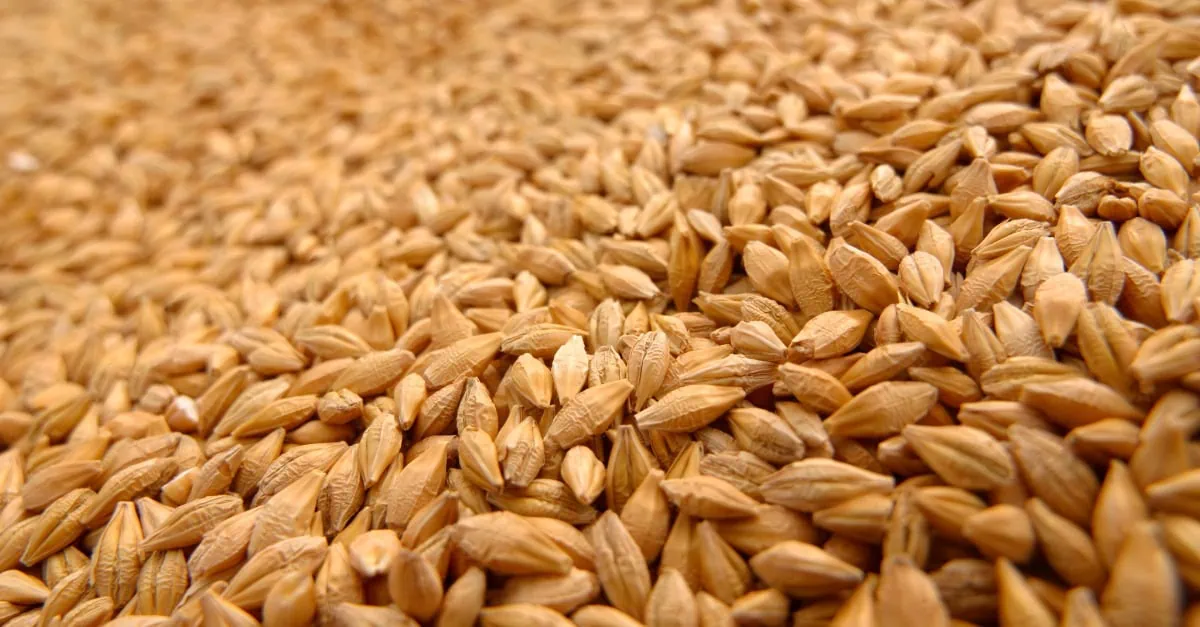
The IGC barley sub-index edged marginally higher to 244.47. The 2026 EU barley outlook points to a slightly tighter supply balance, with production projected at 54.7 MMT compared to 55.7 MMT last year.
French crop conditions are notably stronger than a year ago. As of 26 March, 84% of winter soft wheat was rated good or very good (up from 74% last year), while winter barley reached 81% (up from 70%). Crop development is running significantly ahead of average, with spring barley sowing complete.
Old-crop barley volumes in Ukraine are gradually running out, leaving limited exporter activity. Trading is expected to remain subdued until new crop supply emerges, while reduced availability continues to support prices.
The European Commission forecasts EU barley exports to third countries at 10.1 MMT in 2026/27, compared to 11 MMT this season.
Soybeans: biofuel policy and strong Brent provide lift
CBOT soybeans increased to 1,171 US cents/bu from 1,157 US cents/bu two weeks ago, with prices at other origins also moving higher.
Support came from firm Brent crude and the finalisation of the U.S. “Set 2” biofuel rule, which sets the highest blending requirements in the programme’s history. Total Renewable Volume Obligations are set at 80.51 MMT for 2026 and 81.14 MMT for 2027.
Global supply remains ample. In Argentina, the harvest has started with improved crop conditions, while Brazil’s 2025/26 production is projected at 184.7 MMT. U.S. soybean planted area was estimated at 84.7 million acres, broadly in line with expectations and above last year’s 81.2 million acres.
It remains uncertain whether China will maintain active buying following the U.S. Supreme Court decision to cancel Trump-era duties.
Read the full grains market forecast in our bakery H2 outlook report for free: https://vespertool.com/download/bakery-h2-2026-market-outlook/